Every team that grows in programmatic advertising eventually asks the same question: how much does a DSP cost? The answer depends less on the software itself and more on the model behind it. A demand-side platform can be rented for a monthly fee, licensed for a one-time payment, or acquired outright with full source code.
The difference between these models is not only price. It is control. A rented platform keeps you dependent on someone else’s roadmap, limits, and fees. An owned platform turns your media buying into infrastructure — an asset your business controls, customizes, and can even resell.
This guide breaks down real DSP pricing across all three models, explains what each price actually includes, compares buying against building from scratch, and lists the hidden costs you should ask about before signing anything.
What Determines the Cost of a DSP?
A DSP is not a single product. It is a stack of bidders, integrations, data pipelines, user interfaces, and reporting systems working together in real time. When you evaluate DSP pricing, you are really evaluating five things:
- Ownership level — are you renting access, licensing the platform, or buying the source code?
- Traffic capacity — how many queries per second (QPS) can the platform process, and is that capacity capped or billed separately?
- Supply access — how many SSPs and ad exchanges are already integrated, and what does each new integration cost?
- Customization rights — can you change features, branding, and infrastructure, or only use what is given?
- Ongoing fees — setup fees, upgrade fees, support fees, and revenue shares that accumulate over time.
Two DSP offers with the same headline price can have completely different total costs once QPS fees and revenue shares are added. That is why the pricing model matters more than the price tag.
The Three Ways to Get a DSP: Rent, License, or Own
The market has settled into three standard models. Understanding them makes every DSP price list easier to read.
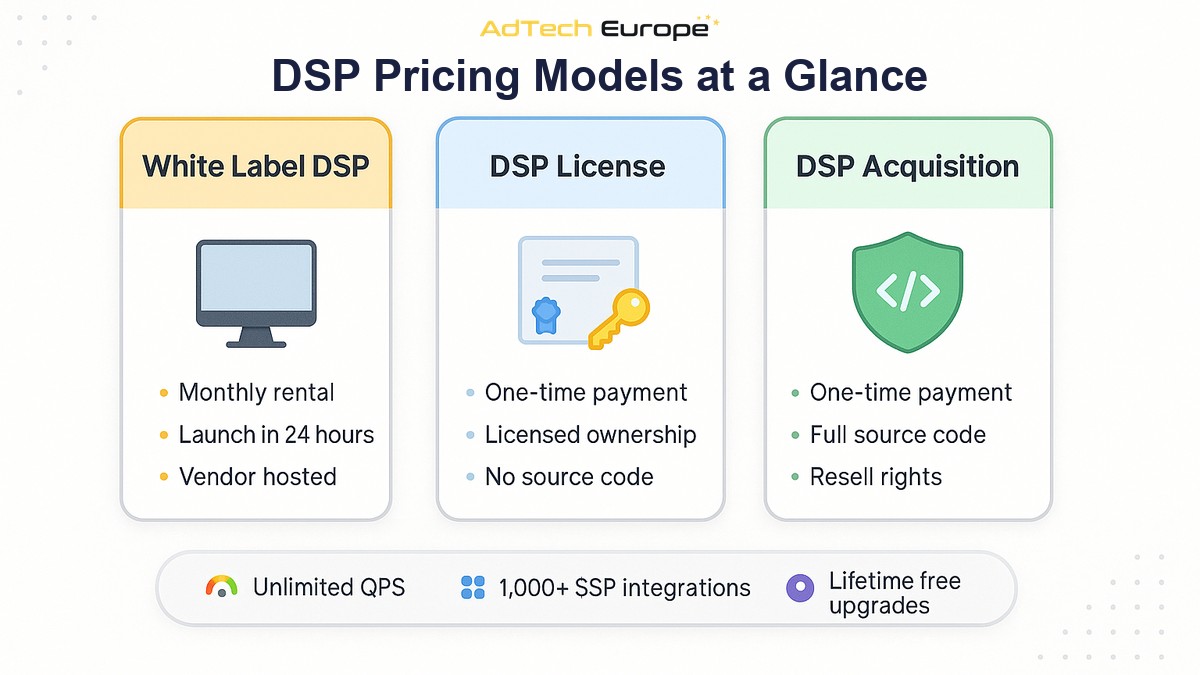
| Model | What You Get | Typical Cost Structure |
| White label DSP (rental) | A fully managed platform under your brand, hosted and maintained by the vendor | Monthly subscription plus setup fee |
| DSP license | Licensed ownership of the platform with limited customization, no source code | One-time payment or installments |
| DSP acquisition | Full source code ownership with unlimited customization and redistribution options | One-time payment or installments |
Each model fits a different stage of business. The sections below use AdTech Europe’s published DSP pricing as a concrete, verifiable example of what each model costs in practice.
White Label DSP Cost: Renting the Platform
A white label DSP is the fastest and cheapest way to run your own branded buying platform. At AdTech Europe, the white label plan costs $500 per month with a $1,000 setup fee, on a month-to-month contract. The platform can be live within 24 hours.
What the Monthly Fee Includes
- Unlimited QPS scaling, with no per-QPS fees
- Access to 1,000+ SSP integrations for programmatic supply
- Full white label branding under your own domain and identity
- Onboarding package and lifetime free upgrades
The trade-off is ownership. You are renting infrastructure, not building an asset. If you stop paying, the platform is gone. For teams testing whether a platform business fits them, that flexibility is a feature. For teams already spending heavily every month, rented technology becomes the bottleneck — a topic covered in more depth in DSP acquisition vs white-label DSP.
DSP License Cost: Owning the Platform Without the Source Code
A DSP license sits between renting and full acquisition. At AdTech Europe, the DSP License costs $25,000 as a one-time payment with no setup fee, or five monthly installments of $5,000 with a $2,500 setup fee.
The license includes licensed platform ownership, unlimited QPS, the same 1,000+ SSP integrations, OpenRTB and XML connectivity, ad exchange (ADX) integration, an AI automation suite, a white label reseller plugin, and lifetime free upgrades. Customization is possible but limited, and the source code stays with the vendor.
This model suits businesses that want to stop paying rent and start owning their margin structure, but do not need to modify the platform’s core. The differences are examined feature by feature in license vs full ownership.
DSP Acquisition Cost: Full Source Code Ownership
DSP acquisition is the top of the ownership ladder. At AdTech Europe, a full acquisition costs $50,000 as a one-time payment with no setup fee, or five monthly installments of $10,000 with a $5,000 setup fee.
Acquisition includes everything in the license model plus full source code ownership, unlimited customization, full infrastructure control, and optional redistribution rights — meaning you can adapt the platform, integrate it with your own systems, and even resell it. What a source-code purchase actually contains is detailed in buy a DSP platform with source code.
For context, the platform being acquired carries an estimated development value of over $500,000. The acquisition price is a fraction of what building the same technology would cost — which is exactly why this model exists.
DSP Cost Comparison: All Three Models Side by Side
| Cost Factor | White Label DSP | DSP License | DSP Acquisition |
| Price | $500/month + $1,000 setup | $25,000 one-time (no setup fee) | $50,000 one-time (no setup fee) |
| Installment option | Month-to-month by design | 5 × $5,000 + $2,500 setup | 5 × $10,000 + $5,000 setup |
| Ownership | Rental | Licensed ownership | Full source code ownership |
| Customization | Branding only | Limited | Unlimited |
| QPS | Unlimited | Unlimited | Unlimited |
| SSP integrations | 1,000+ | 1,000+ | 1,000+ |
| Redistribution rights | No | No | Available as add-on |
| Time to launch | Within 24 hours | 5–7 business days | 5–7 business days |
Pricing shown is AdTech Europe’s published pricing as of July 2026 — always confirm current figures on the pricing page.
How Much Does It Cost to Build a DSP From Scratch?
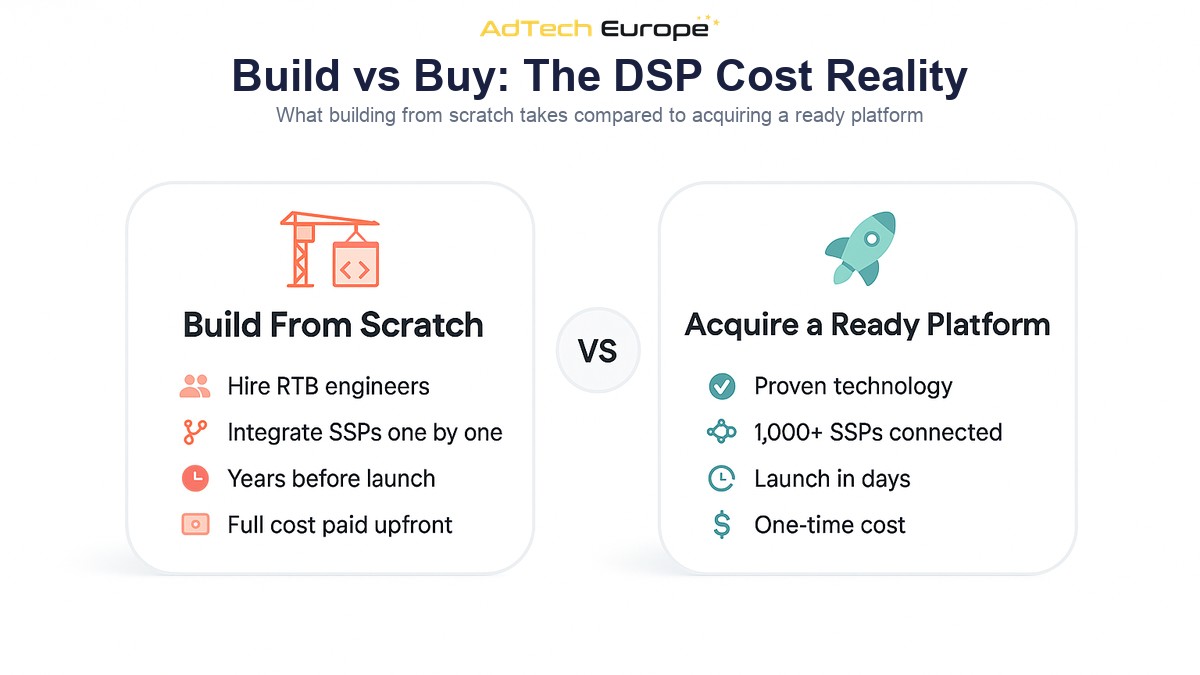
The alternative to buying is building. It is also the reason ready-made DSP pricing looks the way it does. Building a production-grade DSP means hiring engineers who understand real-time bidding, building a bidder that answers auctions in milliseconds, negotiating and maintaining SSP integrations one by one, passing quality reviews with supply partners, and running infrastructure that survives billions of daily bid requests.
That work takes an experienced team years, not months. A platform like the one AdTech Europe offers for acquisition carries an estimated development value of over $500,000 — before counting the years of integration work that connect it to live programmatic inventory. Building also means paying the full cost before the first campaign runs, while buying means launching within days on technology that is already processing traffic.
Building from scratch makes sense for companies whose product is the technology itself. For agencies, ad networks, and media-buying teams whose product is campaign performance, acquiring proven technology is almost always the faster and cheaper path. How the investment translates into a business model is covered in how DSP owners make money.
Hidden DSP Costs to Ask About Before You Buy
Headline prices rarely tell the whole story. Before committing to any DSP offer, ask about these five cost drivers:
1. QPS Fees
Many vendors cap queries per second and charge for additional capacity. As your buying scales, QPS fees can quietly exceed the platform fee itself. Confirm whether QPS is truly unlimited.
2. Integration Fees
If SSP and exchange integrations are billed per connection, supply growth becomes a cost center. Ask how many integrations are included and what a new one costs.
3. Upgrade and Maintenance Fees
Some contracts charge for version upgrades or ongoing maintenance. Lifetime free upgrades, where offered, remove an entire category of future spend.
4. Revenue Shares
A percentage of media spend can dwarf any flat fee at scale. If a vendor takes a share of spend, model it against your projected volumes before comparing prices.
5. Exit Costs
With rented platforms, ask what happens to your data, campaign history, and integrations if you leave. Migration cost is a real cost. A structured review process helps here — see the DSP acquisition checklist.
Which DSP Pricing Model Is Right for You?
- Choose the white label DSP if you are validating a platform business, want to launch within 24 hours, and prefer a small monthly commitment over a capital investment.
- Choose the DSP license if you run steady programmatic volume, want to stop paying rent on your core infrastructure, and do not need to change the platform’s code.
- Choose DSP acquisition if the platform is strategic to your business — you want full source code, unlimited customization, and the option to resell or launch your own ad network on top of it.
A useful rule of thumb: compare your current monthly platform fees and tech-related revenue shares against the one-time cost of ownership. Many teams discover that ownership pays for itself within the first year — a scenario examined in this DSP investment recovery case study.
Ready to Price Out Your Own DSP?
AdTech Europe helps agencies, ad networks, media-buying teams, and adtech entrepreneurs move from renting advertising technology to owning it — with transparent pricing, unlimited QPS, 1,000+ SSP integrations, full onboarding, and deployment measured in days, not years.
To get an exact quote for your use case, review the current DSP pricing or schedule a programmatic strategy meeting with the AdTech Europe team.
FAQs
How much does a DSP cost per month?
A fully managed white label DSP starts at $500 per month plus a $1,000 setup fee at AdTech Europe. Monthly pricing elsewhere varies widely, and offers with low headline fees often add QPS charges or revenue shares, so always compare total cost.
How much does it cost to buy a DSP outright?
At AdTech Europe, a DSP License costs $25,000 and a full DSP Acquisition with source code costs $50,000, each as a one-time payment with no setup fee. Both include unlimited QPS, 1,000+ SSP integrations, and lifetime free upgrades.
Is building a DSP cheaper than buying one?
Almost never. A production-grade DSP represents hundreds of thousands of dollars in development work plus years of SSP integration effort. Buying proven technology costs a fraction of that and launches in days instead of years.
What is the difference between a DSP license and a DSP acquisition?
A license gives you ownership of a working platform with limited customization but no source code. An acquisition transfers the full source code, unlimited customization, infrastructure control, and optional redistribution rights.
Are there ongoing fees after buying a DSP?
That depends on the vendor. Ask specifically about QPS fees, integration fees, upgrade charges, and revenue shares. AdTech Europe’s ownership plans include unlimited QPS and lifetime free upgrades, so the purchase price is the core cost.
How long does it take to launch a purchased DSP?
A white label DSP can be live within 24 hours. Licensed and acquired platforms typically deploy within 5–7 business days, including branding, integration setup, and onboarding.
Can I resell a DSP after acquiring it?
With a full source-code acquisition, redistribution rights are available, allowing you to white-label and resell the platform to your own clients. Rental and license models do not include resale rights.