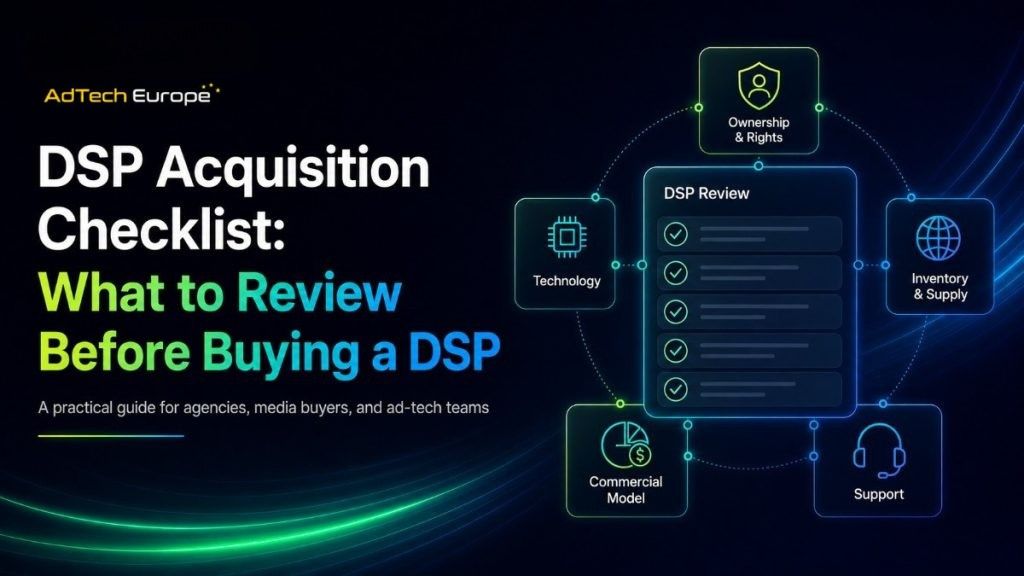
Buying a DSP is not just a software decision. It is a business decision that affects your traffic access, campaign control, revenue model, data ownership, and long-term growth.
Many advertisers, agencies, ad networks, and media buyers start with third-party DSP access. At first, it feels simple. But as spend grows, limited transparency, platform fees, fixed bidding rules, and weak customization can reduce profit and control.
This DSP acquisition checklist helps you review what matters before you buy, license, or fully own a demand-side platform. It is built for advertisers, agencies, DSP owners, and ad-tech businesses that want more control over programmatic buying.
Key Takeaways
- A DSP acquisition checklist helps buyers review ownership, source code, inventory, technology, support, and business risk.
- Buying a DSP platform with source code gives more control than standard access or white-label use.
- DSP owners make money through media margin, platform fees, managed services, advertiser accounts, and custom setup fees.
- DSP ownership gives stronger control over data, bidding logic, supply integrations, and long-term platform value.
- DSP access is faster to start, but full ownership is better for businesses that want independence and scale.
What Is DSP Acquisition?
DSP acquisition means buying, licensing, or taking ownership of a demand-side platform that helps advertisers buy programmatic inventory through automated bidding.
The acquisition can include different levels of control. Some buyers only get dashboard access. Others get white-label branding. More advanced buyers acquire source code, infrastructure control, and the ability to customize the platform.
A clear DSP acquisition plan helps buyers understand what they are really getting before they commit.
| DSP Model | What You Get | Best For |
| DSP access | Login access to an existing platform | Small teams testing programmatic buying |
| White-label DSP | Branded platform with vendor-owned backend | Agencies needing fast launch |
| DSP license | Controlled platform use under license terms | Growing ad-tech businesses |
| Full DSP ownership | Source code, platform control, and deeper customization | Agencies, networks, and DSP owners building long-term value |
How DSP Acquisition Works
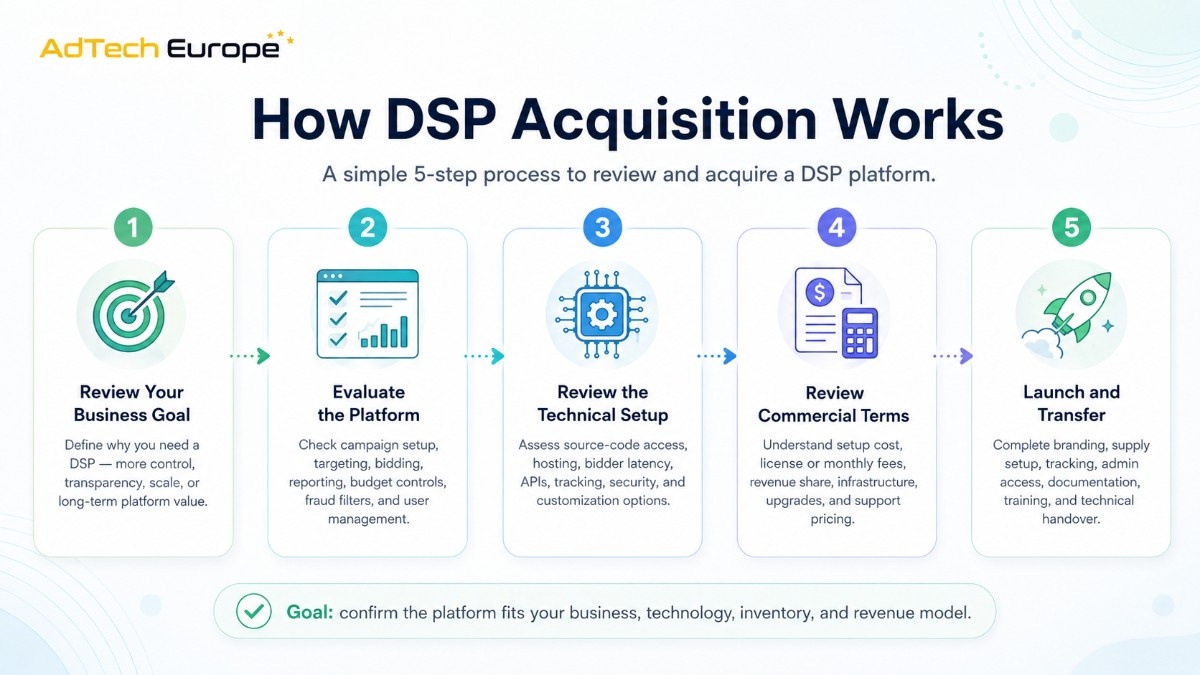
DSP acquisition usually follows a clear review and transfer process. The goal is to confirm whether the platform can support your buying needs, advertiser base, and revenue model.
1. Review Your Business Goal
Start by defining why you want a DSP.
Common goals include:
- Reducing dependence on third-party platforms
- Launching a programmatic ad platform
- Serving agency clients under one system
- Improving campaign transparency
- Controlling bidding and optimization rules
- Building a long-term ad-tech asset
2. Evaluate the Platform
Next, review the core DSP functions. A proper acquisition workflow should explain what is included before the deal moves forward.
Check whether the DSP includes campaign setup, targeting, real-time bidding, creative management, reporting, budget controls, fraud filters, admin controls, and user management.
3. Review the Technical Setup
The technical setup decides how much control you will have after launch.
Review source code access, hosting, bidder latency, APIs, database structure, tracking, log storage, security, and custom development options.
4. Review Commercial Terms
DSP acquisition costs are not only upfront costs.
You should also check monthly fees, revenue share, support fees, infrastructure cost, upgrade cost, minimum spend rules, and custom feature pricing.
5. Launch and Transfer
After approval, the platform is prepared for launch. This may include branding, domains, supply setup, tracking configuration, admin access, documentation, and training.
For full ownership, the buyer should also receive source-code access, deployment support, technical handover, and clear post-launch support terms.
DSP Acquisition Checklist
Use this checklist to review a DSP before buying, licensing, or acquiring ownership.
| Category | What to Review | Buyer Question |
| 1. Ownership & Rights | Platform access, source code, IP rights, exit terms | What do we actually own? |
| 2. Technology & Stack | Bidder, dashboard, APIs, tracking, reporting | Can the platform support our model? |
| 3. Inventory & Supply | SSPs, exchanges, direct supply, traffic quality | Can we access scalable inventory? |
| 4. Commercial Model | Setup cost, license fee, margin, revenue share | How will we make money? |
| 5. Operations & Support | Hosting, updates, fraud controls, maintenance | Can we run it reliably? |
1. Ownership and Rights
Ownership is the first thing to confirm.
Some DSP deals only give you access to the dashboard. Others include white-label branding but keep the backend under vendor control. Full ownership should give you stronger rights over the platform, source code, data, and future development.
Ask:
- Do we own the platform or only access it?
- Is source code included?
- Can we modify the system?
- Who owns campaign data and logs?
- What happens if we leave the vendor?
2. Technology and Stack
A DSP must be fast, stable, and flexible. The bidder, campaign manager, tracking system, reporting engine, and admin panel should work together without creating delays.
Ask:
- Can the bidder handle high request volume?
- Does reporting update in real time?
- Are APIs available?
- Can we add new features later?
- Is the platform ready for custom development?
3. Inventory and Supply
A DSP needs strong supply access to create value. Without quality inventory, even a good platform may fail to scale.
Ask:
- Which SSPs or exchanges are connected?
- Is web and app inventory available?
- Which geos and formats are supported?
- Can we add new supply partners?
- Can we control weak or low-quality sources?
4. Commercial Model
The DSP should match your business model. Some buyers want to run campaigns for clients. Others want to charge platform access or build their own advertiser base.
Ask:
- Can we apply media margin?
- Can we charge platform fees?
- Are managed services supported?
- Are billing tools included?
- Are there hidden vendor fees?
5. Operations and Support
After launch, the DSP needs maintenance. Support, updates, fraud controls, and infrastructure planning are important for long-term stability.
Ask:
- Who manages hosting?
- What support is included?
- How are bugs fixed?
- Are fraud filters included?
- Can the system scale as traffic grows?
Buy DSP Platform With Source Code
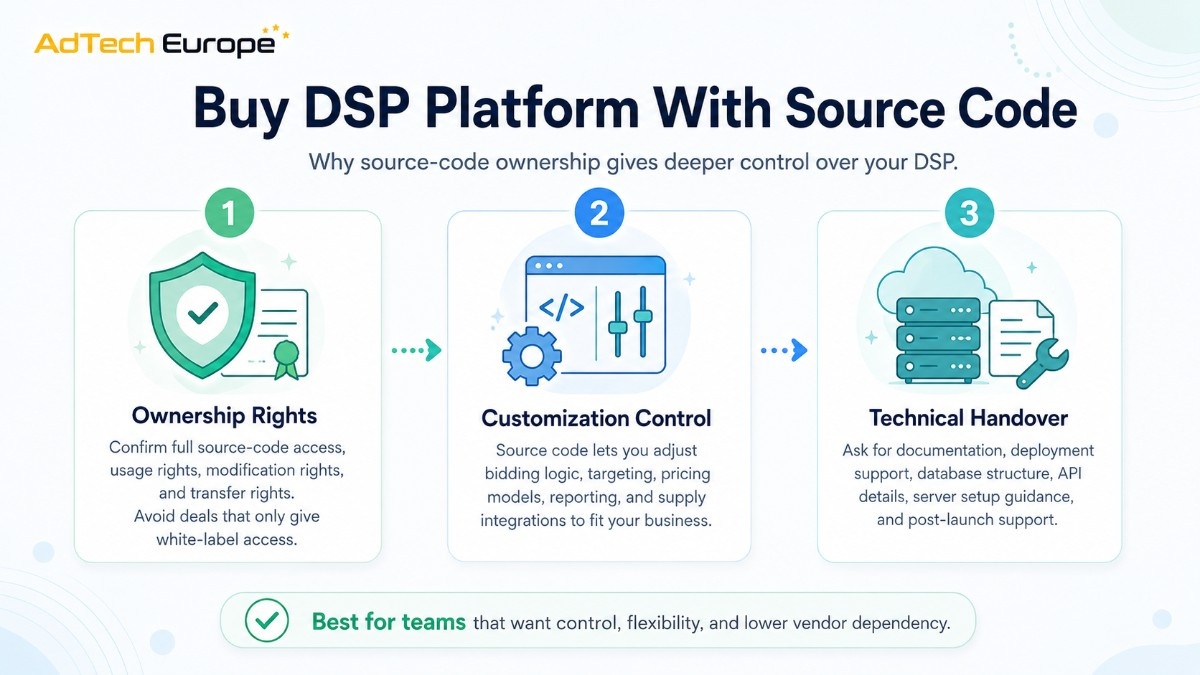
Buying a DSP platform with source code gives your business deeper control than standard DSP access. You are not only renting a dashboard. You can customize how the platform works.
A source-code DSP is useful when you want to control bidding logic, add integrations, adjust reporting, build custom features, and reduce vendor dependency.
1. Ownership Rights
Confirm whether the deal includes full source-code access, usage rights, modification rights, and transfer rights.
Some vendors offer white-label dashboards but keep the backend code restricted. That limits your ability to build your own platform value.
2. Customization Control
Source code matters because it lets you change the platform.
You may want to adjust bidding rules, targeting filters, pricing models, optimization logic, reporting views, or supply integrations. These changes are hard when the vendor controls the backend.
3. Technical Handover
Source code has value only when your team can use it.
Ask for documentation, deployment support, database structure, API details, server setup guidance, and post-launch technical support.
Programmatic DSP Business Model: How DSP Owners Make Money
A DSP can be more than a media buying tool. It can become a revenue-generating ad-tech business.
Programmatic advertising is growing fast, which makes DSP ownership a strong business opportunity. According to IAB Europe, Europe’s digital advertising market reached €118.9 billion in 2024, with programmatic advertising growing by 18.4%. EMARKETER also expects programmatic to make up 90% of worldwide display ad budgets by 2026.
This growth shows why owning a DSP can be valuable for agencies, ad networks, and ad-tech businesses. With the right platform, DSP owners can earn revenue through media margins, platform fees, managed services, setup fees, and advertiser accounts.
DSP owners usually make money through several models.
| Revenue Model | How It Works | Best For |
| Media margin | Buy inventory at one price and sell with markup | Agencies and ad networks |
| Platform fee | Charge advertisers for platform access | DSP operators |
| Managed service | Run campaigns for clients | Agencies and media buying teams |
| Seat fee | Charge users or teams for accounts | Enterprise-style platforms |
| Setup fee | Charge for onboarding or branding | White-label or custom DSP providers |
| Minimum spend | Require advertisers to spend a set amount | Performance-focused DSPs |
A strong DSP business model depends on advertiser demand, supply quality, margin control, and campaign performance.
DSP owners make more money when they can reduce supply costs, improve traffic quality, retain advertisers, offer useful reporting, and control platform pricing.
DSP Ownership vs DSP Access
DSP ownership and DSP access are not the same.
DSP access means you can use a platform. DSP ownership means you control the platform and can build business value around it.
| Area | DSP Access | DSP Ownership |
| Branding | Limited or shared | Full brand control |
| Source code | Usually not included | Included in full ownership |
| Bidder logic | Vendor-controlled | Buyer-controlled |
| Data control | Limited | Stronger control |
| Supply path | Vendor-managed | Can be expanded |
| Fees | Ongoing platform fees | Lower long-term dependency |
| Customization | Limited | Flexible |
| Business value | Low asset value | Builds owned technology |
For teams comparing DSP control models, the main question is simple: do you want to use someone else’s system or build value around your own?
DSP access is useful for testing. DSP ownership is better for businesses that want control, margin, and long-term independence.
Inventory and Supply Review
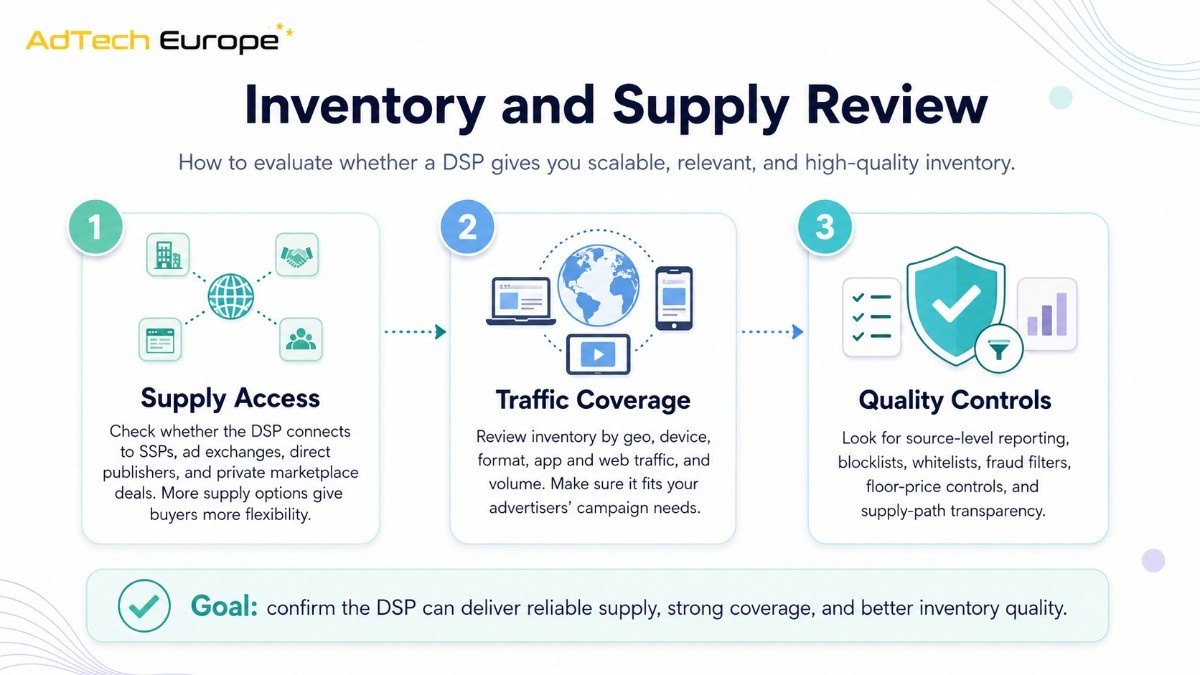
A DSP is only as strong as the inventory it can access. Before buying a DSP, review whether the platform connects to reliable supply and supports the traffic your advertisers need.
Strong programmatic inventory access helps DSP owners scale campaigns without depending on weak or unknown sources.
1. Supply Access
Check whether the DSP connects to SSPs, ad exchanges, direct publishers, or private marketplace deals.
A platform with more supply options gives buyers more flexibility. It also helps agencies and networks serve different campaign goals from one system.
2. Traffic Coverage
Review the traffic coverage by geo, device, format, app inventory, web inventory, and volume.
If your advertisers need mobile traffic, check device, OS, app, and carrier-level options. If they need brand campaigns, review display, native, video, and premium web inventory.
3. Quality Controls
Inventory quality matters as much as volume.
The DSP should support source-level reporting, blocklists, whitelists, fraud filters, floor-price controls, and supply-path transparency. These controls help reduce wasted spend and improve campaign decisions.
Technical Stack Review
The technical stack decides how stable, fast, and scalable the DSP will be after acquisition.
A modern DSP technology stack should support bidding, tracking, reporting, campaign management, supply integrations, and admin control.
1. Core Platform System
Review the main systems inside the DSP.
This includes the bidder, campaign manager, creative server, tracking system, reporting engine, admin panel, user dashboard, and billing tools.
Each system should work together smoothly. If one part is weak, the whole platform may suffer.
2. Performance Infrastructure
Programmatic bidding happens in milliseconds. A slow system can lose auctions and reduce campaign performance.
Check bidder latency, server setup, uptime, bid request capacity, log storage, and scaling plan.
3. Integration Flexibility
The DSP should be flexible enough to grow with your business.
Review API access, tracking pixels, postbacks, third-party tools, SSP integrations, custom reporting, and custom development options.
License vs Full Ownership
A license gives you access to a DSP under vendor terms. Full ownership gives you more control over the platform, code, data, infrastructure, and business direction.
The right choice depends on your budget, technical capacity, and growth plan.
| Area | License Model | Full Ownership |
| Launch speed | Faster | Takes more setup |
| Source code | Usually limited | Included or transferable |
| Customization | Vendor-controlled | Buyer-controlled |
| Data control | Partial | Stronger control |
| Long-term value | Lower asset value | Builds owned technology |
| Cost structure | Lower upfront, ongoing fees | Higher upfront, more control |
| Best for | Testing or early growth | Scaling a DSP business |
A license or ownership decision should not be based only on price. It should be based on control, risk, business model, and long-term value.
Choose a license model if you want faster launch, lower starting cost, vendor support, and less technical responsibility.
Choose full ownership if you want source-code control, custom bidder logic, stronger data ownership, and long-term platform independence.
Who Should Use This DSP Acquisition Checklist?
This checklist is useful for businesses that want to move beyond basic DSP access.
It is especially useful for:
- Agencies managing programmatic campaigns for clients
- Ad networks building their own buying technology
- Media buyers scaling traffic spend
- Affiliate teams running high-volume campaigns
- Existing DSP owners upgrading their platform
- Ad-tech entrepreneurs launching a DSP business
Many teams move from buying traffic to owning technology when platform dependency starts limiting growth. The shift from media buyer to owner can create better control, better margins, and stronger long-term value.
Final Questions Before Buying a DSP
Before signing a DSP acquisition deal, review these final questions.
Ownership Questions
- What exactly do we own?
- Is source code included?
- Can we modify the platform?
- Can we move hosting later?
Supply Questions
- Which supply partners are connected?
- Can we add new SSPs?
- Do we control traffic sources?
- Can we block weak inventory?
Business Questions
- How will we earn revenue?
- What fees continue after launch?
- Can we charge advertisers directly?
- Can we run managed campaigns?
Technical Questions
- Can the bidder scale?
- Is documentation included?
- Are APIs available?
- What support is included?
If a vendor cannot answer these clearly, the acquisition risk is higher.
Ready to Own Your Programmatic DSP?
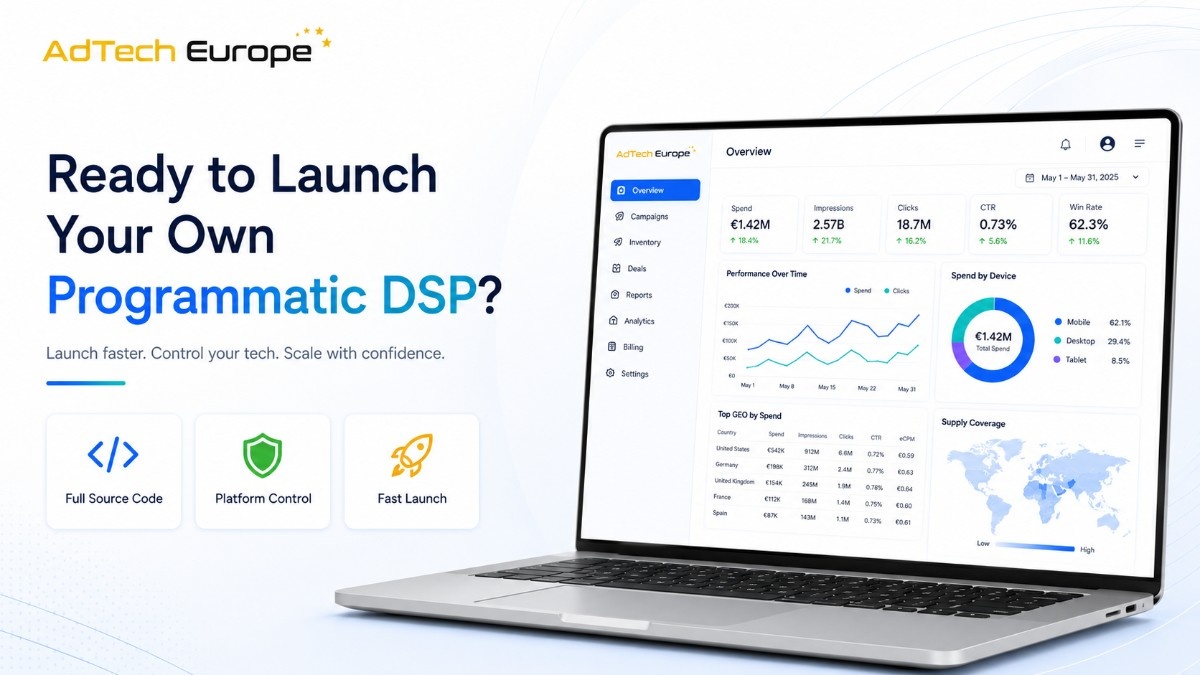
AdTech Europe helps advertisers, agencies, media buyers, ad networks, and DSP owners acquire a fully owned demand-side platform with source-code access, white-label branding, programmatic supply integrations, scalable infrastructure, and custom development support.
Whether you want to launch your own DSP business, reduce dependence on third-party platforms, control your bidding logic, or build long-term programmatic revenue, AdTech Europe gives you the technology, integrations, transparency, and ownership needed to operate your own DSP with confidence.
FAQS
1. What should I check first before buying a DSP?
Start with ownership rights. Confirm whether you are buying full ownership, licensing the platform, or only getting access to a vendor-owned system.
2. Is buying a DSP with source code better than white-label access?
Yes, if you need deep customization, bidder control, and long-term independence. White-label access is faster, but source-code ownership gives more control.
3. How much technical knowledge do I need to own a DSP?
You do not need to code daily, but you need technical support for hosting, updates, integrations, security, and custom changes.
4. Can a DSP owner connect new SSPs later?
Yes, if the platform supports new integrations and you have the technical rights to add supply partners. This is easier with source-code ownership.
5. How do DSP owners earn profit?
DSP owners earn through media margin, platform fees, managed services, advertiser accounts, setup fees, and sometimes data or targeting services.
6. What is the biggest risk in DSP acquisition?
The biggest risk is buying limited access while thinking you own the platform. Always review contracts, source-code rights, data rights, and exit terms.
7. Is full DSP ownership suitable for small advertisers?
Usually, full ownership is better for agencies, ad networks, and high-volume buyers. Small advertisers may start with DSP access or licensing first.
8. Why does inventory quality matter in DSP acquisition?
A DSP needs strong supply to deliver real value. Without quality inventory, even a good platform may struggle to scale campaigns or produce strong results.