Launching a programmatic advertising business requires more than access to traffic and campaigns. One of the most important strategic decisions is choosing the right platform model.
Should you license a DSP and get started quickly, or invest in full ownership and build long-term infrastructure?
Both approaches are valid, but they serve different business goals. Understanding the difference between a License Plan and a Full Ownership Plan is essential if you want to scale efficiently and position your business correctly in the market.
At AdTech Europe, both models are available, allowing agencies, media buyers, and entrepreneurs to choose the structure that best fits their growth strategy.
Understanding the License Model
A License Plan provides access to a fully functional DSP environment under your brand without requiring you to build or manage the underlying technology.
This approach is designed for speed and simplicity. Businesses can launch quickly, onboard advertisers, and start running campaigns without dealing with infrastructure, development, or system maintenance.
The platform is already built, optimized, and connected to supply sources. This allows users to focus on campaign execution, client acquisition, and revenue generation.
For many businesses, this is the most efficient way to enter the programmatic ecosystem.
When a License Plan Makes Sense
The license model is particularly suitable for businesses that want to move quickly or validate their market position.
It is commonly chosen by agencies expanding into programmatic advertising, affiliate teams testing new traffic strategies, and entrepreneurs launching new ad networks.
Because the technical complexity is handled externally, the focus remains on operations. This reduces the time required to generate revenue and allows teams to scale without building internal engineering capabilities.
However, while the license model provides speed, it does not provide full control over the underlying infrastructure.
Understanding Full Ownership
A Full Ownership Plan represents a fundamentally different approach. Instead of accessing a platform, you own it.
This includes the core technology, system architecture, integrations, and data. Ownership transforms the DSP from a tool into a business asset.
With full ownership, your platform becomes part of your company’s long-term value. You are no longer dependent on external systems, and you gain the ability to customize and expand the platform according to your specific needs.
This model is designed for businesses that are focused on building scalable, independent ad tech operations.
Strategic Advantages of Ownership
Owning a DSP provides several structural advantages that go beyond day-to-day operations.
First, it eliminates dependency on third-party platforms. This allows businesses to operate without restrictions related to traffic volume, feature limitations, or policy changes.
Second, it improves cost efficiency. Without platform-level scaling fees or revenue sharing, businesses can maintain better margins as they grow.
Third, it creates long-term value. A fully owned DSP is not just a tool for generating revenue. It is an asset that contributes to company valuation and can be expanded, licensed, or integrated into broader business strategies.
These factors make ownership particularly attractive for companies that are already operating at scale or planning significant growth.
Key Differences Between License and Ownership
The distinction between the two models is primarily strategic rather than technical.
A License Plan is focused on accessibility and speed. It allows businesses to enter the market quickly and operate efficiently without infrastructure concerns.
A Full Ownership Plan is focused on control and long-term growth. It enables businesses to build their own ecosystem and operate independently.
The choice between the two depends on your priorities. If your goal is to launch quickly and validate your business model, a license may be sufficient. If your goal is to build a scalable and valuable ad tech company, ownership becomes the more appropriate option.
Cost Structure and Scalability
Both models at AdTech Europe are designed with scalability in mind.
Unlike traditional platforms that charge increasing fees as traffic grows, the cost structure is aligned with infrastructure usage. As your platform scales, your primary costs are related to hosting, bandwidth, and system resources.
This approach ensures that growth does not result in disproportionate cost increases. It also provides transparency, allowing businesses to predict and manage expenses more effectively.
For companies planning long-term expansion, this model supports sustainable scaling without hidden limitations.
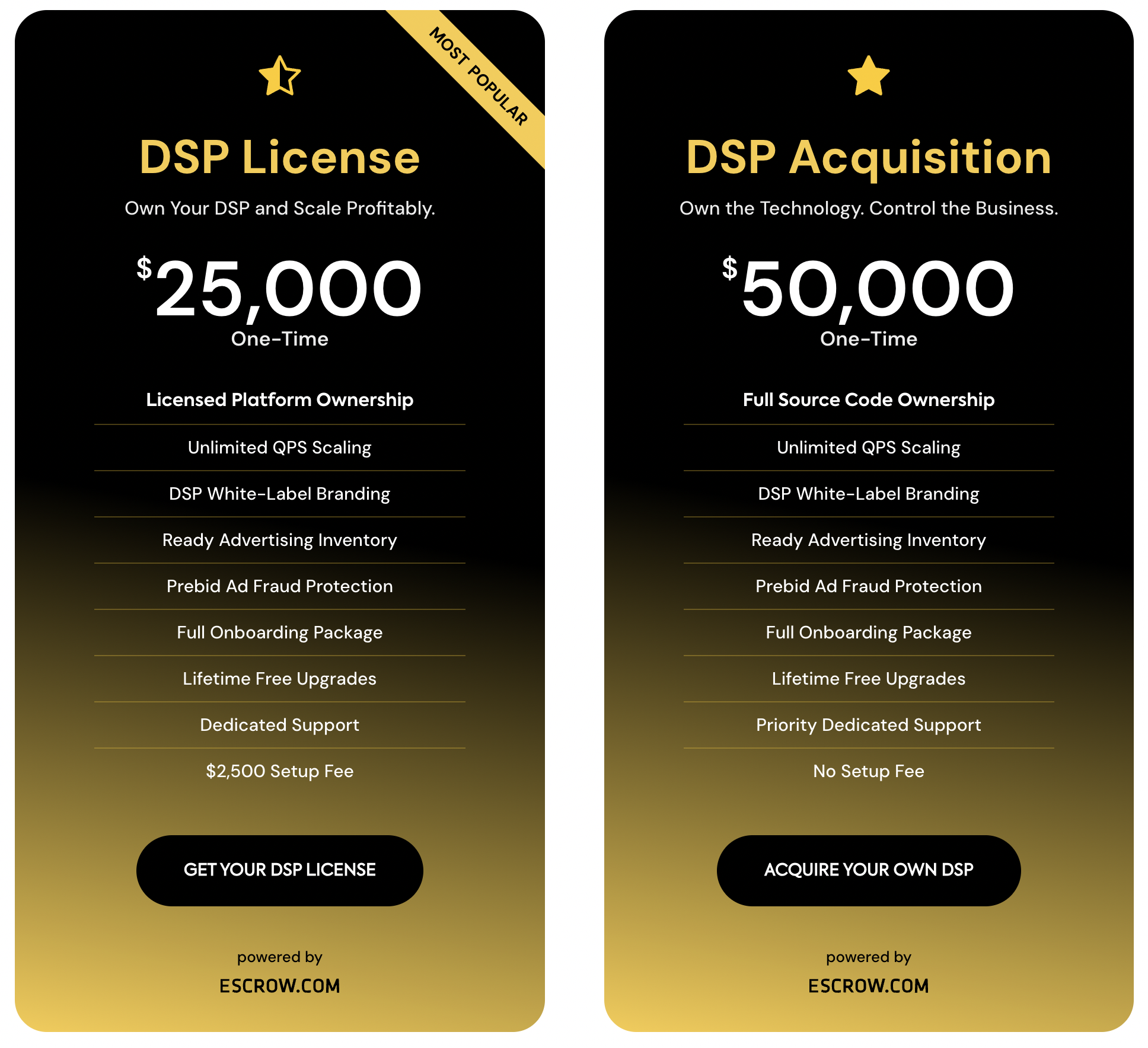
Choosing the Right Model for Your Business
The decision between licensing and ownership should be based on your current position and future goals.
If you are entering the market, testing new ideas, or prioritizing speed, a License Plan provides an efficient starting point.
If you are already managing significant budgets, building a client base, or aiming to create a long-term asset, a Full Ownership Plan offers greater strategic value.
Many businesses start with a license and transition to ownership as they grow. This progression allows them to gain experience while gradually increasing control over their infrastructure.
Conclusion
Choosing between a License Plan and a Full Ownership Plan is one of the most important decisions in building a programmatic advertising business.
The license model offers speed and simplicity, making it ideal for market entry and early-stage growth. Full ownership offers control and long-term value, making it suitable for businesses focused on scaling and independence.
Understanding these differences allows you to align your platform strategy with your business objectives and position yourself effectively in the evolving programmatic landscape.
For more details on available plans, visit:
https://adtech.eu/pricing/