Programmatic advertising can feel confusing because many platforms work at the same time. Advertisers hear terms like DSP, SSP, RTB, ad exchange, ad inventory, and bid request. Each one matters, but DSP vs SSP is the core relationship that powers most automated media buying.
The problem is simple. Advertisers want the right users at the right price. Publishers want to sell their ad space for the best possible revenue. Without the right technology, both sides waste time, money, and opportunities in a fast-moving auction environment.
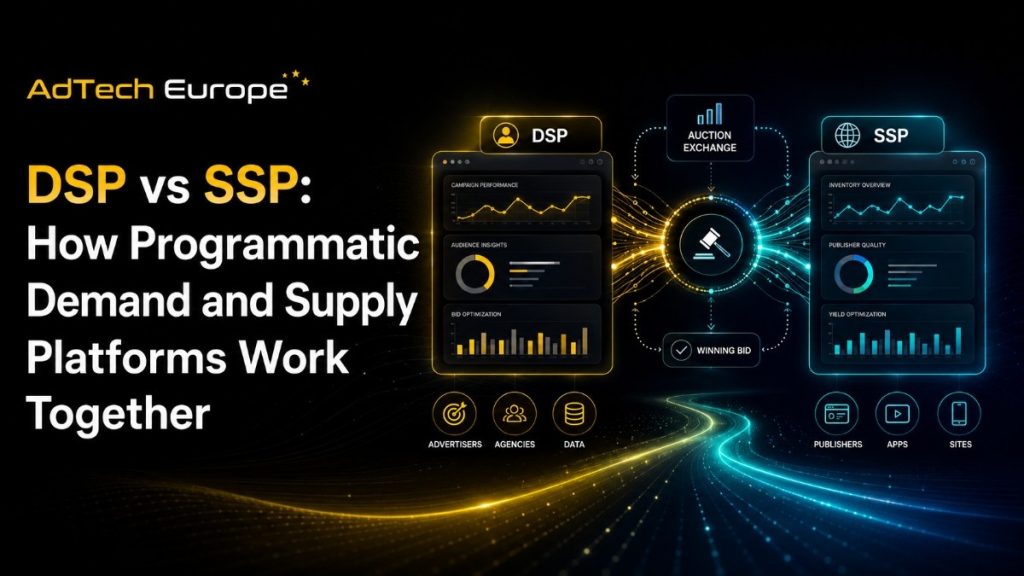
A DSP helps advertisers buy media. An SSP helps publishers sell inventory. Together, they connect demand and supply through automated auctions, data signals, and real-time bidding. For agencies, media buyers, and advertisers, understanding this relationship is key to improving performance and gaining more control.
What Is a DSP in Programmatic Advertising?
A demand-side platform, or DSP, is software used by advertisers, agencies, and media buyers to buy digital ad inventory automatically. It lets buyers manage campaigns across websites, apps, video, connected TV, native placements, and other programmatic channels from one platform.
Instead of contacting each publisher one by one, advertisers use a DSP to access many inventory sources at scale. A DSP can connect with ad exchanges, SSPs, data providers, and measurement tools to help buyers reach users based on targeting rules and campaign goals.
A DSP is built for performance. It helps advertisers control targeting, bidding, budgets, pacing, frequency, creatives, and reporting. For buyers who want more ownership, a programmatic buying platform can also reduce dependence on closed third-party systems.
Key DSP Functions for Advertisers
| DSP Function | What It Helps Advertisers Do |
| Audience targeting | Reach users based on behavior, location, device, context, or data signals |
| Real-time bidding | Decide what each impression is worth before placing a bid |
| Budget pacing | Spend campaign budgets smoothly across time |
| Creative management | Upload, test, and rotate ads across formats |
| Frequency control | Limit how often the same user sees an ad |
| Performance reporting | Track impressions, clicks, conversions, cost, and ROI |
A DSP is not just a buying tool. It is also a decision engine. Every bid request must be judged quickly based on user value, placement quality, price, campaign goals, and expected outcome.
What Is an SSP in Programmatic Advertising?
A supply-side platform, or SSP, is software used by publishers, app owners, media owners, and digital inventory sellers. Its job is to help them manage, package, sell, and optimize available ad impressions.
Publishers use SSPs to connect their inventory to many demand sources. These sources may include DSPs, ad exchanges, ad networks, agency trading desks, and direct programmatic buyers. The goal is to increase competition for each impression and improve yield.
An SSP protects the publisher’s business interests. It helps set floor prices, block unwanted advertisers, control ad quality, manage deal types, and choose which demand partners can access inventory. For advertisers, strong programmatic inventory access can improve reach and supply quality.
Key SSP Functions for Publishers
| SSP Function | What It Helps Publishers Do |
| Inventory management | Organize and sell ad space across web, app, video, or CTV |
| Yield optimization | Maximize revenue from each impression |
| Floor pricing | Set minimum acceptable CPMs |
| Demand access | Connect inventory to DSPs, exchanges, and buyers |
| Brand safety controls | Block unsuitable ads or categories |
| Deal management | Support open auctions, private marketplaces, and direct deals |
An SSP works from the seller’s side. It wants to get the best price while keeping user experience, ad quality, and publisher rules under control.
DSP vs SSP: The Main Difference
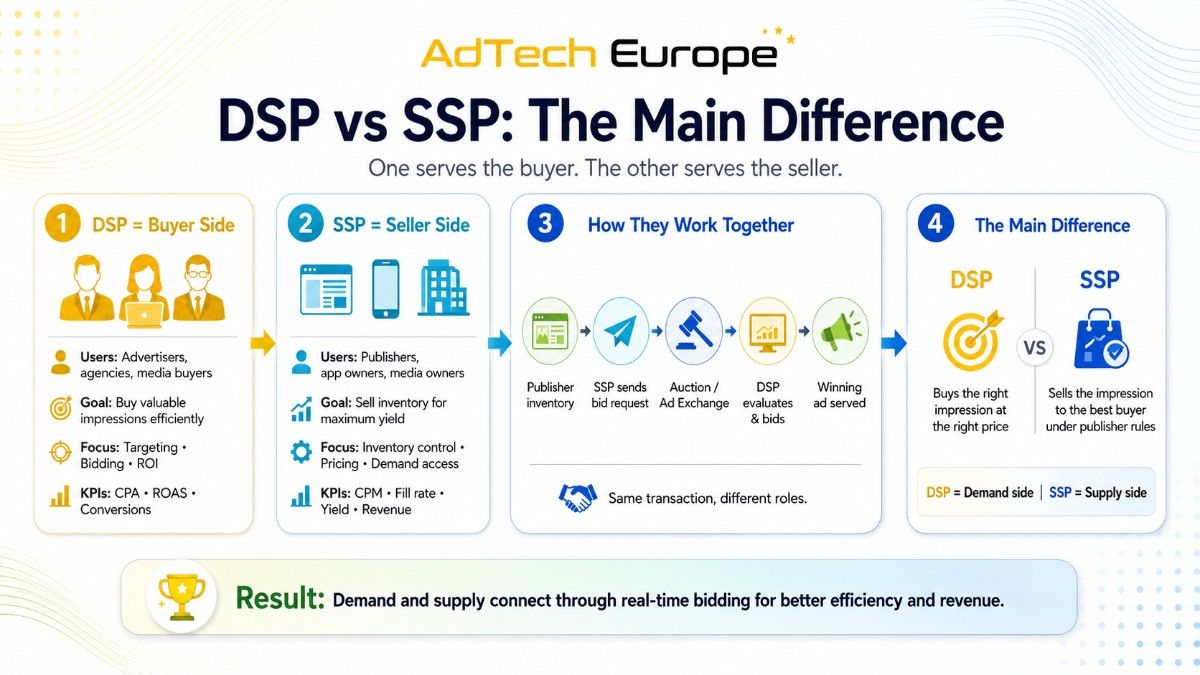
The main difference between DSP and SSP is the user they serve. A DSP serves the buyer. An SSP serves the seller. One helps advertisers buy ad impressions efficiently. The other helps publishers sell impressions profitably.
Both platforms are part of the same programmatic transaction. The DSP tries to buy the best impression at the right price. The SSP tries to sell that same impression to the best buyer under the publisher’s rules.
| Area | DSP | SSP |
| Primary user | Advertisers, agencies, media buyers | Publishers, app owners, media owners |
| Main goal | Buy valuable impressions efficiently | Sell inventory for maximum yield |
| Focus | Targeting, bidding, performance, ROI | Inventory control, pricing, demand access |
| Data use | Audience, campaign, conversion, bid data | Inventory, placement, user, yield data |
| Success metric | CPA, ROAS, CTR, conversions, reach | CPM, fill rate, yield, revenue |
| Platform side | Demand side | Supply side |
A useful way to think about DSP vs SSP is a marketplace. The DSP represents the buyer with a budget. The SSP represents the seller with available inventory. The auction decides whether both sides agree on price and value.
How DSPs and SSPs Work Together
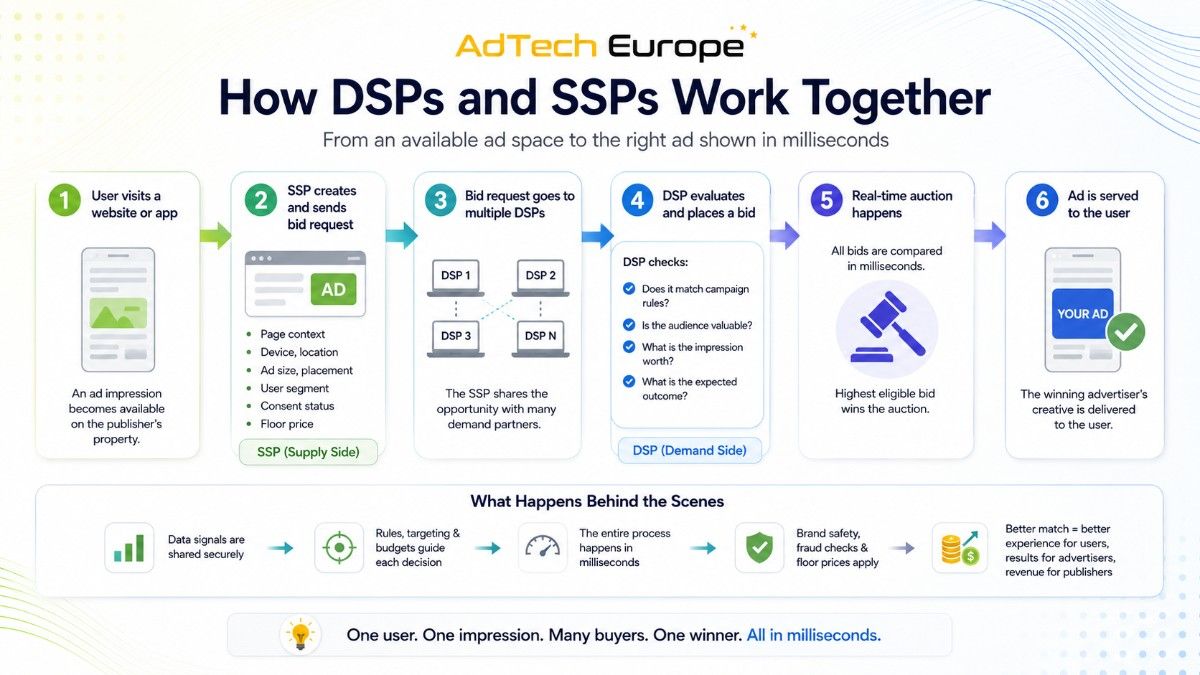
DSPs and SSPs work together through programmatic auctions. When a user opens a website or app, the publisher has an ad impression available. The SSP packages that opportunity and sends it into the programmatic ecosystem.
The DSP receives a bid request. This request may include signals such as page context, device type, location, ad size, placement, user segment, consent status, and floor price. The DSP checks whether the impression matches the advertiser’s campaign rules.
If the impression is valuable, the DSP places a bid. If the bid wins, the advertiser’s creative is served to the user. This process often happens in milliseconds, making DSP and RTB closely connected in modern media buying.
A Simple Programmatic Auction Flow
| Step | What Happens | Platform Involved |
| 1 | User opens a page or app | Publisher |
| 2 | Ad impression becomes available | SSP |
| 3 | Bid request is sent to buyers | SSP / Ad Exchange |
| 4 | DSP checks targeting and value | DSP |
| 5 | DSP submits a bid | DSP |
| 6 | Winning ad is served | Ad server / Publisher |
This is why DSPs and SSPs are not competitors in the same way. They sit on opposite sides of the trade. The advertiser needs the DSP. The publisher needs the SSP. The transaction needs both sides to communicate clearly.
Where Ad Exchanges Fit Between DSPs and SSPs
An ad exchange is the marketplace layer that helps DSPs and SSPs trade impressions. It receives supply from SSPs and makes it available to DSPs through auction rules.
In some setups, DSPs connect directly to SSPs. In others, an ad exchange sits between them. The exact setup depends on the platform, inventory type, auction model, and commercial relationships.
For advertisers, the key point is access. A DSP should provide clean paths to quality supply. Poor exchange paths can create duplicate auctions, hidden costs, and wasted spend. Strong DSP exchange connections help buyers improve transparency and campaign efficiency.
Why DSP vs SSP Matters for Advertisers
Advertisers do not usually operate an SSP unless they own inventory. But they must understand how SSPs affect media buying. SSP rules shape price floors, auction access, placement quality, and supply paths.
If a DSP connects to poor supply sources, advertisers may pay for low-quality impressions. If the DSP has weak optimization, buyers may overbid, underperform, or lose valuable users to competitors.
Understanding DSP vs SSP helps advertisers ask better questions:
- Where does the DSP get inventory?
- Which SSPs and exchanges are connected?
- Are there duplicate supply paths?
- Can bidding logic be customized?
- How transparent are fees and auction data?
- Can performance be measured beyond clicks?
These questions matter because media buying is not only about reach. It is about controlled reach, clean supply, smart bids, and measurable outcomes.
How DSPs Improve Media Buying Control
A DSP gives advertisers a central place to manage buying decisions. This is important for teams running campaigns across many channels, regions, audiences, and formats.
With a DSP, buyers can control who they target, how much they bid, where ads appear, and how budgets are spent. They can also test campaign rules, optimize toward conversions, and reduce manual work.
For agencies and high-volume advertisers, DSP media buying can support scale without losing control. The right setup helps teams move from basic campaign delivery to performance-led buying.
DSP Capabilities That Support Better Performance
| Capability | Why It Matters |
| Custom bidding | Helps value impressions based on business goals |
| Supply filtering | Reduces waste from poor-quality placements |
| Data integration | Improves audience and conversion targeting |
| Frequency management | Prevents overserving ads to the same user |
| Creative testing | Finds which messages drive better response |
| Reporting access | Shows what is working and what needs adjustment |
The strongest DSP setups are not only automated. They are also flexible. Advertisers need the ability to adjust buying logic as markets, users, prices, and campaign goals change.
How SSPs Influence Supply Quality
SSPs decide how publisher inventory enters the market. They can group impressions, set rules, manage access, and control which demand partners can bid. This affects what advertisers can buy through their DSP.
High-quality SSP supply can help advertisers reach real users in brand-safe environments. Low-quality or unclear supply can lead to wasted impressions, weak viewability, fraud risk, or poor conversion results.
This is why advertisers should not look only at DSP features. They should also check the supply chain behind the DSP. A strong DSP should offer access to reliable SSPs, clean inventory sources, and transparent auction paths.
Open Auction, Private Marketplace, and Programmatic Direct
DSPs and SSPs can work together across different deal types. Each deal type offers a different balance of scale, control, price, and access.
| Deal Type | Best For | How DSP and SSP Work |
| Open auction | Broad reach and flexible buying | SSP opens inventory to many DSP bidders |
| Private marketplace | Better control and selected buyers | SSP offers inventory to approved DSPs |
| Preferred deal | Fixed access without guaranteed volume | DSP buys selected inventory at agreed terms |
| Programmatic guaranteed | Reserved inventory with automation | DSP and SSP support direct automated delivery |
Open auctions are useful for scale. Private marketplaces are useful for quality and control. Programmatic guaranteed is useful when advertisers need reserved access with automated delivery.
DSP vs SSP and Supply Path Optimization
- Supply path optimization means choosing the best route to buy inventory. The same impression may appear through multiple SSPs or exchanges. Without control, advertisers may bid on duplicate supply or pay unnecessary fees.
- A DSP can help identify cleaner paths. It can prioritize direct SSP connections, block weak sources, reduce duplication, and improve cost efficiency. This helps advertisers buy closer to the publisher and avoid waste.
- Supply path optimization is especially important for agencies, ad networks, and DSP owners. When buying volume grows, small inefficiencies become expensive. Better path control can improve CPM, win rate, viewability, and return on ad spend.
DSP Ownership vs Using a Third-Party DSP
Many advertisers start with third-party DSP access. This can be useful for testing programmatic buying quickly. But as spend grows, some companies want more control over bidding logic, data, integrations, fees, and platform branding.
Owning a DSP can help advertisers, agencies, and ad tech businesses reduce dependency on external platforms. It can also support custom algorithms, white-label models, direct supply integrations, and deeper reporting access.
This is where custom adtech development becomes important. A company that owns its platform can shape the technology around its business model instead of adapting every workflow to someone else’s rules.
When Owning a DSP May Make Sense
Owning or licensing a DSP may fit when a business needs more control than standard self-serve tools allow. This is common for agencies, ad networks, media buyers, performance teams, and companies building programmatic products.
A owned DSP can support:
- Custom bidding logic
- White-label platform branding
- Direct supply integrations
- First-party data use
- Custom reporting workflows
- Better control over margins
This does not mean every advertiser needs to own a DSP. Smaller advertisers may be fine using managed services or existing platforms. But high-spend buyers and adtech companies often benefit from more control.
Common DSP and SSP Examples in the Market
DSP and SSP examples help make the ecosystem easier to understand. On the DSP side, advertisers use platforms to buy display, video, mobile, native, CTV, and other digital media. On the SSP side, publishers use platforms to sell inventory to many buyers.
This matters because programmatic buying continues to expand across Europe, with IAB Europe reporting that programmatic advertising rebounded with 18.4% growth in its latest AdEx Benchmark Report.
Examples are useful, but buyers should not choose a platform by name alone. The better question is whether the platform supports your goals, data needs, supply access, reporting standards, and control requirements.
A practical DSP and SSP comparison can help teams understand how different platforms fit into the wider programmatic ecosystem before making buying or ownership decisions.
What to Check Before Choosing a DSP
Choosing a DSP should be based on business needs, not only feature lists. A platform may look strong but still limit control, transparency, or growth.
Advertisers should review supply access, bidding options, reporting depth, data integrations, fraud protection, creative formats, and support for different deal types. They should also check whether the DSP can scale with their business model.
Before making a buying decision, teams should compare critical DSP features against real campaign goals. The best DSP is the one that gives buyers practical control over performance, cost, and growth.
How DSPs and SSPs Affect Campaign Performance
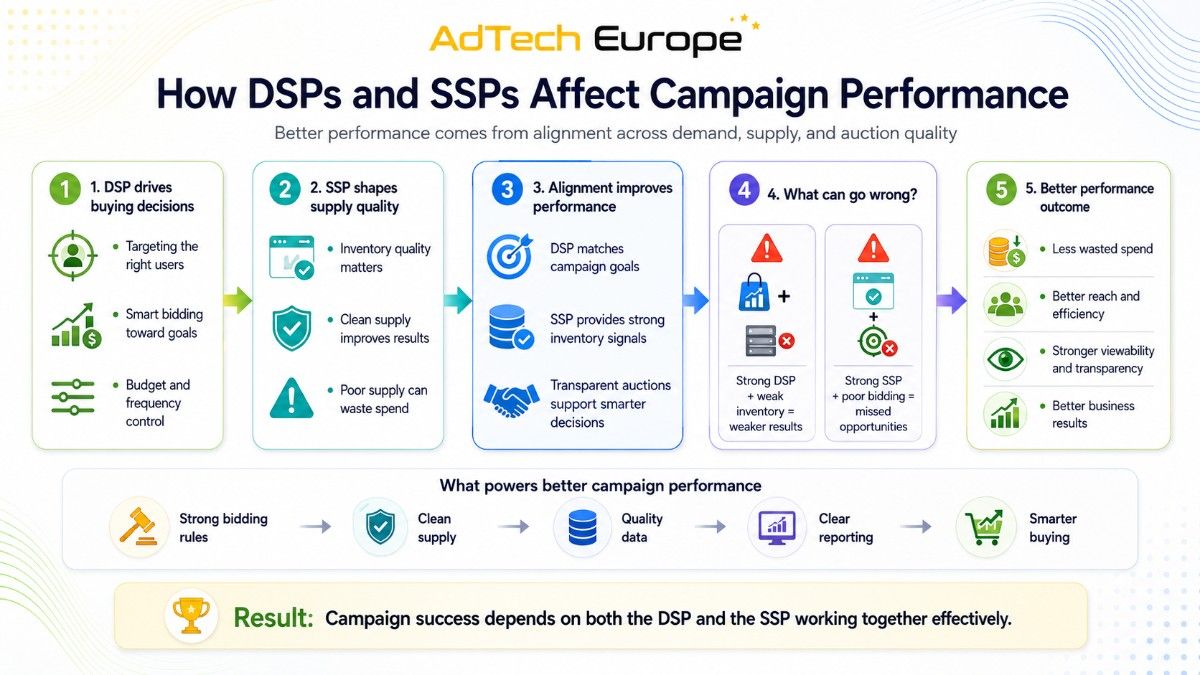
- Campaign performance depends on both the demand side and the supply side:
- A DSP may have strong targeting, but weak inventory can reduce results.
- An SSP may offer good supply, but poor DSP bidding can miss the best users.
- Good performance comes from alignment:
- The DSP must understand campaign goals.
- The SSP must provide quality inventory signals.
- The auction must be transparent enough for buyers to make smart decisions.
- Programmatic success is not only about automation:
- It is about smarter buying.
- Strong bidding rules, clean supply, clear reporting, and quality data all work together to improve programmatic ad performance.
Smart Bidding in the DSP and SSP Relationship
Smart bidding is where the DSP decides how much to pay for each impression. It may use campaign goals, conversion data, user signals, historical performance, and supply quality to set the bid.
The SSP sets the selling conditions, such as floor price and auction access. The DSP responds with a bid that matches the advertiser’s value for that impression. When this works well, advertisers avoid overpaying and improve campaign efficiency.
Strong bidding strategy control helps advertisers move beyond basic CPM buying. It lets them optimize toward clicks, leads, sales, installs, or other real business outcomes.
DSP vs SSP: What Advertisers Should Remember
DSPs and SSPs are different, but they work together in the same programmatic trade. The DSP represents demand. The SSP represents supply. The ad exchange or direct connection helps both sides meet in real time.
For advertisers, the DSP is the main control point. It shapes targeting, bidding, budget use, reporting, and optimization. But SSP quality still matters because it affects what inventory is available and how clean the buying path is.
The best programmatic results come from understanding both sides. Advertisers who know how demand and supply connect can reduce waste, improve transparency, and build stronger media buying operations.
Ready to Build More Control Into Your Programmatic Buying?
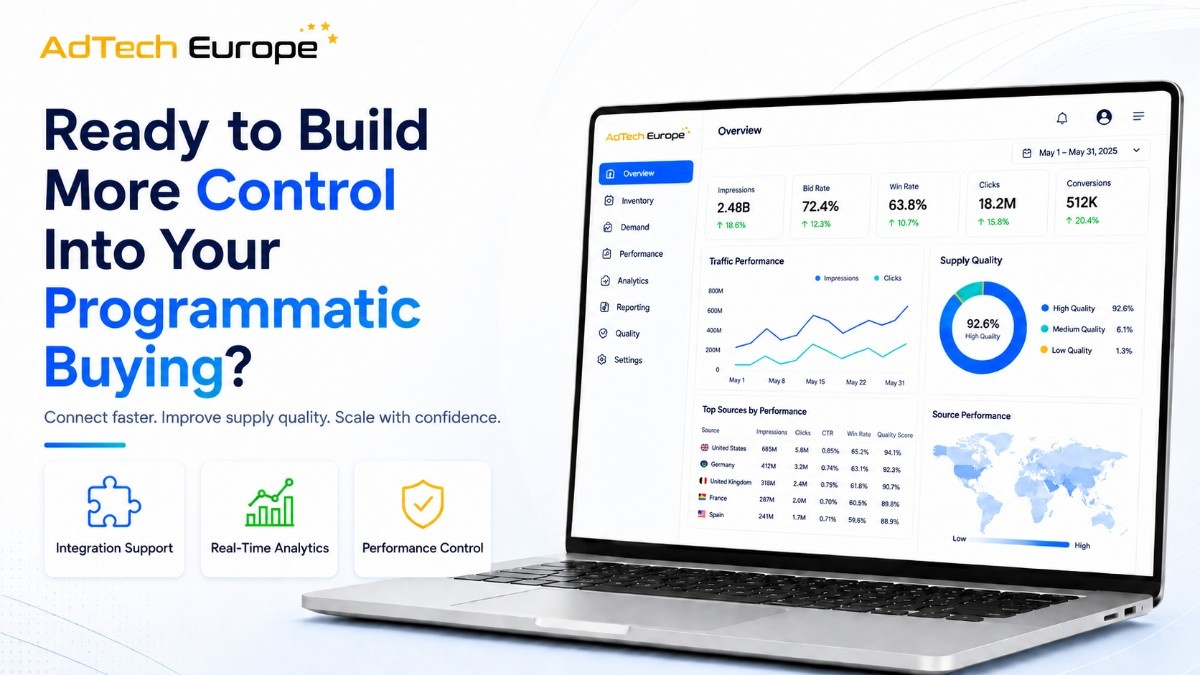
AdTech Europe helps advertisers, agencies, media buyers, ad networks, and DSP owners gain more control over programmatic advertising by offering the infrastructure, integrations, and support needed to launch a DSP, access quality supply, improve bidding, reduce wasted spend, and scale efficiently.
For teams ready to discuss platform ownership, supply access, or custom programmatic development, you can schedule a programmatic strategy meeting with AdTech Europe.
FAQs
Can an advertiser use an SSP directly?
Usually, no. SSPs are built for publishers and inventory owners. Advertisers normally use a DSP to access SSP inventory through auctions, private marketplaces, or direct programmatic deals.
Do DSPs and SSPs share user data?
They may pass limited signals through bid requests, depending on consent, privacy rules, platform settings, and browser or device restrictions. The level of data depends on the market, regulation, and technical setup.
What is the difference between SSP and ad server?
An SSP helps publishers sell inventory through programmatic demand. An ad server manages ad delivery, campaign rules, placements, and reporting. Publishers often use both tools together.
Why do advertisers connect DSPs to multiple SSPs?
Multiple SSP connections can increase reach and inventory access. But too many paths can also create duplication. Advertisers should balance scale with supply path quality and cost control.
Is header bidding related to SSPs?
Yes. Header bidding lets publishers offer inventory to multiple demand sources before calling the ad server. SSPs often participate in header bidding to increase competition and publisher revenue.
Can a company own both a DSP and an SSP?
Yes, but the business must manage conflicts carefully. A DSP serves buyers, while an SSP serves sellers. Clear rules, transparency, and separation are important when one company operates both sides.
Which is more important for advertisers: DSP or SSP?
The DSP is usually more important for advertisers because it controls buying decisions. However, SSP quality still matters because it affects inventory access, auction price, placement quality, and campaign outcomes.