Buying digital media at scale is no longer about contacting publishers one by one. Advertisers need reach across websites, apps, CTV, video, native, audio, and emerging channels while still controlling budget, audience quality, and performance.
The problem is that scale can quickly create waste. Without the right controls, buyers may pay for low-quality impressions, duplicate users, weak placements, hidden reseller paths, or inventory that does not support the campaign goal.
DSP media buying solves this with one system to plan, bid, optimize, and measure programmatic campaigns. It helps advertisers, agencies, and media buyers buy faster, reduce manual work, and build a more controlled buying operation.
What Is DSP Media Buying?
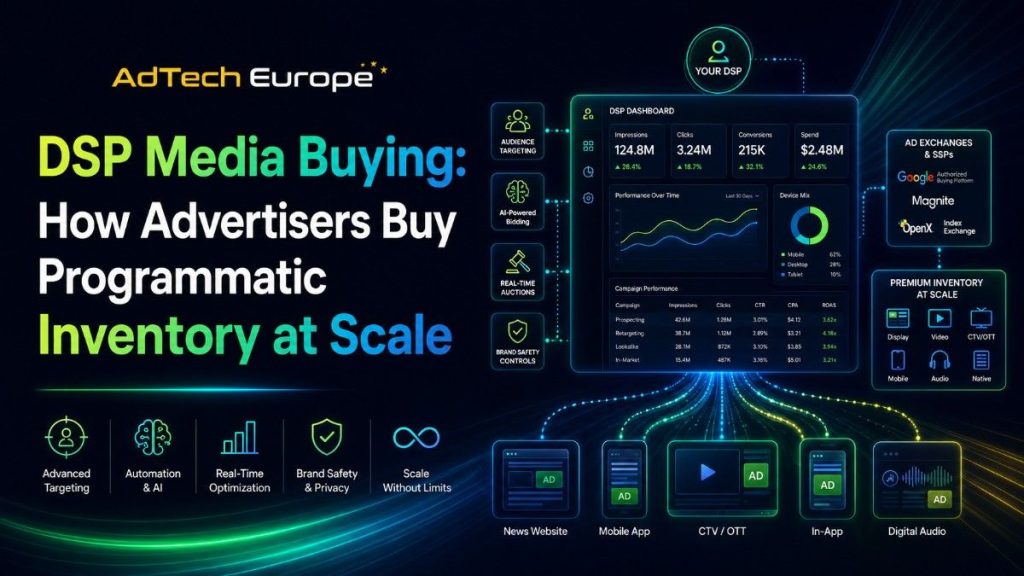
DSP media buying is the process of using a demand-side platform to buy digital ad inventory automatically. The DSP connects advertisers to ad exchanges, SSPs, publishers, data partners, and measurement tools so each impression can be evaluated before a bid is placed.
A strong DSP manages budgets, audiences, creatives, frequency, supply paths, pacing, and reports. For advertisers new to the model, programmatic DSP basics explain why the platform sits at the center of modern programmatic buying.
How a DSP Buys Inventory at Scale
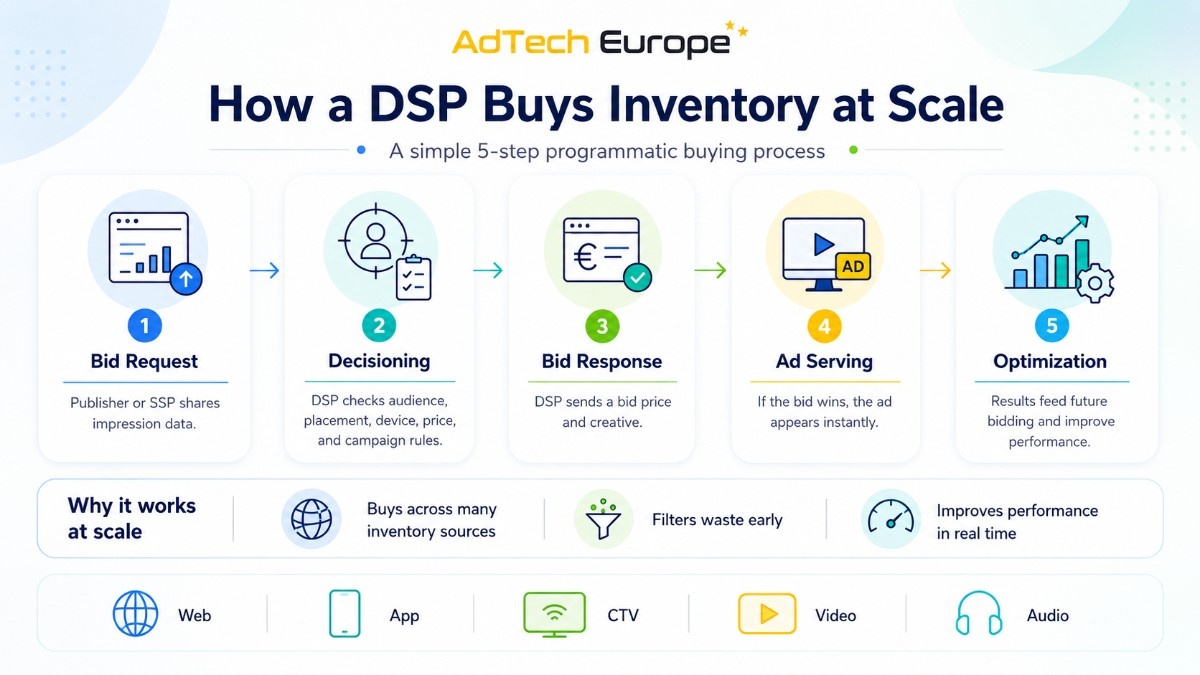
A DSP treats every impression as a decision. When a user loads a page, app, or CTV stream, the publisher’s SSP sends a bid request. The DSP checks the user, placement, price, device, format, and campaign rules before deciding whether to bid.
| Stage | What Happens | Why It Matters |
| Bid request | SSP shares impression data | DSP can judge fit |
| Decisioning | DSP applies targeting rules | Waste is filtered early |
| Bid response | DSP sends price and creative | Auction moves in real time |
| Ad serving | Winning creative is shown | User sees the ad instantly |
| Optimization | Results feed future bidding | Performance improves |
This process runs across many sources at once. That is why advertisers use programmatic inventory access when they want reach without losing control over where campaigns appear.
Main Programmatic Inventory Sources
Not all inventory is bought the same way. Open auctions offer reach, while private deals offer stronger control. The best setup depends on the campaign goal, budget, audience size, brand safety needs, and publisher transparency.
| Inventory Type | Best For | Buyer Control |
| Open auction | Broad reach and testing | Medium |
| Private marketplace | Premium publisher access | High |
| Preferred deal | Priority access at set price | High |
| Programmatic guaranteed | Reserved volume and terms | Very high |
| Direct integration | Custom supply relationships | Very high |
Advertisers should not choose inventory only by CPM. A cheaper impression can be costly if it has poor viewability, weak audience fit, or a long reseller path.
DSP Buying vs Manual Media Buying
Manual buying can work for narrow direct deals, but it does not scale well across many publishers, audiences, and channels. DSP buying gives media teams more automation, faster feedback, and better control at impression level.
| Area | Manual Buying | DSP Media Buying |
| Buying speed | Slow negotiation | Automated auction or deal |
| Targeting | Publisher-level | Audience, context, device |
| Optimization | Periodic changes | Real-time adjustments |
| Reporting | Separate reports | Central dashboard |
| Scale | Relationship-limited | Multi-source access |
For a wider strategic view, the full DSP buying guide supports teams comparing DSP advertising with other buying models.
Core Controls Advertisers Need Inside a DSP
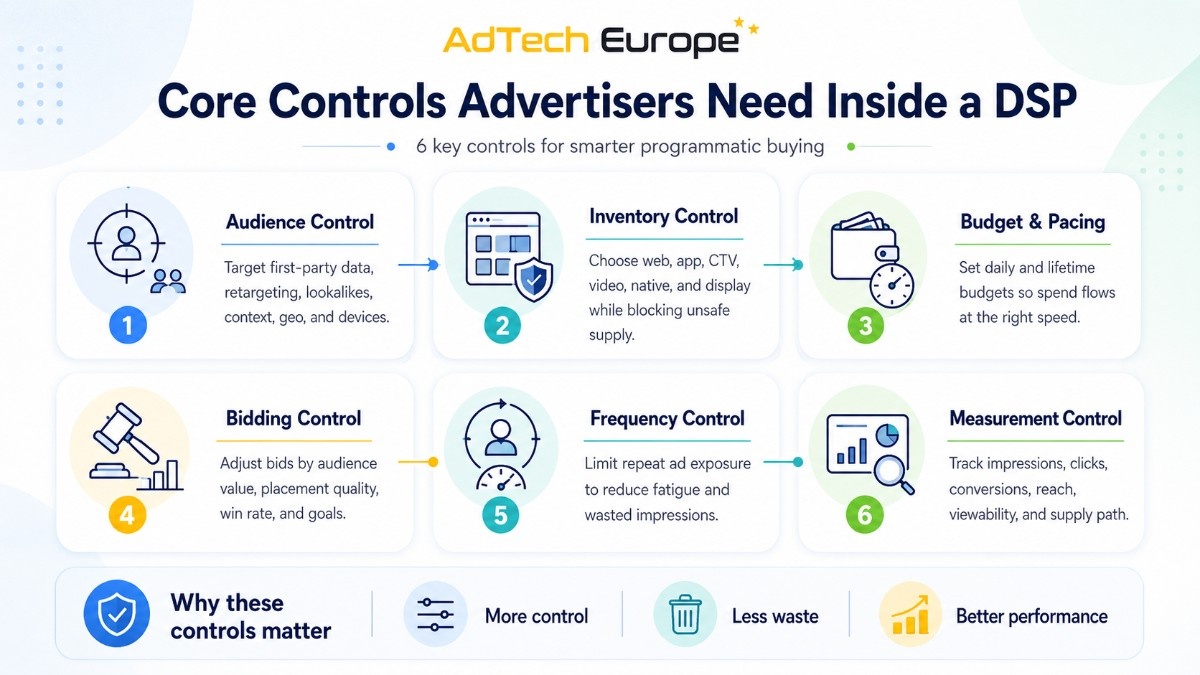
The real value of DSP media buying is control. Advertisers should be able to decide who sees the ad, where it appears, how often it is shown, how much each impression is worth, and when spend should be adjusted.
A strong DSP should give media buyers control across these key areas:
- Audience control: Build and target segments using first-party data, retargeting pools, lookalike audiences, contextual signals, geo data, device type, and campaign behavior.
- Inventory control: Choose where ads can appear across websites, apps, CTV, video, native, and display while blocking low-quality domains, unsafe placements, or unwanted supply sources.
- Budget and pacing control: Set daily, lifetime, campaign, and line-item budgets so spend is delivered at the right speed without wasting budget too early.
- Bidding control: Adjust bid rules based on placement quality, audience value, win rate, viewability, conversion intent, time of day, and campaign goal.
- Frequency control: Limit how often the same user sees an ad to reduce ad fatigue, wasted impressions, and poor user experience.
- Measurement control: Track impressions, clicks, conversions, viewability, cost, reach, frequency, supply path, and placement-level performance from one reporting layer.
These controls help advertisers move from basic media buying to performance-focused buying. A platform with strong planning, execution, and reporting depth gives advertisers better DSP feature depth across the full campaign lifecycle.
Bidding and Budget Logic
Bidding and budget logic decide how a DSP spends money across available impressions. The goal is not only to win auctions, but to win the right auctions at the right price.
A strong DSP should help advertisers manage bidding and spend through clear controls:
- Bid value: Set bids based on audience quality, placement value, conversion intent, device type, viewability, and expected performance.
- Budget pacing: Control how fast daily or lifetime budgets are spent so campaigns do not run out too early or underdeliver.
- Goal-based bidding: Optimize bids toward campaign goals such as reach, clicks, leads, conversions, video completion, or return on ad spend.
- Real-time adjustments: Increase or reduce bids based on live signals like win rate, inventory quality, time of day, location, and user behavior.
- Spend allocation: Move budget toward stronger audiences, creatives, publishers, devices, or deal types as performance data improves.
- Overbidding control: Avoid paying too much for low-value impressions by using bid caps, floor price checks, and supply path data.
Smart bidding helps advertisers reduce wasted spend and focus budget on impressions that are more likely to create value, which matters more in 2026 as U.S. programmatic ad spending is expected to top $200 billion.
With the right smart bidding strategies, media buyers can improve campaign efficiency while keeping stronger control over scale and performance.
Data, Identity, and Targeting
DSPs rely on data to decide which impressions matter. Advertisers can use first-party data, CRM segments, remarketing pools, contextual signals, lookalike audiences, publisher data, and campaign engagement data to improve buying decisions.
As third-party identifiers become less reliable, advertisers need stronger first-party data and privacy-safe targeting. Contextual signals, clean data workflows, and consent-aware audience building help brands reach users without depending only on legacy cookie-based tactics.
When targeting and optimization work together, DSP marketing performance becomes easier to improve across awareness, retargeting, lead generation, and conversion campaigns.
Transparency, Fraud Control, and Supply Paths
Scale is useful only when buyers know what they are buying. A DSP should support supply path optimization, ads.txt, app-ads.txt, sellers.json, SupplyChain object checks, domain lists, app lists, placement reporting, and log-level data where available.
These controls help advertisers reduce hidden fees, unauthorized reselling, spoofed domains, bot traffic, unsafe placements, and duplicate supply. They also help agencies prove where budget went and why certain supply sources were kept, blocked, or adjusted.
Better transparency often leads to campaign performance gains because buyers can move spend away from weak supply paths and toward stronger placements.
When Advertisers Should Own a DSP
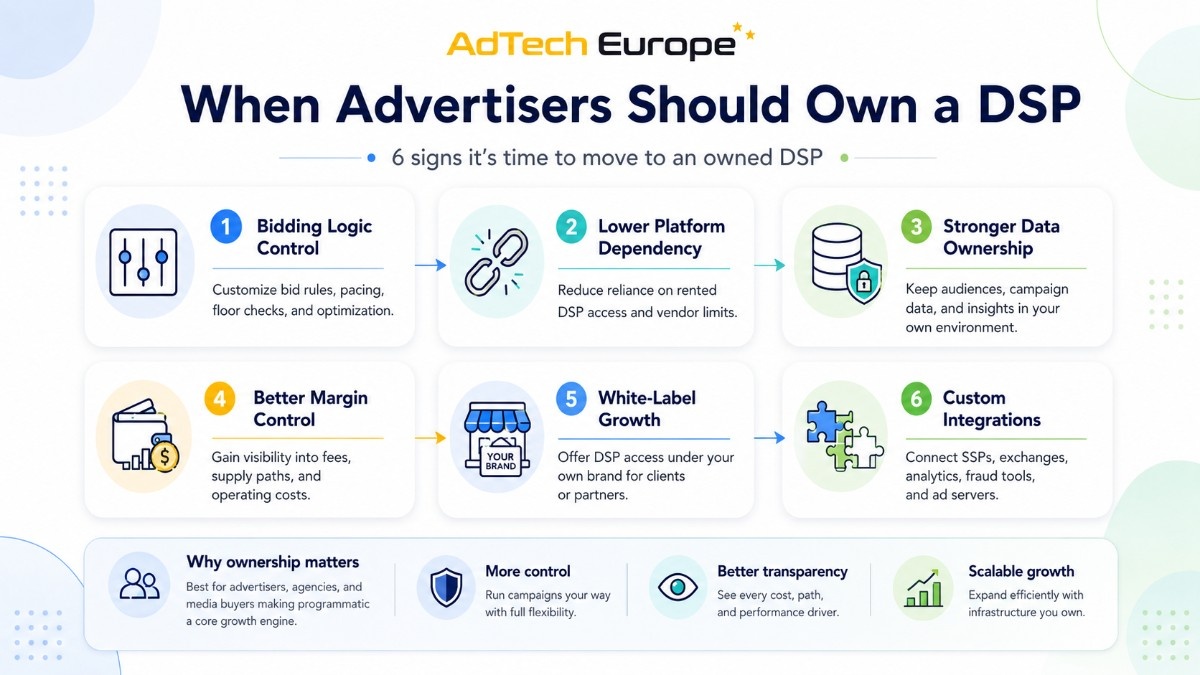
Advertisers should consider owning a DSP when media buying becomes a core part of their growth, not just a campaign activity. At this stage, full platform control can reduce dependency, improve transparency, and support long-term programmatic revenue.
Owning a DSP makes sense when advertisers, agencies, or media buyers need:
- More control over bidding logic: Customize bid rules, pacing, floor price checks, and optimization models instead of relying only on fixed third-party settings.
- Lower platform dependency: Reduce reliance on rented DSP access, external account limits, shared workflows, and vendor-controlled roadmap decisions.
- Stronger data ownership: Keep first-party audiences, campaign data, reporting logic, and performance insights inside a controlled technology environment.
- Better margin control: Manage platform fees, supply integrations, reseller paths, and operational costs with more visibility over where spend goes.
- White-label business growth: Offer DSP access under your own brand for advertisers, agencies, partners, or internal media buying teams.
- Custom integrations: Connect preferred SSPs, exchanges, data partners, analytics tools, fraud filters, ad servers, or private inventory sources.
For growing agencies and programmatic businesses, owned DSP control can turn media buying from a managed service into a scalable technology asset.
Choosing the Right DSP Setup
The right setup depends on business model, technical resources, and revenue goals. A brand may need managed access. An agency may need white-label control. A programmatic company may need source-code ownership and custom supply integrations.
| DSP Setup | Best Fit | Main Advantage |
| Managed DSP | Smaller teams | Easier launch |
| Self-serve DSP | Skilled media teams | More control |
| White-label DSP | Agencies and networks | Branded ownership |
| Custom-owned DSP | Scaling adtech businesses | Full technology control |
For teams that need unique workflows, supply paths, or bidding rules, custom DSP development can create a platform around the business instead of forcing the business around a fixed tool.
Ready to Control DSP Media Buying at Scale?
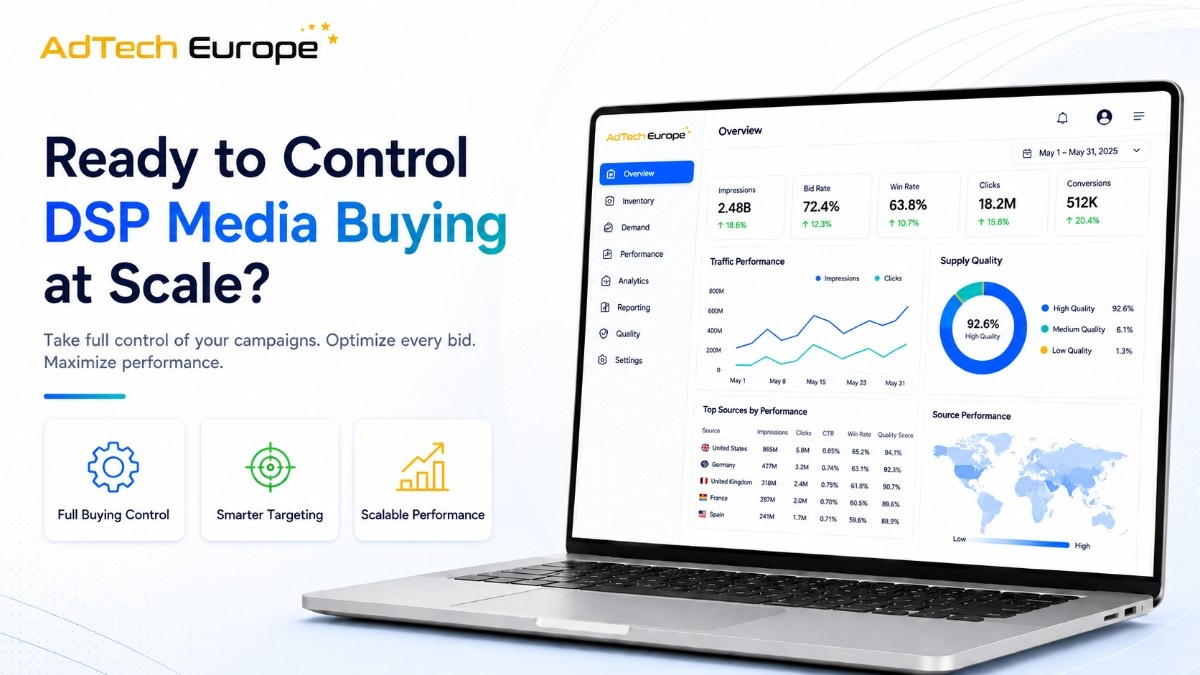
AdTech Europe helps advertisers, agencies, media buyers, ad networks, and DSP owners build or acquire programmatic technology with white-label options, supply integrations, campaign controls, scalable infrastructure, and source-code access.
Whether you want to reduce third-party platform dependency, improve bidding control, launch a DSP business, or scale programmatic revenue, AdTech Europe gives you the technology and support needed to buy media with more confidence.
Start with a DSP strategy session with AdTech EU to discuss the right setup for your programmatic buying goals.
FAQs
How much budget do I need to start DSP media buying?
There is no fixed rule, but DSP buying works best when there is enough budget to test audiences, placements, creatives, and bidding logic.
Is a DSP better than Google Ads?
A DSP is better for programmatic reach across many publishers, exchanges, and channels. Google Ads is useful inside Google-owned inventory and search demand.
Can an agency use one DSP for multiple clients?
Yes. Agencies often use a DSP to manage separate advertisers, budgets, audiences, reports, and campaigns from one platform.
What is the difference between a DSP and an ad server?
A DSP buys media. An ad server delivers creatives, tracks impressions, and measures ad activity.
Does DSP media buying work for B2B campaigns?
Yes. B2B advertisers can use firmographic data, account lists, contextual targeting, retargeting, and publisher deal IDs to reach business audiences.
Can I run CTV campaigns through a DSP?
Yes. Many DSPs support CTV inventory through exchanges, PMPs, and direct supply partners.