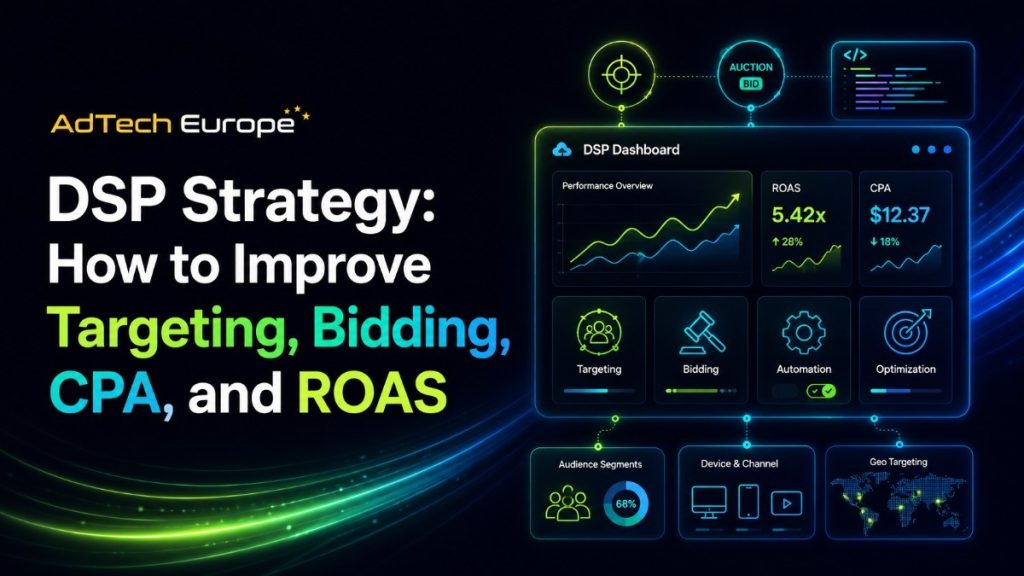
Programmatic campaigns can spend fast, but speed does not always create profit. Many advertisers launch inside a demand-side platform, add broad audiences, trust automated bidding, and expect the system to find buyers. Then CPA rises, ROAS falls, and the team cannot explain where the money went.
The problem is not always the DSP. The problem is often the DSP strategy. If targeting, bidding, conversion tracking, inventory quality, and budget pacing are not connected, the platform optimizes toward weak signals. It may buy cheap impressions, weak clicks, or conversions that do not create revenue.
A strong DSP strategy turns the platform into a controlled performance system. It helps advertisers, agencies, and media buyers decide who to reach, what each impression is worth, when to bid higher, when to stop spending, and how to scale without losing margin.
What Is DSP Strategy?
DSP strategy is the plan behind how a demand-side platform buys media, uses data, sets bids, measures outcomes, and improves performance over time. It connects campaign goals with platform controls, so every targeting rule, bid model, and optimization action supports a clear business result.
A basic setup may get ads live. A strategy makes sure spend moves toward useful impressions, qualified users, cleaner supply, and profitable conversions. Teams that need the wider foundation can align this article with a broader DSP advertising strategy.
| Strategy Layer | What It Controls | Why It Matters |
| Audience targeting | Who sees the ad | Reduces wasted reach |
| Bidding logic | What each impression is worth | Protects CPA and margin |
| Inventory quality | Where ads appear | Improves traffic value |
| Measurement | Which actions count | Trains better optimization |
| Pacing | How budget is spent | Prevents early waste |
| Ownership | Who controls the platform | Improves long-term scale |
Start With the Right Performance Goal
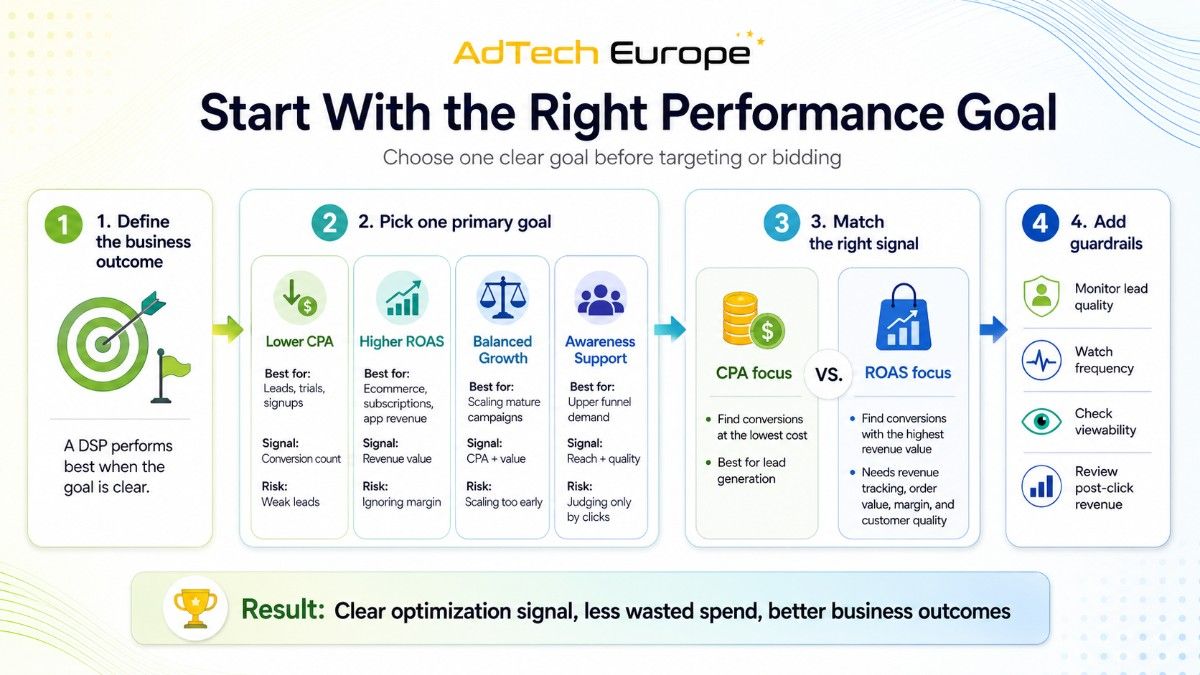
A DSP cannot optimize well when the goal is unclear. Before choosing audiences or bids, define the main performance outcome. For lead generation, the goal may be lower CPA. For ecommerce, subscription, or app revenue, the goal may be stronger ROAS.
CPA and ROAS need different signals. CPA asks the platform to find conversions at the lowest cost. ROAS asks it to find conversions with the highest revenue value. That means revenue tracking, order value, margin, and customer quality matter more in a ROAS-focused campaign.
| Goal | Best For | Main Signal | Common Mistake |
| Lower CPA | Leads, trials, signups | Conversion count | Counting weak leads |
| Higher ROAS | Ecommerce, subscriptions | Revenue value | Ignoring margin |
| Balanced growth | Scaling mature campaigns | CPA and value | Scaling too early |
| Awareness support | Upper funnel demand | Reach and quality | Judging only by clicks |
A useful DSP strategy sets one primary goal and a few guardrails. A campaign can optimize for CPA while monitoring lead quality, frequency, viewability, and post-click revenue. This keeps the DSP from chasing cheap actions that do not help the business.
Improve Targeting With Better Signals
Targeting is not about adding more filters. It is about improving the match between user intent, inventory context, creative message, and conversion value. Too many layers can shrink reach. Too few layers can send budget into low-intent traffic.
A strong targeting plan starts with first-party data. Website visitors, CRM lists, app users, cart abandoners, past buyers, and high-value customers give the DSP stronger signals than generic segments. When these signals are clean, bidding systems can learn faster and waste less.
| Audience Type | Use Case | Optimization Tip |
| First-party users | Retargeting and lookalikes | Segment by recency and value |
| Contextual audiences | Privacy-safe prospecting | Match topics to offer intent |
| Behavioral segments | Scale and discovery | Test against first-party data |
| Exclusion lists | Waste reduction | Remove converters and poor traffic |
| High-value cohorts | ROAS growth | Build value-based lookalikes |
Contextual targeting is also important. If a user is reading content related to the offer, the impression may be valuable even without personal identifiers. This makes contextual rules useful for privacy-aware prospecting and for campaigns with limited first-party data.
For agencies and media buyers, better targeting also depends on access to supply. A DSP with strong quality inventory access can give campaigns more room to test channels, formats, publishers, and exchanges without relying only on one traffic source.
Use Bidding to Control Value, Not Just Cost
Bidding is where strategy turns into money. Every bid tells the platform what an impression is worth. If the bid is too low, the campaign may miss valuable users. If it is too high, the campaign may win impressions that cannot return profit.
The best DSP strategy starts with a bid ceiling based on business value. For CPA campaigns, this means knowing the maximum cost per lead or acquisition. For ROAS campaigns, it means knowing average order value, margin, repeat purchase rate, and expected customer value.
Smart bidding can help, but it needs clear data. A campaign with broken conversion tracking, mixed events, or weak revenue values can train the algorithm in the wrong direction. Teams using smart bidding methods should audit events before increasing automation.
Practical Bidding Rules
Keep bidding simple at the start:
- Use manual or controlled bids while gathering data.
- Separate prospecting and retargeting budgets.
- Raise bids for high-value segments.
- Lower bids for weak placements.
- Cap frequency to avoid overexposure.
- Change targets gradually after learning.
Bid adjustments should follow patterns, not single-day noise. A placement with one bad day may recover. A supply source with repeated poor conversion quality should lose budget. A small audience with high ROAS may deserve higher bids, but only if it can scale without fatigue.
Lower CPA by Fixing the Funnel
A high CPA does not always mean the DSP is buying badly. It can also mean the landing page is slow, the form asks too much, the offer is weak, or the conversion event is too deep for the campaign stage.
To lower CPA, map every step from impression to conversion. Check CTR, landing page visits, bounce rate, form starts, completed conversions, and post-conversion quality. This shows whether the issue is targeting, creative, site experience, or bid pressure.
A practical way to reduce wasted spend is to remove low-quality combinations first. These may include weak devices, poor geos, low-viewability placements, repeated non-converting users, or traffic sources with abnormal click patterns.
CPA also improves when warm and cold users are separated. Pricing-page visitors should not share the same bid, message, or frequency cap as broad prospecting audiences. Each audience has a different intent level and should have its own cost expectation.
Improve ROAS With Revenue-Based Optimization
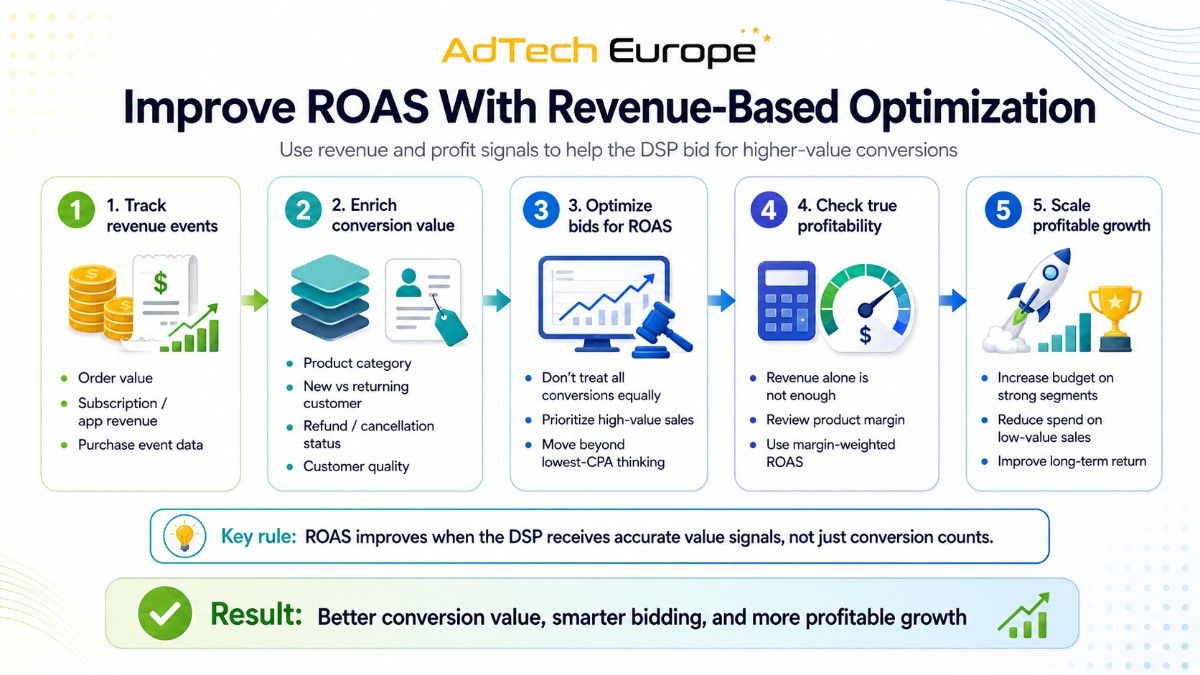
ROAS requires better value data than CPA. If every conversion is treated the same, the DSP cannot tell the difference between a low-value buyer and a profitable customer. That is why ecommerce, marketplace, subscription, and app advertisers need revenue events.
A ROAS-focused DSP strategy should pass order value, product category, new versus returning customer status, and refund or cancellation data where possible.
Google’s official Ads guidance says advertisers that switch from Target CPA to Target ROAS can see 14% more conversion value at a similar return on ad spend, which shows why value-based bidding needs accurate revenue signals.
Margin matters too. A campaign can show high revenue but weak profit if it sells low-margin products. Advanced teams use margin-weighted ROAS, where reporting values conversions by profit contribution instead of only sales value.
For advertisers comparing real outcomes, DSP campaign examples can help connect bid logic, audience choice, creative format, and revenue goals in a more practical way.
Control Inventory Quality and Supply Paths
Inventory quality has a direct impact on CPA and ROAS. Cheap impressions may look efficient, but they can hide low attention, weak viewability, poor placement quality, ad fraud, or users who rarely convert. A low CPM is not useful if it cannot create business results.
A good DSP strategy reviews supply paths, publisher groups, exchange performance, placement quality, and post-bid verification. It also compares cost with downstream quality. Sometimes the better move is paying more for cleaner supply because conversion rate and customer value improve.
Supply-path optimization should not only remove waste. It should identify which paths produce real outcomes. Agencies managing multiple advertisers can use programmatic media buying rules to group supply by vertical, funnel stage, and risk level.
When DSP Ownership Improves Strategy
Using a third-party DSP can be enough for basic campaign access. But advertisers, agencies, media buyers, and ad networks often reach a point where rented access limits growth. They may need more control over data, supply, bidding logic, reporting, pricing, and integrations.
Owning or controlling a DSP can support stronger strategy because the team is not locked into fixed platform rules. It can build custom optimization, connect preferred supply, set its own margins, manage advertisers under its brand, and improve transparency across the buying process.
This matters when performance depends on unique rules. A team may want custom scoring for leads, private supply integrations, special pacing logic, or margin controls. With custom DSP logic, the strategy can fit the business instead of forcing the business to fit the platform.
The DSP ownership case is strongest when the company wants long-term control, not only campaign access. Ownership can reduce dependency and create a platform asset that supports future revenue.
Track the Metrics That Explain Performance
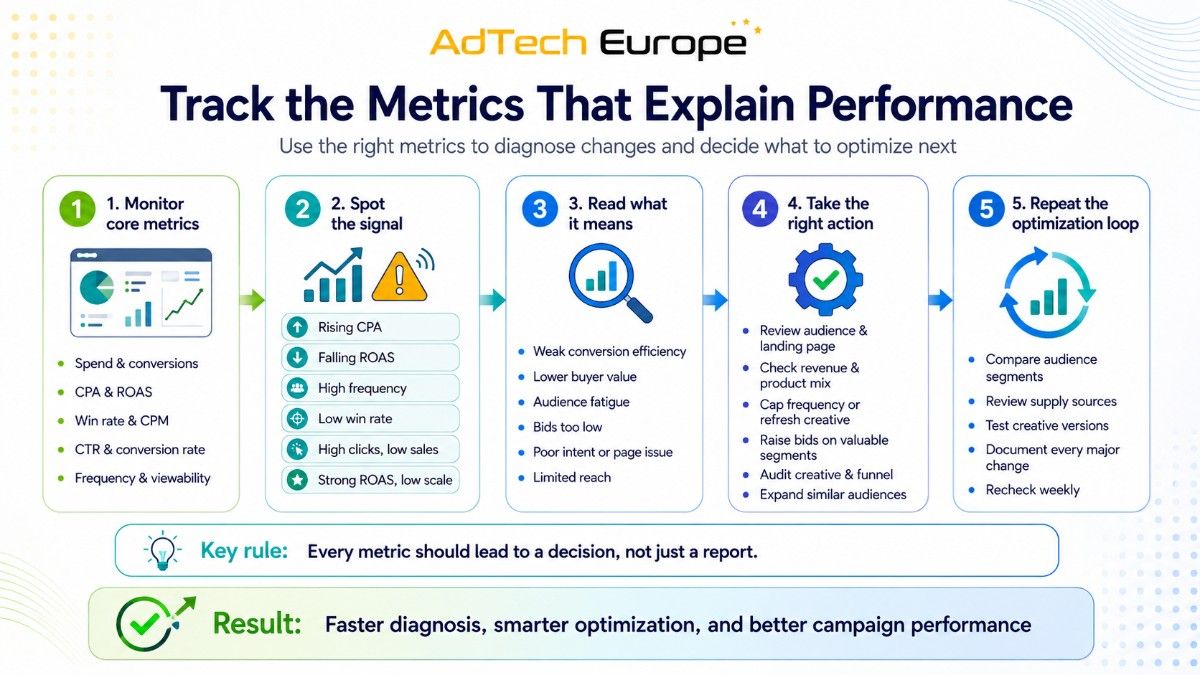
Good reporting does more than show spend and conversions. It explains why performance changed. A DSP strategy should review auction cost, win rate, CPM, CTR, CPC, CPA, ROAS, frequency, viewability, conversion rate, supply source, audience segment, and creative version.
The goal is not to watch every metric equally. The goal is to link each metric to a decision. If frequency is high and CPA is rising, reduce exposure. If win rate is low on high-value users, increase bids. If clicks are high but conversions are low, test the landing page.
| Signal | What It May Mean | Action |
| Rising CPA | Weak conversion efficiency | Review audience and page |
| Falling ROAS | Lower buyer value | Check revenue and product mix |
| High frequency | Audience fatigue | Cap or refresh creative |
| Low win rate | Bids too low | Raise bids on valuable segments |
| High clicks, low sales | Poor intent or page issue | Audit creative and funnel |
| Strong ROAS, low scale | Limited reach | Expand similar audiences |
Measurement should also include incrementality. Retargeting can look strong because it reaches users who may have converted anyway. Holdout tests, geo tests, and audience exclusions help advertisers see whether the DSP is creating new value or only claiming existing demand.
Build a Simple DSP Optimization Loop
DSP strategy works best as a repeatable loop. Each week, review what changed, decide what to keep, remove waste, and scale proven patterns. This keeps optimization practical and avoids random edits that confuse campaign learning.
A simple loop is enough for most teams: check tracking, review audience quality, compare supply paths, adjust bids, refresh creatives, and document the reason for every major change. Over time, this creates a decision history that helps campaigns improve faster.
Teams evaluating platform strength should also review core DSP features before scaling spend. The best strategy will struggle if the platform lacks clean reporting, flexible bidding, reliable integrations, and enough control over inventory.
Ready to Build a Smarter DSP Strategy?
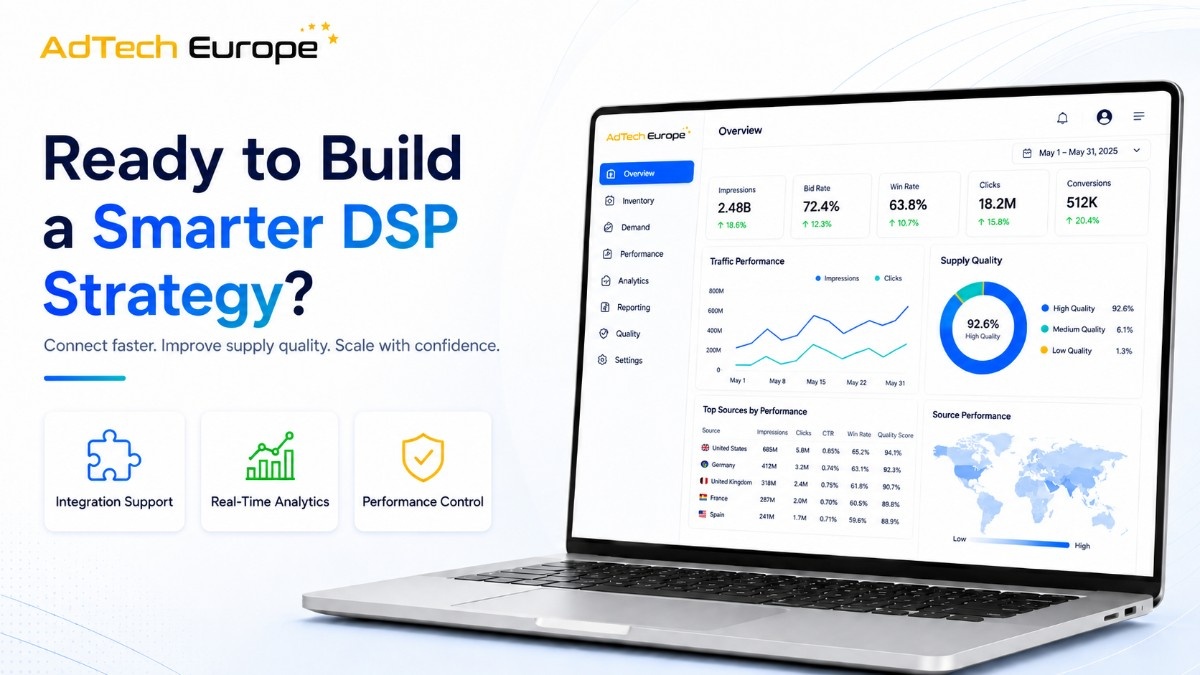
AdTech Europe helps advertisers, agencies, media buyers, ad networks, and DSP owners gain more control over programmatic performance. Whether you want to improve targeting, control bids, reduce CPA, grow ROAS, or operate your own DSP, the right platform structure matters.
With source-code access, white-label branding, programmatic supply integrations, scalable infrastructure, and custom development options, AdTech Europe helps teams move beyond rented access. You can manage advertisers, control bidding logic, improve transparency, and build long-term programmatic revenue with confidence.
For teams planning their next step, you can schedule a DSP strategy meeting with AdTech to clarify whether your business needs campaign optimization, DSP access, or full platform ownership.
FAQs
How long does a DSP need to learn before optimization works?
Most DSP campaigns need enough conversions and stable spend before automated optimization becomes reliable. Avoid major daily changes during the early learning period. Review patterns after meaningful data appears, not after a few clicks.
Should retargeting and prospecting run together?
They should usually be separated. Retargeting users are warmer and often need different bids, creatives, frequency caps, and CPA targets. Mixing them can hide poor prospecting performance.
How often should bids be changed?
Bids should change when there is a clear pattern. Daily bid changes can hurt learning and make results harder to read. Weekly reviews are often enough unless spend is high.
Can a DSP improve performance without third-party cookies?
Yes. DSP performance can improve through first-party data, contextual targeting, clean conversion tracking, supply quality controls, and stronger creative testing. The key is using reliable signals that follow privacy rules.
Why does CPA improve but ROAS stay weak?
This often happens when conversions are cheap but low value. The campaign may generate small orders, weak leads, or customers with poor retention. ROAS needs revenue and quality signals, not only conversion volume.
When should an agency consider owning a DSP?
An agency should consider ownership when it needs more control over margins, data, supply integrations, advertiser management, reporting, or bidding logic. Ownership makes sense when the agency wants to scale a media buying business.