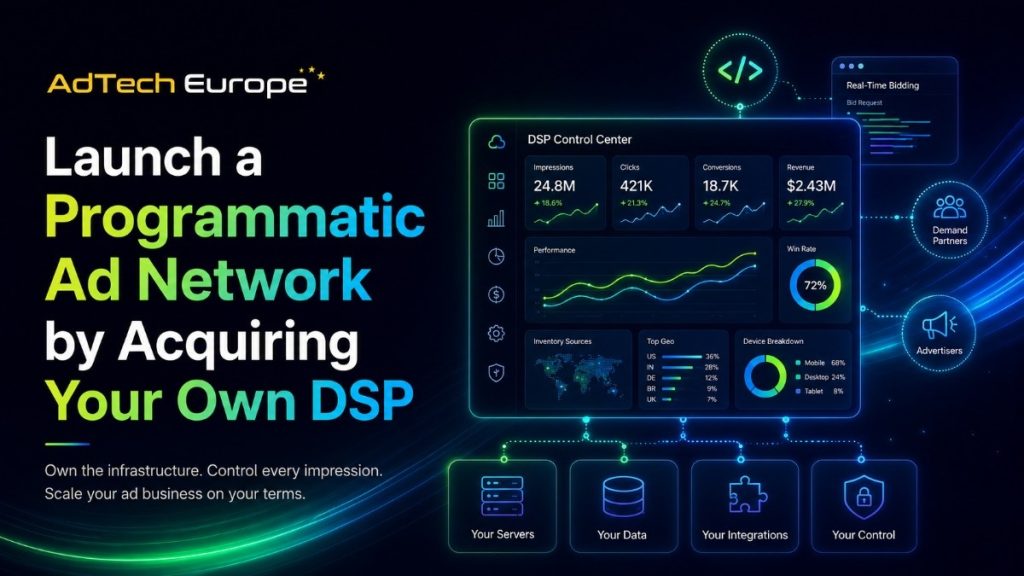
Launching a programmatic ad network sounds powerful, but it can also feel complex. You need advertiser demand, quality inventory, campaign tools, reporting, optimization, and a buying system that can scale without wasting spend.
The problem is that many ad networks depend on rented DSP access, limited white-label platforms, or third-party systems they do not fully control. That can limit margins, data ownership, bidding logic, traffic quality, and long-term growth.
A better path is to launch your programmatic ad network by acquiring your own DSP. For businesses that want to launch programmatic ad network operations with more control, the right platform can help you manage advertisers, connect supply, set custom rules, control media buying, and build a real ad-tech business around owned technology.
What It Means to Launch a Programmatic Ad Network
A programmatic ad network connects advertisers with digital ad inventory through automated buying. Instead of manually choosing every placement, your platform uses a DSP to bid on impressions across websites, apps, display, native, video, and other programmatic channels.
When you own the DSP, your ad network is not just a reseller account. You control the system that powers campaign setup, traffic buying, reporting, optimization, and advertiser management.
The Core Role of Your DSP
Your DSP becomes the operating engine of the ad network. It helps your team create campaigns, manage advertisers, set targeting rules, control bids, approve creatives, and monitor performance from one platform.
It also gives you more control over how budgets are spent. You can decide which supply sources to use, which placements to block, how campaigns are paced, and how results are reported to advertisers.
What Ownership Adds
Owning the DSP gives your business more than a branded dashboard. It gives you control over the platform layer behind the media buying process.
This matters because your team can shape the DSP around your business model, advertiser needs, traffic strategy, and long-term growth plans. For companies that want long-term control, an owned DSP model creates a stronger foundation than relying only on third-party DSP access.
Ad Network vs Owned DSP: The Key Difference
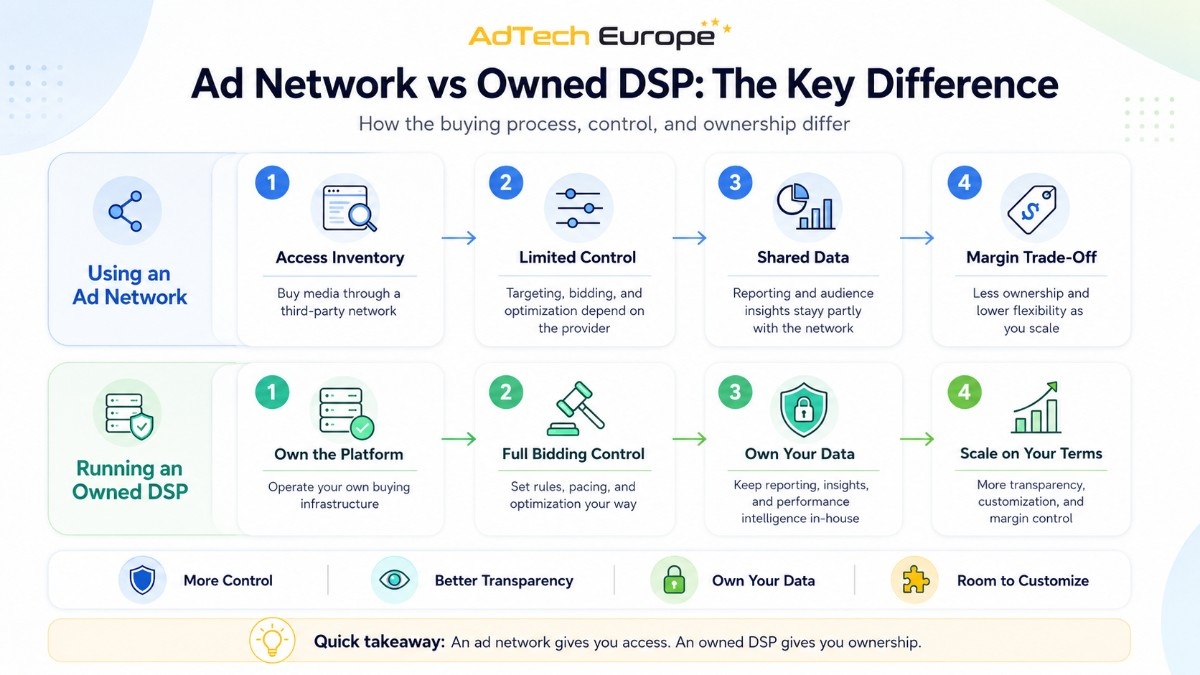
An ad network usually packages media and sells campaign delivery to advertisers. A DSP buys impressions in real time using data, targeting, bid rules, and campaign goals.
When you combine both, you can sell media services while controlling the buying engine behind the results.
| Model | What You Control | Main Limitation |
| Traditional ad network | Advertiser relationships and media packages | Less control over auction-level buying |
| Self-serve DSP access | Campaign setup and budget use | Platform logic and data stay with the vendor |
| White-label DSP | Branding and client-facing interface | Core technology may still be vendor-owned |
| Owned DSP | Technology, data, branding, logic, and integrations | Requires stronger setup and operations |
This is why growing agencies and ad networks often compare DSP access limits before choosing how to scale.
Why Acquiring a DSP Can Be Faster Than Building One
Building a DSP from zero can take years. It requires engineering, ad operations knowledge, bidder infrastructure, reporting systems, campaign tools, supply connections, fraud controls, and compliance workflows.
Acquiring a DSP shortens that path. Instead of starting with a blank system, you begin with working technology and adapt it to your own ad network model.
Step 1: Start With a Working Platform
A ready DSP should already include the core tools needed to run campaigns. This usually means a bidder, campaign dashboard, advertiser accounts, admin controls, reporting, tracking, and budget management.
This helps your team avoid the slow and expensive process of building every feature from the ground up.
Step 2: Adapt the Platform to Your Business
After acquisition, the DSP can be adjusted for your brand, clients, campaign types, and traffic sources. This may include custom dashboards, new pricing models, extra reporting views, or supply integrations.
The goal is not just to own software. The goal is to turn that software into a platform your ad network can operate and scale.
Step 3: Prepare for Launch and Operations
Before going live, your team should confirm ownership terms, technical handover, infrastructure setup, inventory access, support options, and data controls.
The DSP buying process should clearly explain what is included, what can be customized, and what your team needs after launch.
What Your DSP Should Help You Solve
A DSP is not only a campaign dashboard. It should help your ad network buy traffic more efficiently, reduce waste, and give advertisers clearer performance data.
| Business Need | How an Owned DSP Helps |
| Better margin control | You control fees, bid rules, and campaign economics |
| Cleaner traffic buying | You can manage supply sources, blocklists, and quality rules |
| Stronger reporting | You own performance data and client-facing reports |
| Faster scaling | You can add advertisers, campaigns, and inventory sources |
| More platform value | Your DSP becomes a business asset, not only a rented tool |
For agencies, ad networks, and media buyers, the right buyer profile matters because DSP ownership works best when there is already traffic buying experience, advertiser demand, or a clear programmatic growth plan.
Core Components Your DSP Should Have
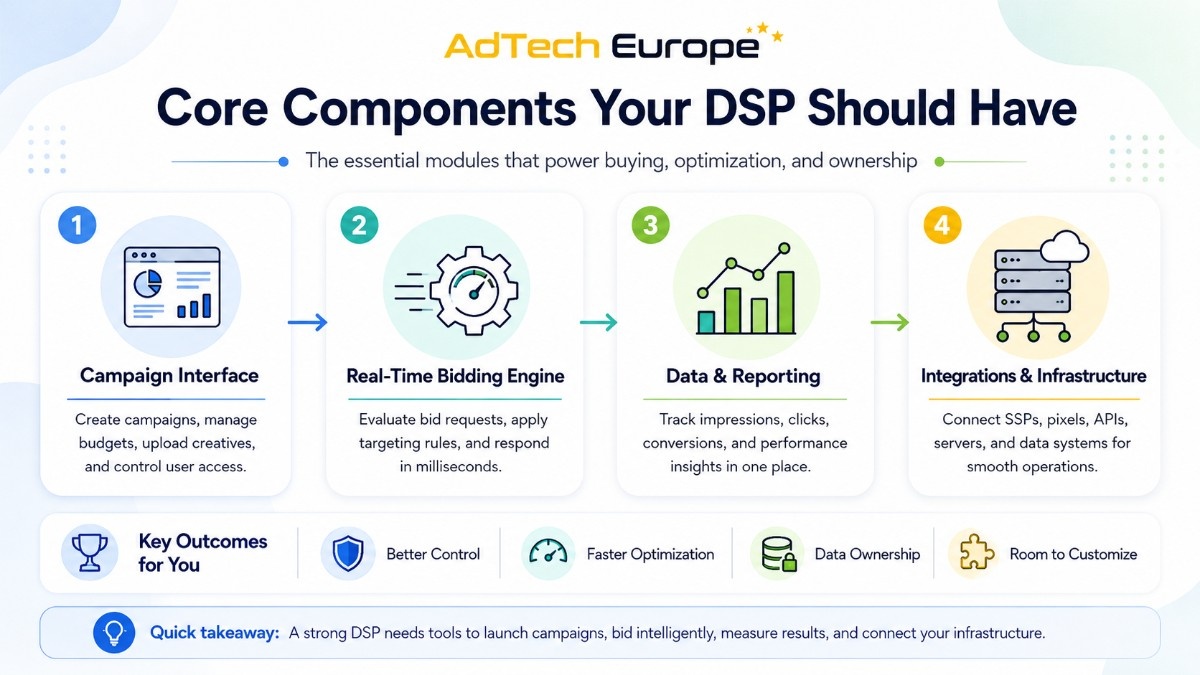
A strong DSP should give your team enough control to manage campaigns, optimize spend, and build trust with advertisers.
Campaign Management
Your platform should let advertisers or internal media buyers create campaigns, set goals, upload creatives, choose targeting, manage budgets, and review results.
The most useful campaign controls include pricing models, daily and lifetime budgets, frequency caps, geo targeting, device targeting, browser targeting, site controls, app controls, and creative approval tools.
Bidder and Optimization Logic
The bidder decides which impressions to buy, how much to bid, and when to stop spending. This is where owned technology becomes valuable.
With source-code control, your team can improve bidding logic, add custom rules, test new optimization methods, and shape the platform around your business goals.
Inventory and Supply Access
Your ad network needs quality programmatic inventory. This can come from SSPs, exchanges, direct publishers, curated supply, or private marketplace deals.
Strong programmatic inventory access helps your network scale without depending on weak or low-quality traffic sources. It also gives you more room to test formats like display, native, mobile app, and video inventory.
What to Check Before Acquiring a DSP
Before you acquire a DSP, check the platform from both a business and technical point of view.
| Area | What to Check |
| Ownership | Do you receive full platform rights or limited access? |
| Code | Is source-code access included? |
| Infrastructure | Can the platform scale with traffic volume? |
| Supply | Are SSP, exchange, or inventory integrations available? |
| Data | Can you own advertiser, campaign, and performance data? |
| Branding | Can the interface match your ad network brand? |
| Reporting | Are reports clear, real-time, and exportable? |
| Compliance | Are privacy, consent, and fraud controls supported? |
| Support | Is technical handover or custom development available? |
A structured DSP acquisition checklist helps reduce risk and makes it easier to compare different platform options.
Owned DSP vs White-Label DSP
A white-label DSP can help you launch quickly under your own brand. It is often easier to start with because the vendor usually manages the core technology, updates, and infrastructure.
But white-label access can also limit your control. In many cases, the vendor still owns the platform, controls the roadmap, sets the rules, and decides how much customization is possible.
An owned DSP gives you more control over the technology, data, integrations, business model, and long-term platform value.
| Comparison Area | White-Label DSP | Owned DSP |
| Branding | Your brand appears on the interface | Full brand control across the platform |
| Technology control | Usually limited | Stronger control over platform logic |
| Source-code access | Often not included | Can be included in the acquisition |
| Customization | Depends on vendor limits | More flexible for custom needs |
| Data ownership | May be shared or limited | Greater control over advertiser and campaign data |
| Vendor dependency | Higher | Lower after setup and handover |
| Long-term value | Mostly access-based | Can become a business asset |
| Best fit | Fast launch with less technical work | Long-term control, margin, and platform growth |
When White-Label Makes Sense
White-label can work well for teams that want a faster launch and do not need deep technical control. It is useful when the main goal is to offer a branded campaign platform without managing the full technology stack.
When Ownership Makes Sense
Ownership is better when you want source-code access, custom bidder logic, stronger margin control, independent supply strategy, and more freedom to build your own programmatic business.
This is why serious programmatic operators often compare white-label limitations before choosing their platform model.
How Your Programmatic Ad Network Makes Money
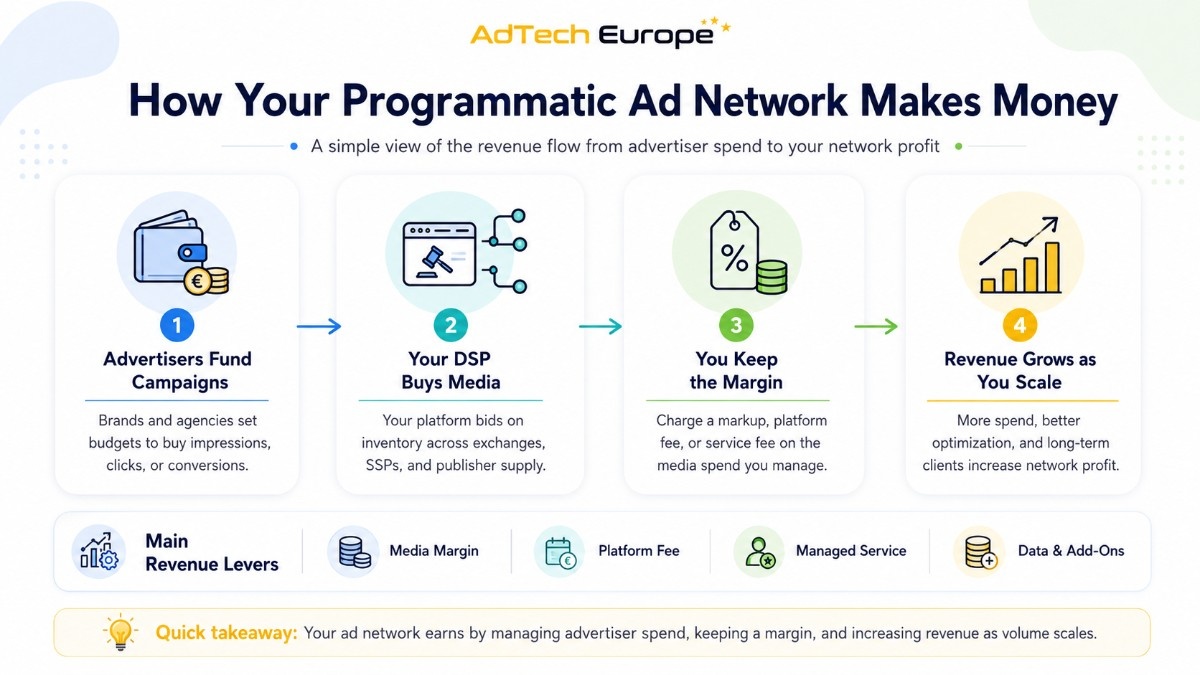
An owned DSP can support several revenue models. The best model depends on your team, clients, traffic volume, and service level.
In 2026, US programmatic ad spending is forecast to top $200 billion, which shows why owning the buying layer can create more room for margin, platform fees, and managed growth.
Media Margin
You buy traffic at one cost and sell campaign delivery with a margin. This is common for managed ad networks and media buying teams.
Platform Access Fees
You give advertisers, agencies, or resellers access to your branded DSP and charge a monthly, usage-based, or seat-based fee.
Managed Service Fees
Your team runs campaigns for clients and charges for strategy, setup, optimization, reporting, and ongoing account management.
Hybrid Model
Many ad-tech businesses combine platform access, media margin, and managed service fees. A strong DSP revenue model should match your advertiser base and operating structure.
Traffic Quality and Transparency Matter
A programmatic ad network must do more than buy cheap impressions. It needs to protect advertiser budgets and show where traffic comes from.
Traffic quality depends on clear supply rules, placement control, invalid traffic filtering, domain-level reporting, and app-level reporting. It also helps to check standards like ads.txt, app-ads.txt, sellers.json, and SupplyChain object when available.
These controls help your team reduce wasted spend, avoid poor-quality supply, and build trust with advertisers.
They also support smarter supply path optimization, where your DSP chooses cleaner and more efficient buying routes instead of buying from every available source.
Practical Launch Roadmap
Keep the launch simple. Start with control, then scale.
Step 1: Define Your Market
Decide who your ad network serves. This could be agencies, local advertisers, affiliate buyers, e-commerce brands, app marketers, or niche verticals.
Step 2: Choose the DSP Ownership Model
Decide whether you need access, white-label, license, or full ownership. If long-term control matters, full DSP ownership is usually the stronger strategic path.
Step 3: Connect Quality Supply
Start with clean, relevant, and scalable inventory. Avoid chasing volume before quality. A smaller pool of trusted inventory is usually better than a large pool of weak traffic.
Step 4: Set Operating Rules
Create rules for campaign approval, prohibited content, fraud checks, budget pacing, client reporting, and traffic quality. These rules help your team stay consistent as more campaigns and advertisers join the platform.
Step 5: Launch With Controlled Spend
Start with a few advertisers or internal campaigns. Track win rate, CPM, CTR, conversions, spend pacing, and traffic quality before scaling.
Ready to Launch Your Programmatic Ad Network?
AdTech Europe helps advertisers, agencies, media buyers, ad networks, and ad-tech businesses acquire and operate their own DSP technology.
If you want to reduce dependence on rented platforms, control your bidding logic, access quality inventory, manage advertisers under your own brand, and build a scalable programmatic business, AdTech Europe can support your move from media buyer to platform owner.
With DSP acquisition, source-code access, supply integrations, infrastructure support, and custom platform work, you can launch a programmatic ad network with more control, better transparency, and stronger long-term growth potential.
FAQs
Is AdTech Europe suitable for agencies and media buyers that want their own DSP?
Yes. AdTech Europe is suitable for agencies, media buyers, ad networks, and ad-tech companies that want more control over bidding, inventory access, advertiser management, reporting, and long-term programmatic growth through their own DSP platform.
What is the fastest way to launch a programmatic ad network?
The fastest way is to acquire or license a ready DSP, brand it for your business, connect supply, and start with controlled advertiser campaigns.
Do I need advertisers before buying a DSP?
You do not need a large advertiser base, but you should have a clear demand plan. This could include agencies, direct brands, affiliates, or internal media buying.
Is owning a DSP better than using a self-serve DSP?
Owning a DSP is better when you need control over data, margins, branding, logic, and integrations. Self-serve access is better for simple campaign buying.
Can an agency launch an ad network with an owned DSP?
Yes. Agencies can use an owned DSP to offer programmatic buying, client dashboards, managed campaigns, and branded platform access.
What inventory should a new ad network start with?
Start with verified display, native, mobile, or video inventory that matches your clients’ goals. Quality matters more than volume at launch.
How much technical knowledge is needed?
You need basic programmatic knowledge and ad operations skills. For deeper platform changes, technical support or custom development is useful.
Can I connect my own traffic sources?
Yes. If the DSP supports supply integrations, you can connect SSPs, exchanges, direct publishers, or curated inventory partners.
What is the biggest risk when launching a programmatic ad network?
The biggest risk is scaling poor-quality traffic too fast. Start with clear rules, trusted supply, transparent reporting, and strong optimization controls.