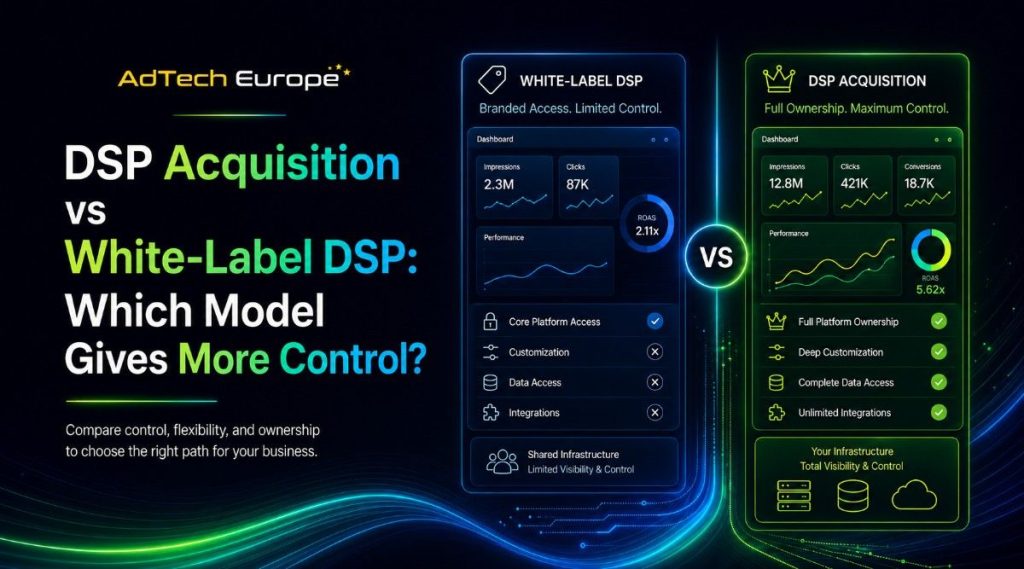
A branded DSP can help you offer programmatic buying under your own name, but branding alone does not always mean control. Many agencies and media buyers later discover that the most important parts of the platform, such as bidding logic, supply access, data ownership, and backend changes, are still controlled by the provider.
This is why DSP acquisition vs white label DSP is a strategic decision, not just a technology choice. White-label DSPs are useful for fast entry and easier setup. DSP acquisition is better suited for businesses that want to own the platform, customize the stack, and build a stronger programmatic asset.
This guide gives you a clear comparison of both models. By the end, you will know which option gives more control, which one fits your current stage, and how to make a smarter decision before investing in a DSP.
DSP Acquisition vs White-Label DSP: Which Option Gives More Control Over Data, Bidding, and Inventory?
A white-label DSP gives branded access to a platform. DSP acquisition gives control over the platform itself. For teams comparing a DSP acquisition model, the key question is simple: do you want to use a platform, or own the technology behind it?
| Control Area | White-Label DSP | DSP Acquisition |
| Branding | Yes | Yes |
| Source code | Usually no | Yes, if included |
| Bidding logic | Limited control | Deeper control |
| Data access | Vendor-defined | Owner-defined |
| Supply integrations | Provider-managed | Can be direct |
| Scaling rules | Provider rules | Owner control |
| Long-term asset value | Lower | Higher |
What Is a White-Label DSP?
A white-label DSP is a ready-made demand-side platform that runs under your brand. You can manage advertisers, launch campaigns, access supply, and use reporting tools without building technology from scratch.
This model works well for fast market entry. It helps agencies and media buyers test demand, serve clients, and create a branded programmatic offer with less technical pressure.
The limit is backend control. Most white-label models do not give full access to the codebase, infrastructure, bidder logic, or raw data systems. You control the brand layer, but not always the core engine.
What Is DSP Acquisition?
DSP acquisition means buying or taking ownership of a working demand-side platform. This can include platform access, admin systems, hosting, supply integrations, onboarding, and source-code access.
The main value is control. You can shape product features, bidding rules, pricing logic, data workflows, advertiser access, and integrations around your own business model.
This makes acquisition attractive for businesses that want to reduce platform dependence and build a real ad-tech asset.
Control Dimensions That Matter Most
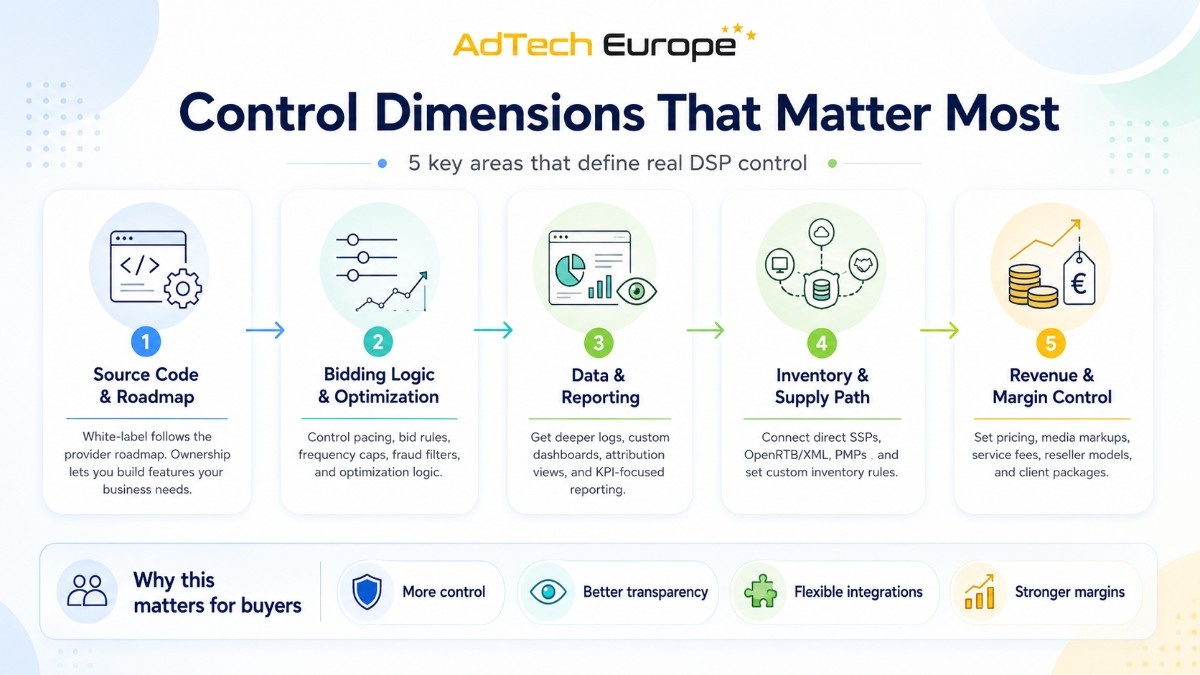
Source Code and Product Roadmap
With a white-label DSP, changes usually depend on the provider’s roadmap. With DSP acquisition, you can build features based on your advertisers, traffic goals, and revenue model.
Bidding Logic and Optimization
Real control is not only about a dashboard. It includes pacing rules, bid floors, campaign algorithms, frequency rules, fraud filters, and optimization logic.
If you own the DSP, you can adjust these systems to match your buying strategy. This is useful when you need stronger control over wasted spend.
Data and Reporting
White-label reporting is often packaged by the vendor. That can work for basic campaign management, but larger buyers may need deeper logs, custom dashboards, attribution views, or BI exports.
An owned DSP gives more room to build reporting around your clients, teams, and KPIs.
Inventory and Supply Path
Both models can give access to programmatic inventory. The difference is control over the supply path.
DSP acquisition can support direct SSP connections, OpenRTB or XML integrations, ADX access, private marketplace deals, and custom inventory rules. This matters for better traffic quality through programmatic supply access.
Revenue and Margin Control
White-label DSPs may include monthly fees, revenue share, usage limits, or provider-side rules. DSP ownership gives more control over media markup, account pricing, managed service fees, reseller models, and custom client packages.
DSP Acquisition vs White-Label DSP: Side-by-Side Comparison Table
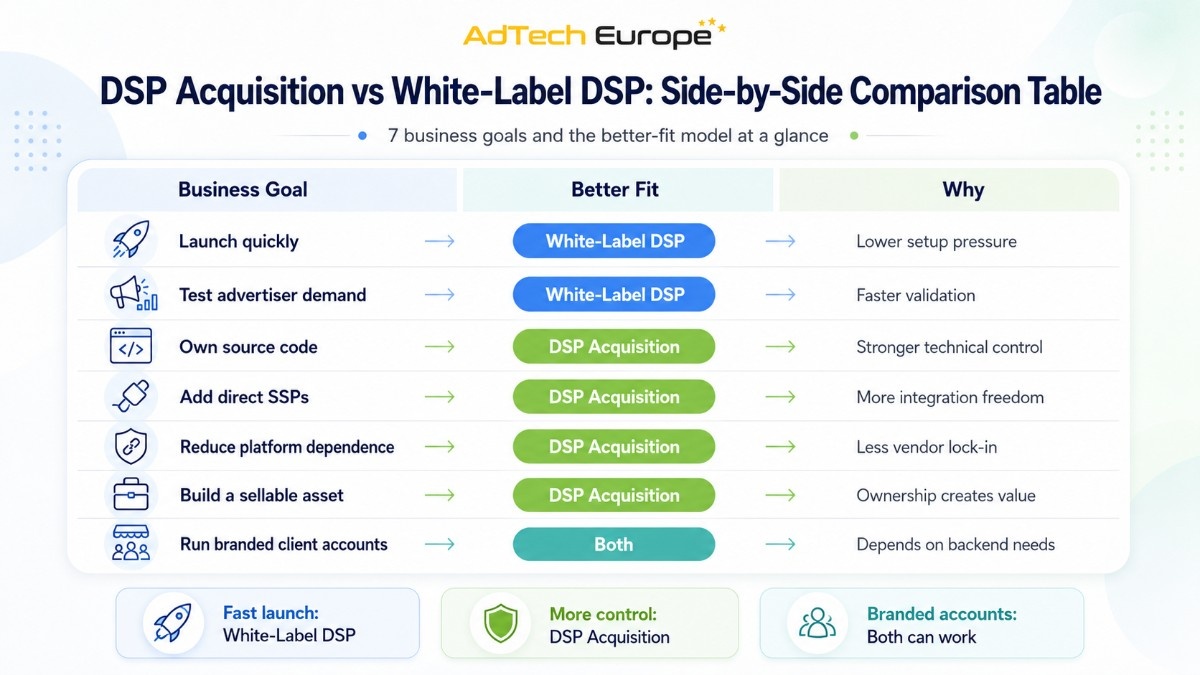
| Business Goal | Better Fit | Why |
| Launch quickly | White-label DSP | Lower setup pressure |
| Test advertiser demand | White-label DSP | Faster validation |
| Own source code | DSP acquisition | Stronger technical control |
| Add direct SSPs | DSP acquisition | More integration freedom |
| Reduce platform dependence | DSP acquisition | Less vendor lock-in |
| Build a sellable asset | DSP acquisition | Ownership creates value |
| Run branded client accounts | Both | Depends on backend needs |
When a White-Label DSP Makes Sense
A white-label DSP is a practical choice when speed matters more than deep control.
This speed matters because worldwide programmatic display ad spending was expected to grow 14.6% in 2025, making fast market entry useful for agencies that want to test demand before investing in full DSP ownership.
It may be the right fit if you:
- Need a fast programmatic launch
- Do not have an internal tech team
- Want to test advertiser demand
- Have moderate media buying volume
- Need branded access, not source-code ownership
- Prefer vendor-managed infrastructure
Many agencies start here before moving into fuller ownership. That path makes sense when growth proves there is enough demand for deeper control through a white-label upgrade path.
When DSP Acquisition Makes Sense
DSP acquisition is a better fit when your business wants control, scale, and long-term margin improvement.
It may be the right fit if you:
- Manage larger ad budgets
- Need custom bidding rules
- Want direct supply integrations
- Need stronger data ownership
- Plan to sell platform access or managed services
- Want technology value, not only campaign access
Before choosing, review the contract, source code terms, support scope, hosting setup, inventory access, and upgrade policy. A clear acquisition review checklist helps reduce risk before money is committed.
Control Terms Buyers Should Ask About
| Term | Why It Matters |
| OpenRTB endpoints | Connect direct programmatic supply |
| XML integrations | Support non-standard supply |
| QPS capacity | Affects traffic volume and bidder load |
| Bidder logs | Help debug spend, wins, and losses |
| Data ownership | Defines who controls campaign learning |
| Reseller rights | Decides if you can sell platform access |
| Hosting control | Affects scaling, uptime, and security |
These details matter more than the logo on the dashboard. A DSP can look branded but still leave the most important control points outside your business.
Final Verdict: Which Model Gives More Control?
White-label DSPs give control over branding, client access, and daily campaign management. They are useful for fast entry and lower technical pressure.
DSP acquisition gives more control over the platform engine, source code, supply strategy, bidding logic, data, pricing, and long-term business value. It is better for teams that want to own the technology layer, not just use it.
The right choice is not “cheap vs expensive.” It is access vs ownership. If you only need a branded tool, white-label may be enough. If you want a strategic programmatic asset, DSP acquisition is the stronger model.
Ready to Own Your Programmatic DSP?
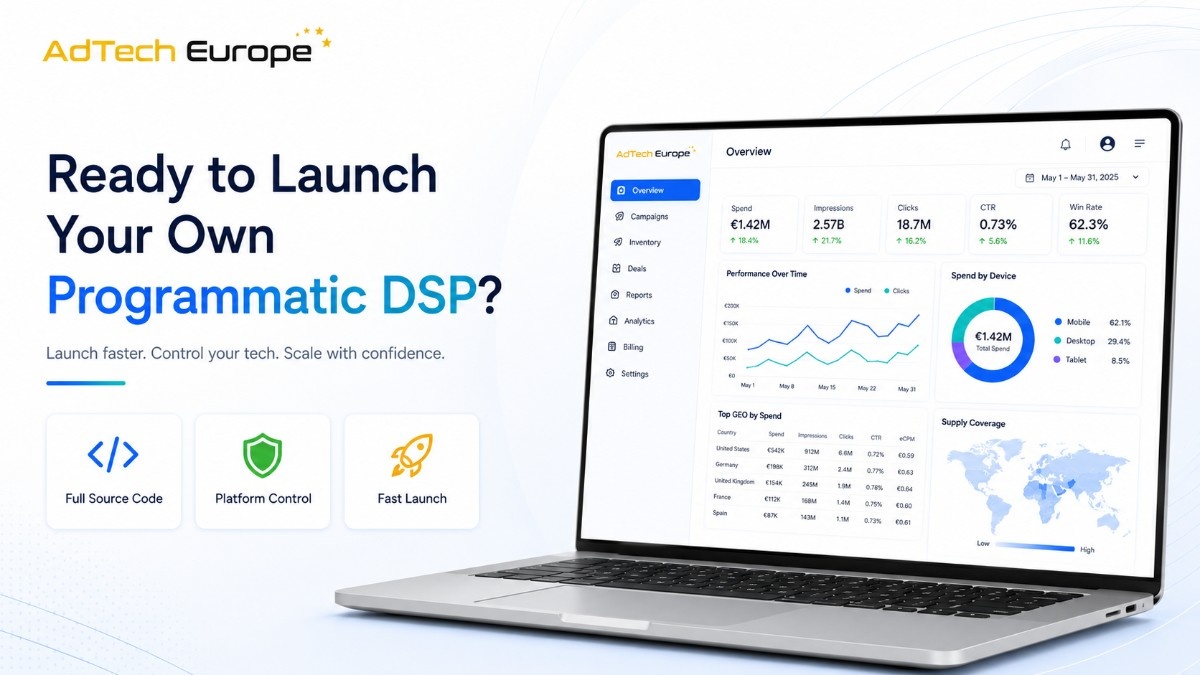
AdTech Europe helps advertisers, agencies, media buyers, ad networks, and DSP owners acquire a fully owned DSP with source-code access, white-label branding, programmatic supply integrations, and scalable infrastructure.
Whether you want to launch your own DSP business, reduce dependence on third-party platforms, control your bidding logic, or build long-term programmatic revenue, connect with AdTech Europe for the technology, integrations, transparency, and ownership needed to operate your own DSP with confidence.
A structured DSP launch process can help your team move from agreement to setup, testing, supply activation, and controlled campaign scaling.
FAQs
Does white-label DSP mean I own the platform?
No. You may own the branding and client relationship, but the core technology is usually controlled by the provider.
Can I move from white-label DSP to DSP acquisition later?
Yes, if the provider supports migration or ownership transfer. Check data, domains, contracts, and integration rights first.
Do I need developers after buying a DSP?
Not always for daily use. Developers are helpful for custom features, integrations, security work, and deeper platform changes.
Which model can reduce wasted spend faster?
White-label can help you start fast. DSP acquisition can reduce waste over time through custom bidding, data, supply rules, and reporting.
Can an acquired DSP support self-serve and managed-service clients?
Yes, if the platform supports account roles, permissions, billing rules, and admin controls.
What should I check before signing a DSP acquisition deal?
Check source code rights, hosting, support, upgrades, supply integrations, data ownership, reseller rights, security, and total operating cost.
Is source code enough to run a successful DSP?
No. You also need hosting, supply access, QA, reporting, support, campaign operations, and a clear revenue model.
Why should businesses choose AdTech Europe for DSP acquisition?
AdTech Europe helps advertisers, agencies, media buyers, and ad-tech companies acquire a DSP with ownership-focused features such as source-code access, white-label branding, programmatic supply integrations, and scalable infrastructure.
Does AdTech Europe support both DSP ownership and white-label DSP needs?
Yes. AdTech Europe supports businesses that want branded DSP access as well as companies looking for deeper ownership, custom development, inventory connections, and long-term control over their programmatic platform.