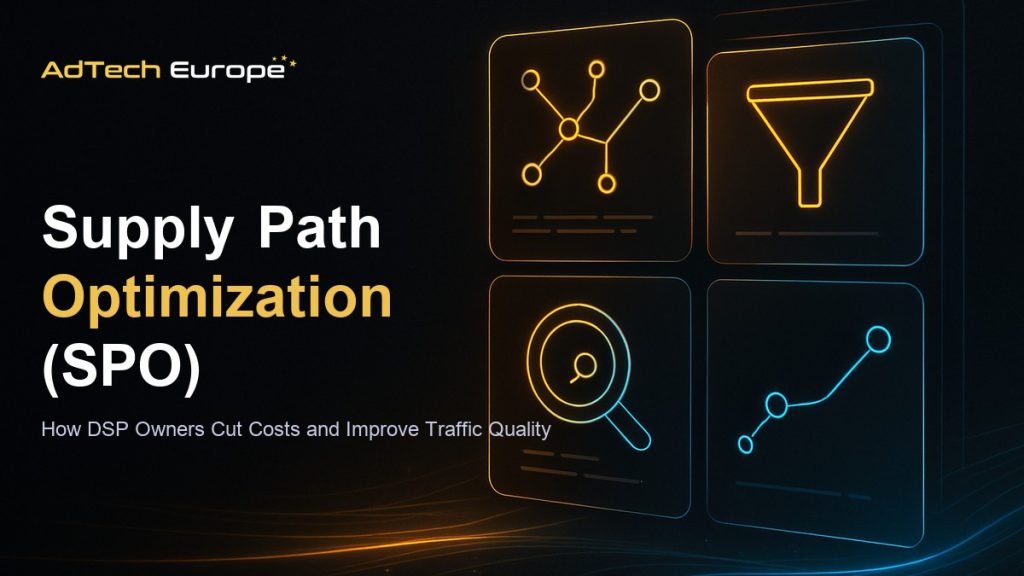
A single impression rarely travels a straight line from publisher to advertiser. It often passes through two, three, or five different supply-side platforms before it ever reaches a DSP’s auction, each one taking a cut and adding a few milliseconds of latency. Media buyers see the end result as a line item cost per impression, with no visibility into how many hands that impression passed through on the way.
That invisible path is expensive. The more resellers and duplicate connections sit between a DSP and the original publisher, the more fees stack up before the ad ever renders, and the harder it becomes to tell a legitimate impression from an inflated or fraudulent one. Two DSPs can bid on the exact same ad slot through entirely different supply paths and pay very different prices for it.
Supply path optimization, or SPO, is how DSP owners find and fix that problem. This guide explains what supply path optimization means, why programmatic supply paths get bloated in the first place, and the practical steps DSP owners take to cut wasted spend and improve traffic quality without reducing their access to inventory.
What Is Supply Path Optimization?
Supply path optimization is the process of identifying which route a bid request travels from publisher to DSP, and choosing the shortest, cleanest, most cost-effective route available for each piece of inventory. A supply-side platform connects publisher inventory to demand, but the same ad slot can be offered to a DSP by more than one SSP at once, sometimes through direct integration and sometimes through a chain of resellers that each repackage and re-list it.
SPO is not about buying less inventory. It is about buying the same inventory through the path that costs the least, carries the least fraud risk, and gives the DSP the clearest signal about where the impression is actually going to render. A DSP that runs SPO well ends up paying less for equivalent traffic while improving the quality of what it wins.
Why Programmatic Supply Paths Get Bloated
Supply paths grow complicated because there is money to be made at every hop. A publisher connects to several SSPs to maximize demand. Some of those SSPs resell inventory to other SSPs to fill gaps. Ad networks aggregate inventory from multiple sources and resell it again under their own listing. By the time a bid request reaches a DSP, it may have already passed through two or three intermediaries, each one adding a margin.
This is not automatically a problem. Reselling can genuinely extend a DSP’s reach into inventory it would not otherwise see. The problem shows up when the same ad slot arrives at the DSP’s auction more than once, through different paths, at different prices, and the DSP has no way to tell that it is looking at duplicate inventory. Left unmanaged, a DSP connected to too many overlapping SSPs and ad networks ends up bidding against itself and paying reseller markup on top of it.
” alt=”Infographic showing a bid request traveling through publisher, reseller, ad network, and DSP hops in a programmatic supply path” width=”1200″ height=”675″ />
The Real Cost of an Unoptimized Supply Path
A bloated supply path costs a DSP owner in three ways: higher effective price per impression, reduced visibility into fraud, and wasted queries per second on duplicate auctions. The table below breaks down what each symptom looks like in practice and what it typically costs.
| Symptom | What causes it | Cost to the DSP |
| Duplicate bid requests | Same ad slot offered by multiple SSPs at once | Wasted auction capacity, inflated win price when the DSP bids against itself |
| Reseller markup stacking | Bid request passes through two or more intermediaries | Higher effective CPM for the same inventory a direct path would offer cheaper |
| Low domain transparency | Resold inventory arrives without a clear publisher domain or app bundle ID | Harder brand safety checks, higher risk of buying misrepresented traffic |
| Latency added per hop | Each intermediary adds routing time before the bid request reaches the DSP | Missed auction deadlines, lower win rate on time-sensitive inventory |
How DSP Owners Run Supply Path Optimization
Supply path optimization is an ongoing operational habit, not a one-time setup step. DSP owners who do it well follow a similar sequence:
- Audit every SSP and ad network connection and map which ones offer overlapping inventory from the same publishers.
- Compare the win price for the same publisher domain or app bundle across different supply sources to spot reseller markup.
- Prioritize direct SSP integrations over multi-hop reseller paths whenever a direct connection is available.
- Monitor win rate, fill rate, and fraud signals per supply source, not just in aggregate.
- Cut or deprioritize supply sources that consistently show low transparency, high latency, or duplicate inventory.
None of these steps require reducing the total number of SSP connections. AdTech Europe DSPs come with 1,000+ SSP integrations built in, which gives DSP owners enough overlapping supply to compare paths and choose the cleanest one rather than being stuck with whatever a single reseller offers.
SPO and Ad Fraud: Why They Are Connected
Every extra hop in a supply path is an extra place where inventory can be misrepresented. A reseller can relabel a low-quality app as a premium one, spoof a domain, or bundle invalid traffic in with legitimate impressions, and a DSP buying several layers downstream has no direct way to verify what it is actually purchasing. This is a major reason traffic quality and supply path length are closely linked.
Shortening the supply path is one of the most effective, and most overlooked, forms of ad fraud protection. A direct SSP integration carries a verifiable publisher domain, app bundle ID, and seller ID that a DSP can check against ads.txt and sellers.json records. A four-hop reseller chain makes that same verification far harder, which is exactly the kind of path bad actors prefer to hide in.
” alt=”Infographic comparing a direct SSP supply path to a multi hop reseller supply path for programmatic advertising” width=”1200″ height=”675″ />
Measuring SPO: Which Reporting Metrics to Watch
Supply path optimization is only real if it shows up in the numbers. DSP owners track it primarily through win rate and effective CPM broken out by supply source, comparing the same publisher inventory across different paths. A supply source with a lower win rate and a higher win price than a direct alternative is a strong candidate to deprioritize.
This is where DSP reporting metrics like win rate, bid rate, and CPM stop being campaign-level summaries and become supply-path diagnostics. Platform owners who can filter these metrics by SSP connection, rather than only by campaign, are the ones who can actually run SPO instead of just talking about it, turning supply path decisions into something a team can act on weekly rather than guess at once a quarter.
Why SPO Is Easier When You Own Your DSP
Supply path optimization requires two things that are hard to get on a rented, self-serve platform: raw, source-level reporting data, and the ability to actually add or remove SSP connections. On many self-serve DSPs, supply source data is abstracted away entirely, and advertisers only see a blended cost per impression with no way to trace which path it came through.
DSP owners who run their own platform through white label DSP, license, or full acquisition ownership get source-level reporting by default and can adjust which SSPs and ad networks are prioritized without waiting on a third-party platform’s roadmap. Combined with unlimited QPS scaling, that means adding a cleaner direct SSP connection never means throttling an existing one just to make room for it.
Common Supply Path Optimization Mistakes to Avoid
Most SPO mistakes come from treating it as a one-time cleanup instead of a recurring check. Supply paths change constantly as SSPs add new reseller relationships and publishers switch monetization partners, so a path that was direct last quarter can quietly become a three-hop reseller chain without anyone noticing.
- Treating SPO as a one-time audit rather than a recurring review, so newly added reseller hops go unnoticed.
- Cutting supply connections aggressively without comparing win rate and price data first, which can shrink inventory access more than it saves.
- Looking only at blended, campaign-level metrics instead of breaking win rate and CPM out by individual supply source.
- Assuming a lower CPM automatically means a better path, without checking whether that inventory is also lower quality or higher fraud risk.
- Ignoring latency as a factor, even though a slow supply path can lose auctions before a bid is ever submitted, regardless of price.
The common thread across these mistakes is treating supply path decisions as a cost-cutting exercise instead of a quality and transparency exercise. The DSP owners who get the most out of SPO are the ones who use it to understand their inventory better, not just to shave a few cents off CPM.
Ready to Clean Up Your Supply Paths?
” alt=”AdTech Europe dashboard image promoting DSP ownership with direct SSP supply path visibility and reporting” width=”1200″ height=”675″ />
AdTech Europe helps agencies, ad networks, and media-buying teams own a DSP with source-level reporting built in from day one, so every supply path decision is based on real win rate and CPM data instead of a blended average. Whether the goal is a fully managed white label platform, a licensed build, or full source code acquisition, the underlying reporting and SSP connections work the same way.
If wasted spend on duplicate or resold inventory is a recurring problem, schedule a programmatic strategy meeting to walk through current supply connections and see where a shorter, cleaner path would cut costs.
FAQs
What is supply path optimization in simple terms?
Supply path optimization is choosing the shortest, most direct route for a bid request to travel from publisher to DSP, instead of buying the same inventory through a longer chain of resellers that each add cost and reduce transparency.
Does supply path optimization mean buying from fewer SSPs?
No. SPO is about choosing the best path to the same inventory, not reducing the number of connections. A DSP with more SSP integrations has more paths to compare and more room to pick the cleanest one.
How does supply path length affect ad fraud risk?
Each additional hop in a supply path makes it harder to verify the original publisher domain or app bundle ID. Shorter, more direct paths are easier to check against ads.txt and sellers.json records, which makes fraud and misrepresentation harder to hide.
What is the difference between a direct SSP path and a reseller path?
A direct path connects the DSP straight to the SSP that has the original relationship with the publisher. A reseller path routes the same inventory through one or more additional intermediaries, each adding a markup and reducing visibility into where the impression actually renders.
Which metrics show whether SPO is working?
Win rate and effective CPM broken out by individual supply source are the clearest signals. If one path consistently shows a lower win rate and higher price than another path for the same publisher inventory, it is a strong candidate to deprioritize.
Can a self-serve DSP run supply path optimization?
Only to a limited degree. Most self-serve platforms show a blended cost per impression without source-level detail, which makes it difficult to identify which specific supply paths are inflating costs or carrying fraud risk.
Why does supply path optimization matter more for DSP owners than for advertisers using a self-serve platform?
DSP owners see the raw, source-level bid data and can directly add, remove, or reprioritize SSP connections. Advertisers on a rented self-serve platform depend on that platform’s own SPO decisions and usually cannot see or change the underlying supply paths themselves.