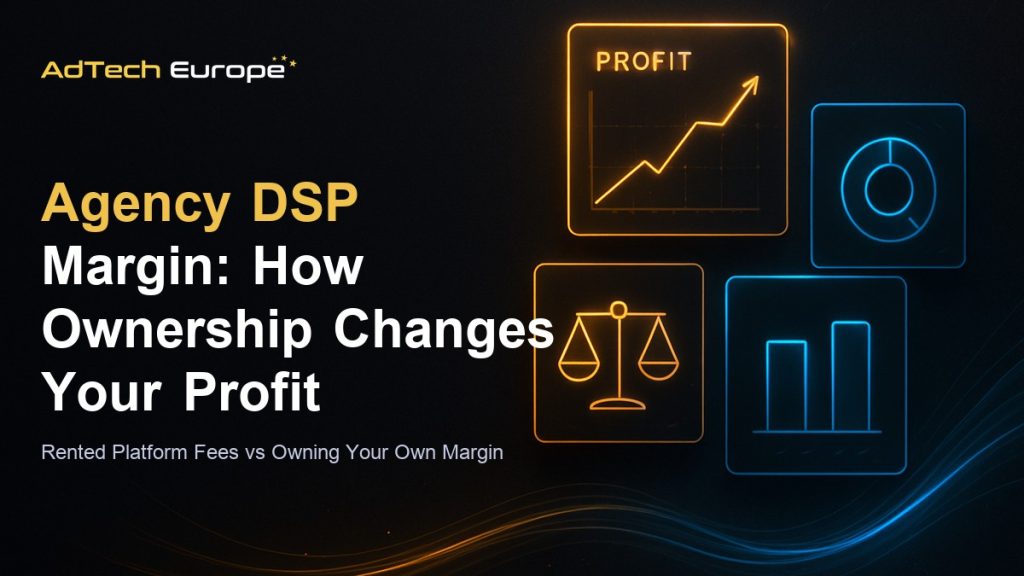
Most agencies running programmatic campaigns think about margin the way they think about any other line item: media cost on one side, client billing on the other, and whatever is left over in between. But the platform sitting underneath that spend has its own cost structure, and on a rented self-serve seat, that structure is built to take a cut of every dollar the agency moves, not just the dollars it keeps.
That distinction rarely shows up on a rate card. It shows up months later, when campaign volume grows, the platform fee grows right along with it, and the agency realizes its margin ceiling was set by someone else’s pricing model the whole time. The bigger the agency gets on a rented platform, the more of its own growth it hands back in fees.
This guide breaks down how agency margin actually works on a rented DSP seat, what changes in the cost structure when an agency owns its own platform instead, and how to work out, in concrete terms, when ownership starts paying for itself.
How Agency Margin Works on a Rented DSP Seat
On a rented, self-serve DSP, the platform typically earns its revenue as a percentage of the media spend that flows through it, sometimes layered with a minimum monthly commitment or a revenue share on top of a base fee. That model works fine for the platform: more agency spend means more platform revenue, automatically, with no extra sales effort required.
For the agency, the same structure works in reverse. Every dollar that goes to the platform fee is a dollar that never becomes agency margin, no matter how efficiently the campaign was run or how much value the agency added on top of the media buy. An agency that gets better at buying media doesn’t shrink its platform fee. It just moves more dollars through the same percentage.
This is why margin on a rented seat tends to plateau even as an agency’s book of business grows. Client billing can increase, but the platform’s cut increases in step with it, so the agency’s own margin stays capped by a fee structure it does not control and, in many cases, cannot even fully see.
The Cost Layers Between Media Spend and Agency Profit
A rented seat rarely charges just one fee. Most agency margin gets absorbed across several layers stacked between the media dollar and the agency’s own profit. The table below breaks down where those layers typically sit.
| Cost layer | How it works | Effect on agency margin |
| Platform fee | A percentage of media spend charged by the DSP on every campaign | Scales up automatically as the agency grows, capping margin at scale |
| Minimum spend commitment | A required monthly spend floor to keep seat access or preferred pricing | Forces spend even in slow months, or triggers penalty pricing below the floor |
| Markup ceiling | A cap, formal or informal, on how much the agency can mark up media on top of the platform’s own fee | Limits how much of the agency’s added value can convert into billable margin |
| Reporting and support tiers | Deeper reporting access or dedicated support sold as a paid add-on | Adds cost just to get the visibility needed to defend the margin the agency already has |
None of these layers are hidden fees in a deceptive sense. They are simply how a platform that rents out seat access recovers its own cost and generates its own profit. The issue for an agency is that these layers all sit on top of the media dollar before agency margin is even calculated.
What Changes When an Agency Owns Its DSP
Owning the platform, through a white label DSP, a license, or a full source-code acquisition, replaces a variable, spend-linked fee with a fixed platform cost. That single change restructures agency margin from the ground up.
As a hypothetical illustration: an agency running $80,000 a month in media spend through a rented seat that charges a 10% platform fee is paying $8,000 a month in platform costs, whether the campaigns are performing well or not, and that number keeps climbing as spend grows. At AdTech Europe’s published white label pricing of $500 a month plus a $1,000 setup fee, the same agency’s platform cost stays fixed no matter how much spend moves through it. The percentage that used to go to the rented seat becomes agency margin instead, or gets reinvested into the client relationship.
The mechanism is simple: a fixed cost divided by a growing spend base gets cheaper, as a percentage, with every dollar of growth. A variable fee tied to spend does not. That is the entire difference between a margin structure that improves with scale and one that stays flat no matter how much the agency grows.
” alt=”Infographic comparing a rented DSP cost structure that scales with spend to an owned DSP cost structure with a fixed platform fee” width=”1200″ height=”675″ />
Where the Break-Even Point Usually Sits
Because a rented platform fee is a percentage of spend and an owned platform’s cost is fixed, there is always a spend level where the two lines cross. Below that level, renting can be cheaper in absolute dollars. Above it, owning is cheaper, and the gap widens every month spend keeps growing.
The exact crossover point depends on the fee percentage a given rented seat charges and which ownership tier an agency compares it against, so it is worth working out with real numbers rather than assuming. The comparison matters most for agencies whose spend is trending upward, since a rented fee structure that felt manageable at last year’s volume can quietly become the single largest cost on the books a year later. A closer look at what a DSP actually costs across white label, license, and acquisition pricing is the fastest way to run that math for a specific agency’s spend level.
Margin Control Beyond the Platform Fee
Platform fees are the most visible piece of agency margin, but they are not the only one. Owning the DSP also gives an agency direct control over two other cost levers that a rented seat usually keeps out of reach.
- Supply-side costs: an owned DSP lets an agency run its own supply path optimization, cutting reseller markup on inventory instead of buying whatever path a rented seat’s default settings route through.
- Reporting depth: source-level DSP reporting metrics like win rate and effective CPM, broken out by supply source and campaign, let an agency prove its margin to clients instead of relying on a blended number handed down by the platform.
Both of these compound the fixed-cost advantage described above. A lower cost per impression and clearer proof of value both widen the gap between what a client pays and what the agency spends to deliver it, on top of the platform fee savings alone.
Which Ownership Model Fits Which Agency Size
Not every agency is ready for the same ownership tier, and the right choice depends mostly on current spend volume and how much control the agency wants over the underlying technology.
| Agency stage | Typical fit | Why |
| Growing agency, testing ownership | White label DSP | Low fixed cost, month-to-month, live within 24 hours, no source code to manage |
| Established agency, steady volume | DSP license | One-time cost replaces an ongoing monthly fee, licensed ownership with deeper customization |
| Large agency or ad network | Full DSP acquisition | Full source code, unlimited customization, resale rights available for building a separate revenue stream on top of the core agency business |
Agencies weighing this decision against staying on a rented seat should also read how a self-serve DSP compares to an owned DSP beyond the cost question alone, since control over supply, reporting, and roadmap all factor into the same decision.
” alt=”Infographic showing three DSP ownership tiers for agencies: white label DSP, DSP license, and full DSP acquisition” width=”1200″ height=”675″ />
Common Agency Margin Mistakes When Evaluating DSP Ownership
Agencies that compare renting to owning purely on sticker price often miss the parts of the decision that matter most for long-term margin.
- Comparing a rented seat’s monthly fee to an ownership model’s total price without adjusting for current or projected spend volume.
- Ignoring minimum spend commitments and markup ceilings when calculating what a rented seat actually costs today.
- Treating platform cost as the only margin lever, while ignoring supply path and reporting control as separate sources of savings.
- Underestimating how much a rented seat’s percentage fee will cost once agency spend doubles or triples, instead of pricing the comparison at today’s volume only.
- Choosing an ownership tier based on budget alone rather than matching it to current spend and how fast that spend is growing.
The agencies that get this right treat the platform decision as a margin decision, not just an operating cost line, and revisit it whenever spend volume shifts meaningfully.
Ready to Take Control of Your Agency’s Margin?
” alt=”AdTech Europe dashboard image promoting DSP ownership for agencies to control platform costs and margin” width=”1200″ height=”675″ />
AdTech Europe helps agencies, ad networks, and media-buying teams move from a rented, spend-linked seat to a fixed-cost platform they own outright, with full reporting and supply path control included from day one. Whether the right fit is a white label DSP, a license, or full source code acquisition, the underlying margin math works the same way: fixed cost, growing spend, growing margin.
If platform fees are eating into agency margin as spend grows, schedule a programmatic strategy meeting to work through the numbers for a specific spend level and see where the break-even point actually sits.
FAQs
How does owning a DSP change agency margin?
Owning a DSP replaces a variable, spend-linked platform fee with a fixed platform cost. As media spend grows, the fixed cost shrinks as a percentage, so more of each additional dollar of spend converts into agency margin instead of platform fees.
What fees typically reduce agency margin on a rented DSP seat?
The most common are a percentage-of-spend platform fee, minimum monthly spend commitments, and markup ceilings that limit how much an agency can charge on top of media cost. Deeper reporting or support access is sometimes sold as an additional paid tier on top of those.
At what spend level does owning a DSP start to pay off?
It depends on the specific percentage a rented seat charges compared to the fixed cost of the ownership tier being considered. The comparison is worth running at both current spend and projected spend a year out, since a rented percentage fee that looks manageable today can become the largest line item on the books as spend grows.
Is a white label DSP or a DSP license better for improving agency margin?
A white label DSP has a lower fixed cost and suits agencies still validating ownership economics. A DSP license replaces an ongoing monthly cost with a one-time payment, which tends to improve margin faster for agencies with steady, established spend volume.
Does supply path optimization actually affect agency margin, or just traffic quality?
Both. Cutting reseller markup on supply paths lowers the effective cost per impression, which widens the gap between what a client is billed and what the agency spends to deliver the campaign, directly improving margin alongside traffic quality.
Can a self-serve DSP ever match the margin of an owned DSP?
Not at scale. A self-serve platform’s fee grows in step with agency spend, so its cost as a share of spend stays roughly constant. An owned platform’s fixed cost shrinks as a share of spend the more an agency grows, which a percentage-based fee structure cannot replicate.
What is the biggest mistake agencies make when comparing DSP ownership costs?
Comparing sticker prices at today’s spend volume only, without factoring in minimum commitments, markup ceilings, or how much a percentage-based fee will cost once spend doubles or triples.