Most DSP reporting dashboards focus on the numbers that show up after an auction closes: impressions, wins, spend, conversions. Those numbers matter, but they all assume the DSP actually saw the auction in the first place. Before a bid can be won or lost, the bid request has to reach the platform, get evaluated, and get a response back inside a window measured in milliseconds. The rate at which that can happen is capped by a single infrastructure number: QPS.
QPS is easy to ignore because it rarely produces an error message. When a DSP hits its ceiling, it does not crash or alert anyone. It simply stops seeing a share of the auctions it would otherwise be eligible to bid on, and that traffic goes to a competing buyer instead. A campaign can look healthy on every reported metric while quietly losing reach because the platform underneath it cannot keep up with the volume of requests coming in.
This guide explains what QPS means in programmatic advertising, how it is measured, what actually happens when a DSP exceeds its limit, and why unlimited QPS scaling is one of the first things agencies and media buyers check before they decide to own a DSP rather than rent access to someone else’s.
What Does QPS Mean in Programmatic Advertising?
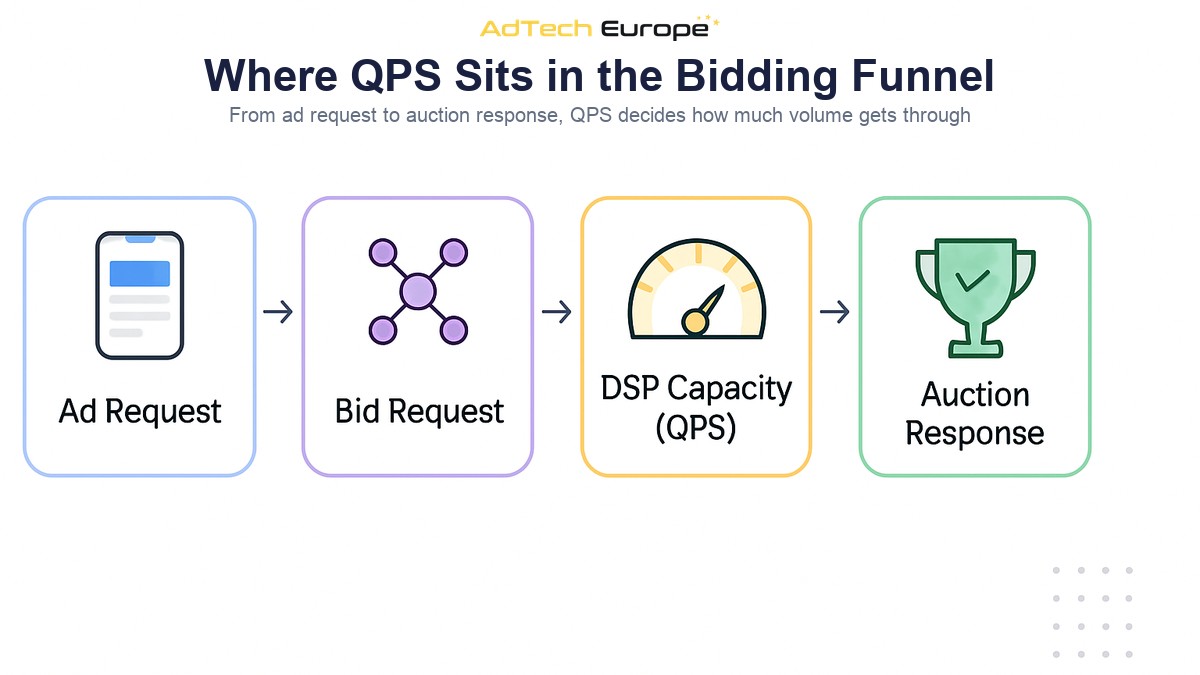
QPS stands for queries per second. In programmatic advertising, it measures how many bid requests a DSP’s server endpoint can receive and respond to every second. Every time a user loads a page or opens an app with an ad slot, the supply-side platform or exchange sends out a bid request to every connected DSP asking, in effect, “do you want this impression, and if so, how much will you pay?” Each of those messages is one query.
A DSP’s QPS capacity is the ceiling on how many of those queries it can process in real time. Because OpenRTB auctions run on strict timeouts, usually somewhere around 100 milliseconds, the DSP does not get to queue up requests and answer them later. It has to accept the request, run targeting and bidding logic, and return a bid or a pass before the auction clock runs out, at the exact volume the exchange is sending.
QPS is a different measurement from the reporting metrics most media buyers check day to day. Win rate and bid rate, for example, describe what happens to the auctions a DSP actually receives. QPS describes how many auctions it is capable of receiving in the first place. A platform can have an excellent win rate on the traffic it sees and still be losing a meaningful share of available impressions simply because its infrastructure cannot accept more requests than a fixed ceiling.
How QPS Requirements Scale With Your Traffic
QPS is not a fixed number a DSP owner picks once. It grows with every dimension of the business: more connected SSPs, more geographies, more ad formats, and more traffic sources all add to the volume of bid requests hitting the platform at the same time. A DSP that only needs to handle a handful of supply partners in one region has very different requirements from one running 1,000+ SSP integrations across display, video, CTV, and mobile app inventory worldwide.
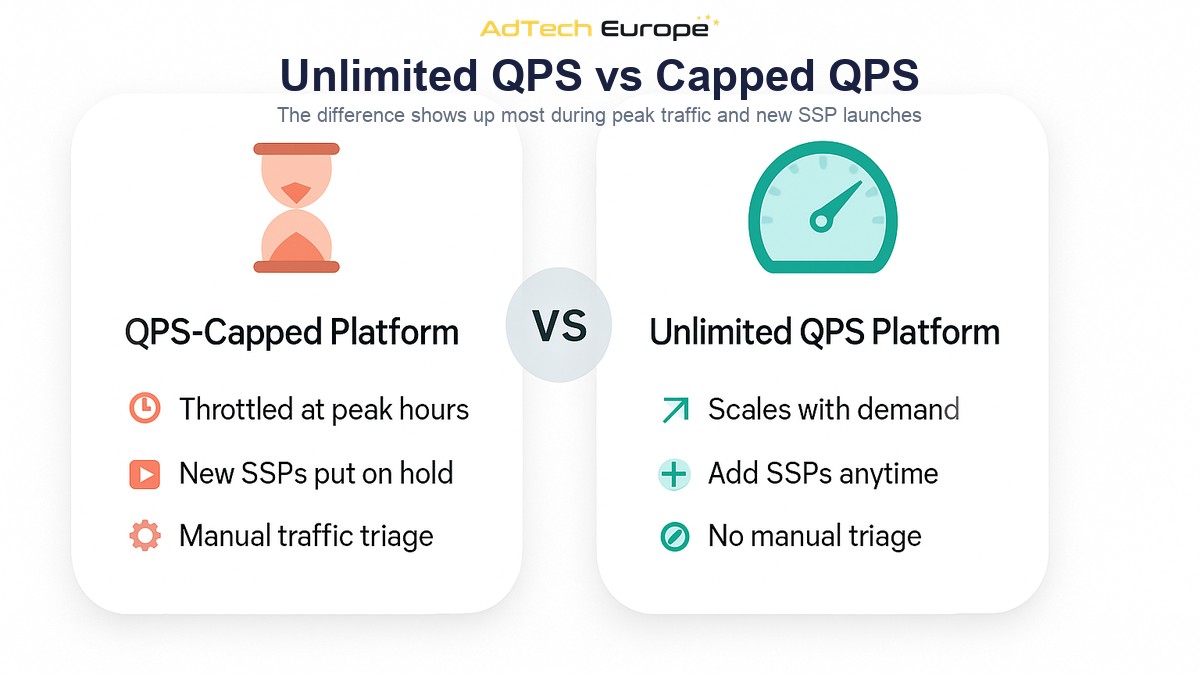
Traffic is also uneven by nature. Bid request volume spikes during peak shopping hours, major sporting events, holiday sales, and breaking news cycles, exactly the moments when advertisers most want their campaigns live and scaling. A DSP sized for average traffic will be fine most days and then quietly throttled during the hours that matter most.
This is why QPS capacity is treated as an infrastructure decision rather than a settings toggle. Expanding it usually means more server capacity, more efficient request handling, and stronger connections with exchanges, which is why it is one of the first questions agencies ask when evaluating whether to rent, license, or acquire a DSP rather than build one from scratch.
What Happens When a DSP Hits Its QPS Cap
A QPS limit rarely produces a visible failure. Instead, it shows up as a set of symptoms that look like other problems unless you know what to check.
| Symptom | What Is Actually Happening |
| Bid requests silently go unanswered | The exchange sent more queries than the DSP endpoint could accept in time, so the request timed out or was dropped before a bid could be returned |
| Reach drops during peak hours | Demand from users is high, but the platform is only able to process a fraction of the auctions actually available |
| Win rate looks normal but volume stalls | The DSP is winning a consistent share of the auctions it sees, but it is only seeing a shrinking slice of total available auctions |
| New SSP connections get capped soon after launch | Exchanges throttle traffic to DSPs that cannot reliably respond fast enough, protecting their own systems at the DSP’s expense |
None of these symptoms show up as an outage. They show up as a campaign that quietly underperforms compared to its budget and targeting, which is why QPS capacity is worth checking before assuming a targeting or bidding problem is to blame.
How to Tell If Your DSP Setup Is QPS-Constrained
Because a QPS ceiling never throws an error, most teams find it by comparing numbers rather than reading an alert. A few checks tend to surface the problem quickly.
- Compare available impressions to received bid requests. If an SSP dashboard shows far more inventory than the DSP reports having been offered, the DSP’s endpoint is likely being throttled upstream
- Look at performance by hour, not just by day. A platform that performs normally most of the day but consistently underperforms during known peak windows is a strong sign of a capacity ceiling rather than a targeting issue
- Watch what happens right after a new SSP integration goes live. A sudden cap on the new connection’s volume within days of launch usually means the exchange throttled the feed after seeing slow or dropped responses
- Ask the platform provider directly whether QPS capacity is fixed, tiered, or unlimited, and whether it is shared across all clients on the same infrastructure or dedicated to your account
That last question matters more than it sounds. Some rented ad-tech platforms pool infrastructure across many clients and quietly cap or deprioritize traffic for smaller accounts during shared peak periods. A platform built around unlimited QPS scaling for every owner, regardless of size, avoids that kind of invisible competition for the same server capacity.
Why DSP Owners Push for Unlimited QPS
For agencies and media buyers who run their own platform rather than buying media through someone else’s, QPS capacity directly determines how much of the business they can grow without renegotiating infrastructure. A few scenarios make the difference concrete:
- Running a flash-sale or event-driven campaign where traffic multiplies for a few hours and the platform needs to absorb it without throttling
- Adding new SSPs or exchanges to expand supply without first checking whether the current infrastructure can take the extra volume
- Expanding into new geographies or launching CTV, DOOH, or in-app inventory that adds an entirely new stream of bid requests on top of existing traffic
- Onboarding new advertiser accounts without degrading performance for existing campaigns already running on the platform
This is also part of why the DSP and SSP relationship matters here. An SSP will only keep sending volume to a DSP that reliably responds within its timeout window at scale. A DSP that gets throttled for missing responses does not just lose the auctions it dropped, it can see the exchange reduce how much traffic it sends going forward.
How the Three DSP Ownership Models Handle QPS
One detail that surprises new platform owners is that QPS is not a premium add-on tied to price. On AdTech Europe’s DSP pricing page, unlimited QPS scaling is included at every ownership tier, not reserved for the most expensive plan.
| Plan | QPS | Ownership | Starting Cost |
| White Label DSP | Unlimited | Rental, month-to-month | $500/mo + $1,000 setup |
| DSP License | Unlimited | Licensed platform ownership | $25,000 one-time |
| DSP Acquisition | Unlimited | Full source code ownership | $50,000 one-time |
The difference between the three plans is how much control and customization comes with the platform, not how much traffic it can handle. A White Label DSP gets the same request-handling capacity as a fully acquired platform with source code access, which means QPS is rarely the deciding factor between the three models. Budget, customization needs, and long-term control usually are.
Ready to Run a DSP Without Throttled Traffic?
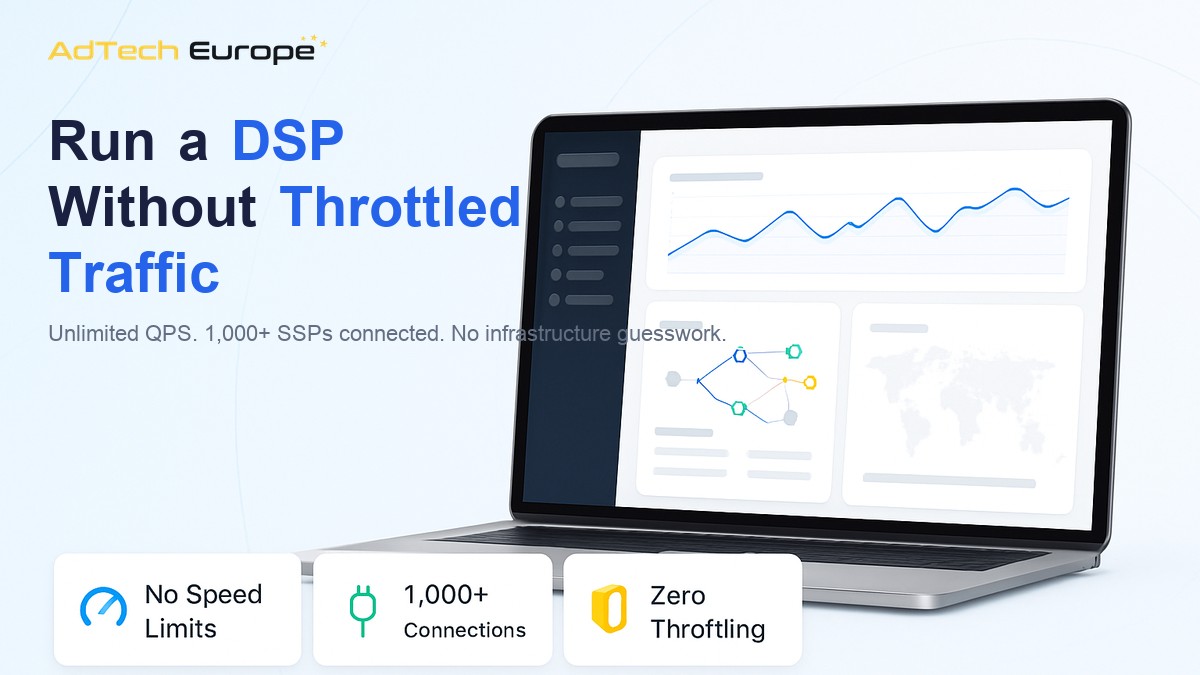
AdTech Europe builds and operates a demand-side platform with unlimited QPS scaling and 1,000+ live SSP integrations already connected, so new bid requests are not something a platform owner has to plan infrastructure around. Whether the goal is renting a fully managed white label platform, licensing a proven one, or acquiring full source code, the underlying capacity to handle traffic spikes is the same across every plan.
To see how the platform handles real bid volume and talk through which ownership model fits your traffic patterns, schedule a programmatic strategy meeting with the AdTech Europe team.
FAQs
What does QPS stand for in programmatic advertising?
QPS stands for queries per second. It measures how many bid requests a DSP’s servers can receive and respond to every second, which sets the ceiling on how much auction volume the platform can actually participate in.
How many QPS does a DSP need?
It depends on how many SSPs are connected, how many geographies and ad formats are active, and how much traffic spikes during peak hours. There is no fixed number; requirements grow as the business connects more supply and launches in more markets.
What happens if my DSP exceeds its QPS limit?
Bid requests beyond the limit are dropped or timed out without any error message. The platform quietly sees fewer auctions than are actually available, which shows up as shrinking reach rather than a visible outage.
Is QPS the same thing as bid rate?
No. QPS is an infrastructure limit on how many bid requests the DSP can process at all. Bid rate is a reporting metric that describes what percentage of the requests actually received result in a bid being submitted.
Does unlimited QPS cost extra on top of a DSP plan?
On AdTech Europe’s pricing, no. Unlimited QPS scaling is included on the White Label DSP, DSP License, and DSP Acquisition plans, so it is not an upgrade tier separate from the base price.
Can QPS capacity become a bottleneck when adding new SSPs?
Yes, if the underlying infrastructure was not built to scale. Each new SSP integration adds another stream of bid requests, and exchanges will throttle traffic to a DSP that cannot reliably respond fast enough within the auction timeout.
Where can I check current DSP pricing that includes unlimited QPS?
AdTech Europe’s pricing page lists current rates for the White Label DSP, DSP License, and DSP Acquisition plans, all of which include unlimited QPS scaling and 1,000+ SSP integrations.