Programmatic buying can look simple from the outside. A DSP sends bids, wins impressions, and delivers ads. But behind every impression is a supply path that affects cost, quality, reach, and campaign results.
The problem is that many DSPs do not fail because of bad bidding logic. They fail because they do not have stable, trusted, and scalable inventory. Weak supply can lead to wasted spend, low conversion rates, poor traffic signals, and limited growth.
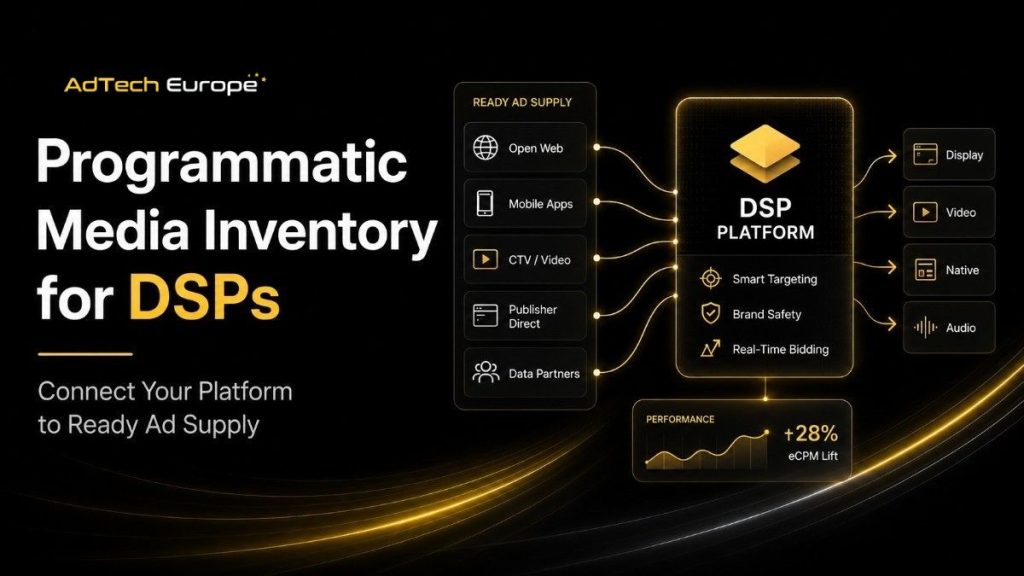
Programmatic media inventory helps solve this. With ready ad supply, DSP owners, agencies, advertisers, and media buyers can connect to traffic sources faster, test more formats, and scale campaigns with better control.
Key Takeaways
- Programmatic media inventory gives DSPs access to ad placements across websites, apps, and digital channels.
- DSPs need ready supply to run campaigns without building every supply connection from zero.
- Quality matters more than raw volume.
- Open RTB and XML integrations help platforms connect with exchanges, SSPs, and supply partners.
- Strong inventory should include transparency, fraud filtering, reporting, and source-level optimization.
What Is Programmatic Media Inventory?
Programmatic media inventory is the digital advertising space such as ad slots on websites, mobile apps, or streaming platforms, that is bought and sold automatically using software. Instead of manual negotiations, it uses machine learning and real-time data to target specific audiences efficiently.
This inventory can appear across:
- Websites
- Mobile apps
- Video players
- Native placements
- Push traffic
- Pop-under placements
- DOOH screens
- Audio environments
For a DSP, inventory is the supply layer. It is what your advertisers buy through your platform.
A DSP with weak supply has fewer chances to win useful impressions. A DSP with strong quality traffic supply can test more sources, compare more segments, and scale campaigns with better data.
How DSPs Connect to Ready Ad Supply
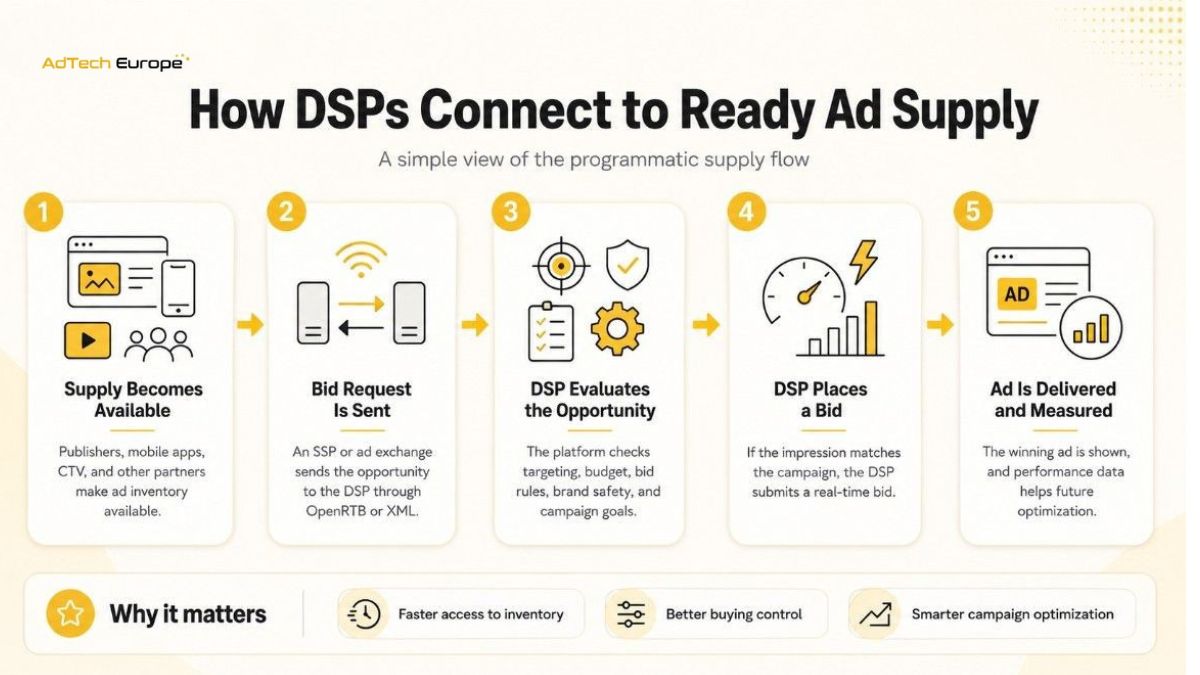
A DSP connects to ready ad supply through programmatic integrations.
The usual flow looks like this:
| Step | What Happens | Why It Matters |
| 1. User visits a page or app | An ad impression becomes available | Creates the buying opportunity |
| 2. Supply partner sends bid request | The DSP receives inventory data | Helps the DSP decide whether to bid |
| 3. DSP checks campaign rules | Geo, device, price, format, and audience are reviewed | Reduces wasted bids |
| 4. DSP submits bid | The platform competes in real time | Gives advertisers access to impressions |
| 5. Winning ad is shown | The ad appears to the user | Campaign data starts building |
This process often happens through OpenRTB supply connectivity or XML-based integrations.
OpenRTB is commonly used for real-time bidding. XML may still be useful for some traffic sources and legacy supply connections.
Why Ready Inventory Matters for DSP Owners
DSP owners need more than software. They need real supply that advertisers can use from day one.
Ready inventory helps DSPs:
- Launch campaigns faster
- Reduce time spent on manual supply deals
- Test more geos and formats
- Improve fill and bid opportunities
- Compare supply partners by performance
- Build trust with advertisers and agencies
Without strong inventory, even a powerful DSP can feel empty. Campaigns may have limited reach, unstable delivery, or poor optimization data.
AdTech Europe’s global ad inventory supports advertisers and DSP operators that need broad access without managing many separate traffic providers.
Main Types of Programmatic Inventory for DSPs
A strong DSP should support more than one format. Different advertisers need different traffic types.
| Inventory Type | Best For | Key Buying Focus |
| Display ads | Reach, retargeting, brand visibility | Placement quality and CPM |
| Video ads | Engagement, product demos, app promotion | Completion rate and viewability |
| Native ads | Content-style offers, discovery | Context and landing page fit |
| Push ads | Direct response and reactivation | CTR and conversion rate |
| Pop-under ads | High-volume testing | Source quality and CPA |
| In-app ads | Mobile campaigns and installs | App category and device data |
| DOOH ads | Location-based awareness | Geo, screen type, and timing |
| Audio ads | Streaming and awareness | Listen-through rate |
DSPs that support multi-format inventory can serve more advertiser needs from one platform.
What Makes Programmatic Inventory High Quality?
High-quality inventory is not just “more impressions.” It is supply that helps advertisers make better decisions.
Strong inventory should include:
- Verified supply partners
- Real users, not bot traffic
- Clear source and placement data
- Geo and device-level reporting
- Fraud detection
- Brand safety controls
- Stable traffic volume
- Transparent pricing
- Optimization by source, zone, or publisher ID
Traffic quality is critical because poor supply can damage both performance and trust. Advertisers should judge inventory by conversions, CPA, ROAS, retention, and source-level value, not only clicks.
For deeper campaign control, traffic quality controls should be part of the buying setup from the start.
Important Inventory Signals to Review
DSPs should review supply before scaling campaigns.
| Signal | What to Check | Why It Matters |
| Source ID | Where traffic comes from | Helps pause weak supply |
| Publisher or app data | Site, app, or placement identity | Improves transparency |
| Geo | Country, region, or city | Helps target profitable markets |
| Device | Mobile, desktop, tablet, CTV | Separates bidding strategy |
| OS and browser | User environment | Improves compatibility |
| Bid floor | Minimum price for inventory | Controls buying cost |
| Win rate | How often bids win | Shows pricing strength |
| Conversion rate | Clicks that become actions | Shows traffic value |
| Fraud score | Risk level of traffic | Protects budget |
| Supply path | Number of intermediaries | Helps reduce hidden costs |
Supply Path Transparency for DSPs
Supply path transparency helps buyers know where inventory comes from.
Important terms include:
ads.txt and app-ads.txt
These files help show which sellers are allowed to sell website or app inventory.
sellers.json
This helps buyers identify the companies selling or reselling inventory.
SupplyChain Object
The SupplyChain object, also called schain, shows the parties involved in selling a bid request.
For DSP owners, these signals help reduce spoofed inventory, hidden reselling, and low-quality paths. They also support better supply path optimization.
A DSP connected to the wider programmatic buying ecosystem should not only buy traffic. It should understand the path behind that traffic.
How to Evaluate Ready Ad Supply Before Scaling
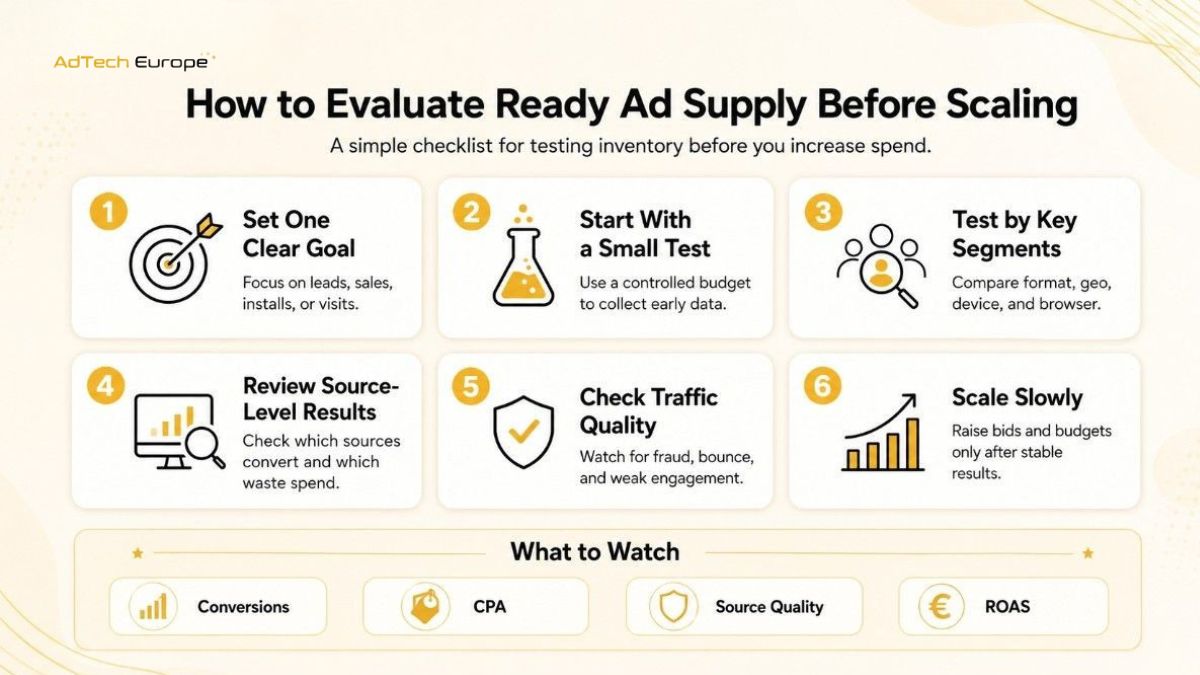
Before increasing spend, test the inventory in a controlled way. The goal is to find sources that bring real value, not just clicks.
1. Set One Clear Goal
Choose one main goal first, such as:
- Leads
- Sales
- App installs
- Website visits
- Retargeting
If the goal is leads, judge the supply by CPA and lead quality, not only CTR.
2. Start With a Small Test Budget
Do not scale new supply too fast. Use a small test budget to collect early data.
Track:
- Spend
- Clicks
- Conversions
- CPA
- Source performance
- Geo and device results
The first test should help you learn which supply is worth scaling.
3. Test by Format, Geo, and Device
Keep the test simple. Separate key segments so results are easier to read.
| Segment | What to Check |
| Format | Display, native, video, push, pop-under |
| Geo | Country or region |
| Device | Mobile, desktop, tablet |
| OS/browser | Android, iOS, Chrome, Safari |
Avoid testing too many variables in one campaign.
4. Review Source-Level Results
Check performance by source, zone, publisher ID, app, or placement.
Look for:
- Sources that convert
- Sources that spend without results
- High bounce rates
- Weak CPA
- Strong ROAS or lead quality
This helps separate useful supply from weak traffic.
5. Check Traffic Quality
Before scaling, make sure the traffic looks clean.
Watch for:
- Fraud or bot signals
- High CTR with no conversions
- Very short time on page
- Unusual click spikes
- Geo or device mismatch
If traffic looks suspicious, pause it or test it separately.
6. Compare Cost With Value
Cheap traffic is not always good traffic.
| Metric | Why It Matters |
| CPC or CPM | Shows traffic cost |
| CPA | Shows cost per result |
| Conversion rate | Shows traffic quality |
| ROAS | Shows revenue value |
| Win rate | Shows bid strength |
Scale sources that show stable value, not only low prices.
7. Build Whitelists and Blacklists
After testing, group your sources:
- Whitelist: Strong sources worth scaling
- Blacklist: Weak sources to block
- Watchlist: Mixed sources that need more data
This makes future campaigns cleaner and easier to control.
8. Scale Slowly
Increase spend in small steps.
You can scale by:
- Raising bids on strong sources
- Increasing daily budget slowly
- Testing similar geos
- Adding new creatives
- Expanding proven formats
Keep monitoring after scaling because traffic quality can change at higher volume.
Programmatic Inventory for Agencies and Media Buyers
Agencies and media buyers need supply that is flexible enough for many clients.
Ready inventory helps them:
- Run campaigns across multiple verticals
- Test different ad formats
- Compare traffic sources
- Control budgets by campaign
- Improve reporting for clients
- Reduce manual vendor management
This is useful for performance campaigns, brand campaigns, affiliate offers, app installs, e-commerce, lead generation, and retargeting.
Programmatic Inventory for DSP Owners
DSP owners have a different need. They need inventory that supports the business behind the platform.
Good supply helps DSP owners:
- Offer real buying options to advertisers
- Improve platform value from day one
- Build advertiser trust
- Reduce supply onboarding delays
- Support white-label or owned DSP models
- Expand into new geos and ad formats
Strong exchange demand access can also make a DSP more useful for partners who need broader programmatic reach.
Common Mistakes to Avoid
Avoid these mistakes when connecting a DSP to media inventory:
- Choosing volume over quality
- Ignoring fraud signals
- Running all formats in one campaign
- Not checking source-level data
- Scaling before conversion data is stable
- Using broad targeting too early
- Ignoring supply path transparency
- Not separating mobile and desktop traffic
- Not reviewing bid floors and win rates
Inventory should help advertisers learn faster, not just spend faster.
How AdTech Europe Helps DSPs Access Programmatic Inventory
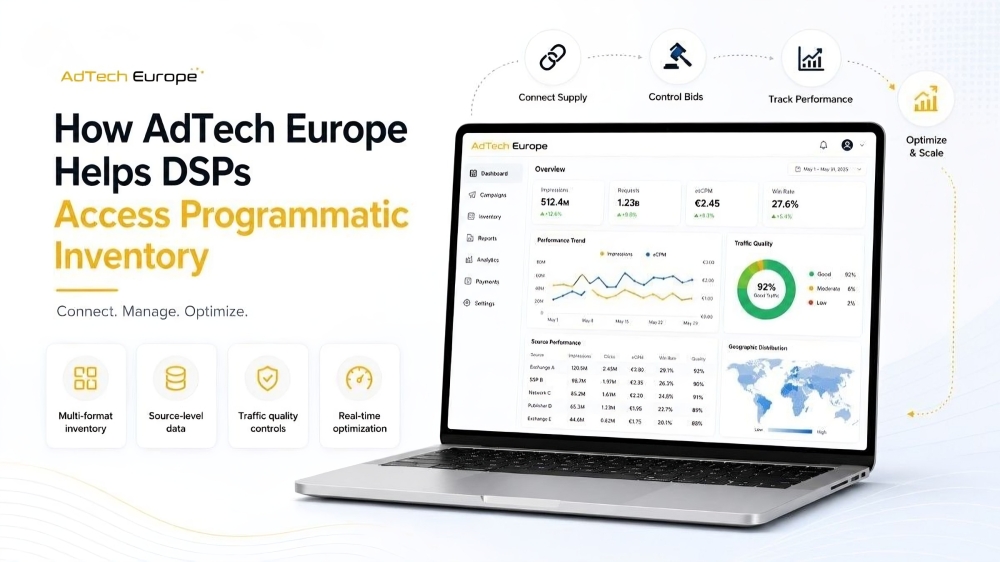
AdTech Europe helps advertisers, agencies, media buyers, and DSP owners connect to ready programmatic ad supply across multiple formats and sources.
With AdTech Europe, businesses can:
- Access multi-format inventory
- Connect with external supply partners and traffic sources
- Use OpenRTB and XML-based supply options
- Target by geo, device, OS, browser, and source
- Review campaign performance
- Use anti-fraud integrations and traffic quality controls
- Choose between white-label, license, rental, or full DSP ownership models
- Scale programmatic campaigns with more platform control and fewer infrastructure limitations
This makes AdTech Europe useful for teams that need more than a basic media buying account. It supports businesses that want DSP infrastructure, programmatic supply access, campaign control, traffic quality tools, and flexible ownership options for long-term programmatic growth.
Ready to Connect Your DSP to Programmatic Ad Supply?
AdTech EU gives advertisers, agencies, media buyers, and DSP owners access to ready programmatic inventory across multiple formats, geos, and traffic sources.
Whether you want to scale campaigns, reduce wasted spend, or build your own DSP business, AdTech Europe helps you connect to quality ad supply with the infrastructure, transparency, and control needed for long-term programmatic growth.
FAQS
What is programmatic media inventory?
Programmatic media inventory is digital ad space that can be bought automatically through platforms like DSPs, SSPs, and ad exchanges.
Why does a DSP need ready ad supply?
A DSP needs supply so advertisers can buy impressions, test campaigns, and scale traffic without waiting for every supply deal to be built manually.
What formats should DSP inventory include?
Common formats include display, video, native, push, pop-under, in-app, DOOH, audio, and HTML ad placements.
Is OpenRTB important for DSP inventory?
Yes. OpenRTB helps DSPs connect to supply partners and take part in real-time bidding auctions.
How can advertisers reduce wasted spend?
They should track conversions, review source-level results, block weak traffic, use fraud filters, and scale only after performance is stable.
What is supply path optimization?
Supply path optimization means choosing cleaner, more efficient routes to inventory. It helps reduce waste, hidden costs, and low-quality traffic.
Can AdTech Europe support DSP owners?
Yes. AdTech Europe supports businesses that want access to ready inventory, programmatic infrastructure, and DSP ownership or platform growth options.