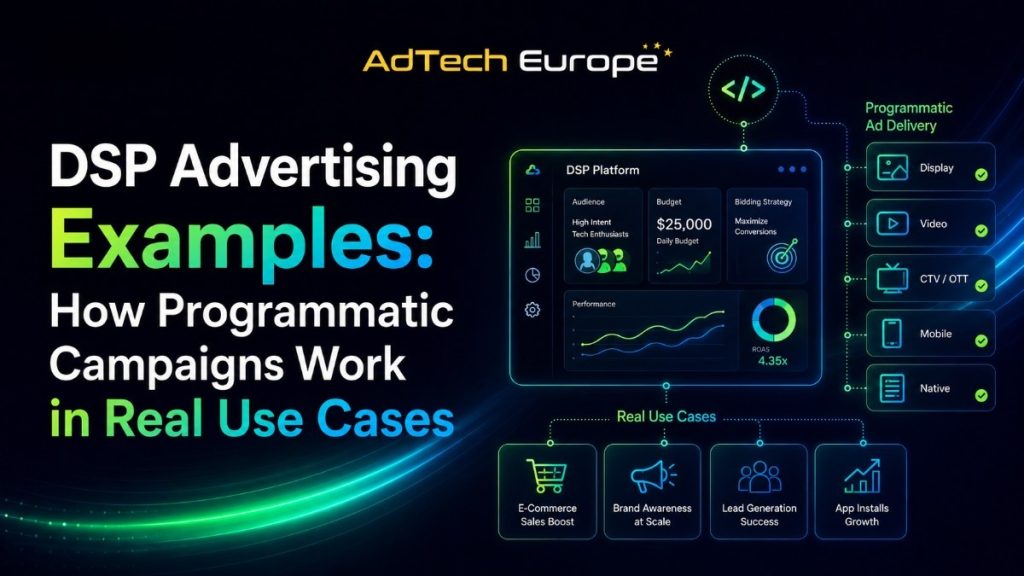
Programmatic advertising can look simple from the outside. You set a budget, choose an audience, upload creatives, and wait for results. But inside a real DSP campaign, many small decisions shape performance before an ad ever appears.
The problem is that many advertisers only see the dashboard. They do not always see how bids are calculated, which inventory is being bought, why some placements waste budget, or how targeting rules affect campaign results.
That is why DSP advertising examples are useful. They show how advertisers, agencies, and media buyers use demand-side platforms to reach better audiences, control spend, test supply, and scale campaigns with more confidence.
What DSP Advertising Examples Actually Show
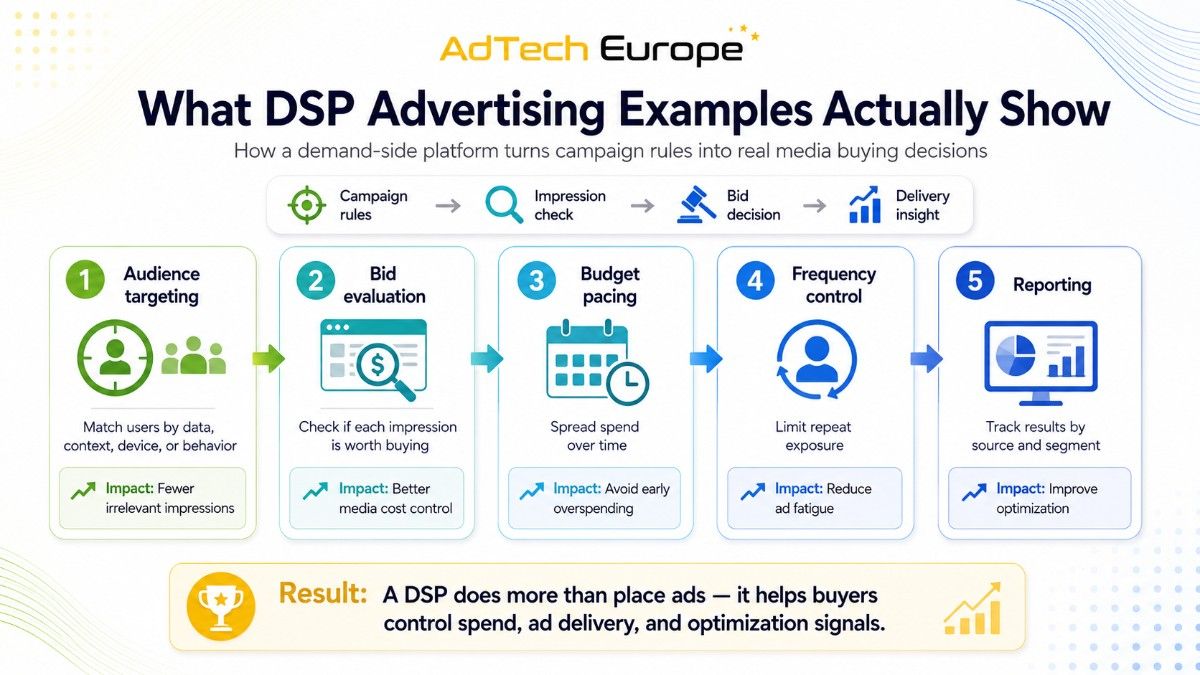
DSP advertising examples show how a demand-side platform turns campaign rules into real media buying decisions. A DSP does not just “place ads.” It evaluates each impression, checks if it matches the campaign, and decides whether it is worth bidding on.
For advertisers that need a deeper base, this DSP buying guide explains how programmatic buying works across exchanges, SSPs, publishers, and digital channels.
| DSP Action | What It Means | Campaign Impact |
| Audience targeting | Matches users by data, context, device, or behavior | Reduces irrelevant impressions |
| Bid evaluation | Checks if an impression is worth buying | Controls media cost |
| Budget pacing | Spends budget over time | Avoids early overspending |
| Frequency control | Limits repeat exposure | Reduces ad fatigue |
| Reporting | Tracks results by source and segment | Improves optimization |
A strong DSP gives buyers more than access to inventory. It gives them a way to control how money is spent, where ads appear, and which signals guide optimization.
How a Programmatic DSP Campaign Works
A programmatic campaign happens very fast, but the logic is simple. The DSP receives a bid request, checks the campaign rules, calculates value, submits a bid, and then tracks the result if the ad is served.
| Step | What Happens | Why It Matters |
| User loads page or app | An ad opportunity appears | Creates available inventory |
| SSP sends request | The impression is offered to buyers | Sends data to DSPs |
| DSP filters | Campaign rules are checked | Blocks poor matches |
| Bid is calculated | Value is estimated | Protects budget |
| Auction runs | DSPs compete for the impression | Winner gets placement |
| Ad is served | Creative appears to the user | Campaign reaches audience |
| Data returns | Results update in the DSP | Optimization begins |
This is where a DSP becomes more than a media buying tool. It becomes the decision engine for campaign performance.
DSP Advertising Example 1: Ecommerce Retargeting Campaign
An ecommerce brand wants to bring back users who viewed a product but did not buy. The DSP builds a retargeting audience from site events, product views, cart activity, or previous ad engagement.
The campaign can use display, native, or video ads to remind users about products they already showed interest in. With proper performance waste control, the buyer can avoid spending on users who already converted.
The key DSP settings are audience recency, frequency caps, bid limits, creative testing, and conversion tracking. The campaign should focus on CPA, ROAS, cart recovery rate, and post-click revenue.
DSP Advertising Example 2: Agency Multi-Client Campaigns
A digital agency may manage many advertisers across different industries. Without a DSP, each campaign may run through separate platforms, reports, fees, and supply rules.
With a DSP, the agency can manage multiple advertisers from one system. Each client can have its own budget, audience segments, creative assets, reporting view, and optimization rules.
This use case is valuable when agencies want to scale media buying while keeping control over margins. Many agencies now review their own DSP because platform dependency can limit flexibility at higher spend levels.
DSP Advertising Example 3: Mobile App Install Campaign
A mobile app company wants new users in selected countries. The DSP targets in-app inventory, mobile web placements, devices, operating systems, connection types, and app categories.
The campaign can start broad, then shift spend toward sources that drive installs and active users. A weak setup may optimize only for cheap installs, while a stronger setup tracks in-app events like sign-ups, purchases, or level completion.
| Campaign Goal | DSP Setup | Main KPI |
| App installs | In-app traffic and device targeting | CPI |
| Trial sign-ups | Event tracking and source filtering | Cost per signup |
| Active users | Post-install event optimization | Retention rate |
| Purchases | ROAS-based bidding | Purchase ROAS |
For this example, the DSP must connect buying data with app analytics. Otherwise, the campaign may buy users who install once but never return.
DSP Advertising Example 4: B2B Lead Generation
A B2B software company wants leads from decision-makers in specific industries. The DSP can use account lists, contextual targeting, firmographic data, job-related signals, and retargeting pools.
This campaign should not chase the cheapest clicks. It should optimize toward qualified leads, demo requests, and sales pipeline value. That means the DSP needs clean conversion tracking and source-level reporting.
The best results often come from combining prospecting and retargeting. Prospecting builds awareness with relevant accounts, while retargeting brings engaged users back to the landing page or demo form.
DSP Advertising Example 5: CTV Awareness With Retargeting
A brand launches a connected TV campaign to build awareness. CTV is strong for reach, but many users do not click TV ads. The DSP should connect CTV exposure with later display, mobile, or native retargeting.
In this setup, the DSP tracks exposed audiences and retargets them on clickable channels. The campaign can measure reach, completion rate, frequency, site visits, and assisted conversions.
For buyers that need broad access, quality programmatic inventory sources matter because premium supply can improve brand safety, viewing quality, and audience fit.
DSP Advertising Example 6: Affiliate and Performance Testing
A performance buyer wants to test several offers across countries, devices, and traffic sources. The DSP gives the buyer fast control over bids, budgets, whitelists, blocklists, and conversion data.
This type of campaign needs strict testing rules. The buyer should avoid judging traffic too early, but also avoid letting bad sources drain spend for too long.
Smart optimization depends on clean data. A guide to bidding for ROI can support campaigns where bids must adjust based on real conversion value, not only clicks.
DSP Advertising Example 7: Owned DSP for Media Buyers
A large media buyer or ad network may use third-party DSP access at first. This is fast, but it can create limits around bidder logic, fees, integrations, data access, and platform roadmap.
An owned DSP changes the model. The business can control branding, integrations, bidding rules, reporting, and the way advertisers access the platform.
| Area | Third-Party DSP | Owned DSP |
| Platform control | Limited | High |
| Bidding logic | Fixed | Customizable |
| Data access | Restricted | More direct |
| Branding | Shared | White-label |
| Margins | Platform fees apply | More margin control |
| Roadmap | Vendor-led | Business-led |
This example matters for agencies and media buyers that want to build a long-term ad-tech business, not only run campaigns inside someone else’s system.
What Makes These DSP Campaigns Work
The best DSP advertising examples share the same pattern. They do not rely only on automation. They combine clear goals, useful data, strong supply control, and practical optimization.
A campaign is more likely to perform when the buyer has:
- A clear KPI before launch
- Clean audience and conversion data
- Strong inventory filtering
- Frequency and pacing controls
- Creative testing by segment
- Reporting by source and placement
These controls are also part of what makes powerful DSP features important for serious media buyers.
How to Match DSP Examples to Campaign Goals
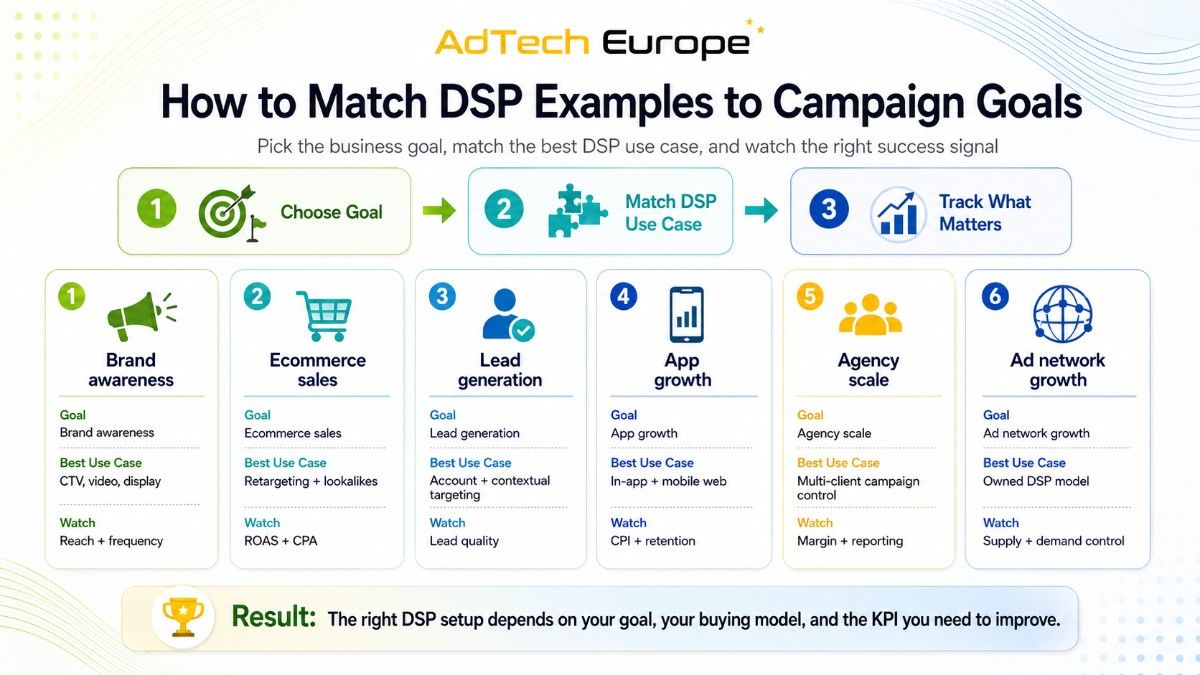
Not every DSP campaign should be built the same way. The right setup depends on the business goal, available data, target audience, and buying model.
| Goal | Best DSP Use Case | What to Watch |
| Brand awareness | CTV, video, display | Reach and frequency |
| Ecommerce sales | Retargeting and lookalikes | ROAS and CPA |
| Lead generation | Account and contextual targeting | Lead quality |
| App growth | In-app and mobile web | CPI and retention |
| Agency scale | Multi-client campaign control | Margin and reporting |
| Ad network growth | Owned DSP model | Supply and demand control |
For advertisers still shaping their programmatic strategy, DSP media buying gives a clearer view of how buying decisions affect campaign performance.
Common Mistakes in DSP Campaigns
The biggest mistake is treating a DSP like a simple ad placement tool. A DSP should be used to test, filter, learn, and improve. Without active optimization, automation can still waste budget.
Another mistake is using too many broad audiences at once. This makes reporting unclear. Buyers should separate campaigns by goal, audience, source, and creative message where possible.
A third mistake is ignoring supply quality. Even a good audience strategy can fail if the campaign buys weak inventory, duplicated supply paths, or placements that do not match the brand.
When Custom DSP Development Makes Sense
Custom DSP development makes sense when standard platform access no longer fits the business model. This often happens when an agency, ad network, or media buyer needs special bidding logic, custom dashboards, private integrations, or deeper data control.
A business may also need custom tools for reporting, advertiser onboarding, fraud controls, campaign automation, or supply partner management. In these cases, custom adtech development can support a more flexible platform strategy.
The key question is simple: are you only buying media, or are you building an advertising business? If the answer is business growth, platform control becomes more important.
Ready to Own Your Programmatic DSP?
AdTech Europe helps advertisers, agencies, media buyers, ad networks, and DSP owners acquire a fully owned demand-side platform with source-code access, white-label branding, supply integrations, and scalable infrastructure.
Whether you want to launch your own DSP business, reduce dependence on third-party platforms, control bidding logic, or build long-term programmatic revenue, AdTech Europe gives you the technology, integrations, transparency, and ownership needed to operate your own DSP with confidence.
For teams ready to move forward, booking a consultation with AdTech Europe can help you define the right DSP setup, supply model, and long-term growth strategy.
FAQs
Is a DSP only used for display advertising?
No. A DSP can buy display, native, video, mobile, in-app, CTV, audio, and sometimes DOOH inventory, depending on the platform and integrations.
What is the first thing to set before launching a DSP campaign?
Start with the campaign goal. Choose whether the campaign is for awareness, clicks, leads, installs, sales, or retargeting before setting bids and audiences.
Can a small advertiser use DSP advertising?
Yes. Small advertisers can use DSPs, but owned DSP models usually make more sense for agencies, networks, and media buyers with larger or repeated spend.
How much data does a DSP need to optimize?
A DSP needs enough impression, click, and conversion data to find patterns. More clean data usually improves optimization, but poor tracking can weaken results.
What is the difference between DSP retargeting and social retargeting?
DSP retargeting can reach users across many websites, apps, exchanges, and channels. Social retargeting usually stays inside one social platform’s inventory.
Why do some DSP campaigns get clicks but no conversions?
This often happens because of weak audience quality, poor landing pages, low-intent placements, misleading creatives, or optimization based only on CTR.
Can a DSP campaign run without third-party cookies?
Yes. DSPs can use first-party data, contextual targeting, device signals, publisher data, clean rooms, and privacy-safe identifiers depending on the setup.
What should agencies ask before choosing a DSP?
Agencies should ask about inventory access, reporting depth, fees, white-label options, account controls, fraud protection, bidder flexibility, and whether ownership is possible.