Programmatic advertising gives advertisers speed, scale, and automation. But many businesses still depend on third-party DSPs where they do not control the code, data, bidding logic, supply paths, or platform roadmap.
That creates a problem. Media buyers may grow spend but still lose margin to platform fees. Agencies may win clients but cannot fully control reporting or optimization. Ad networks may want to build their own programmatic business but face high development costs and long launch timelines.
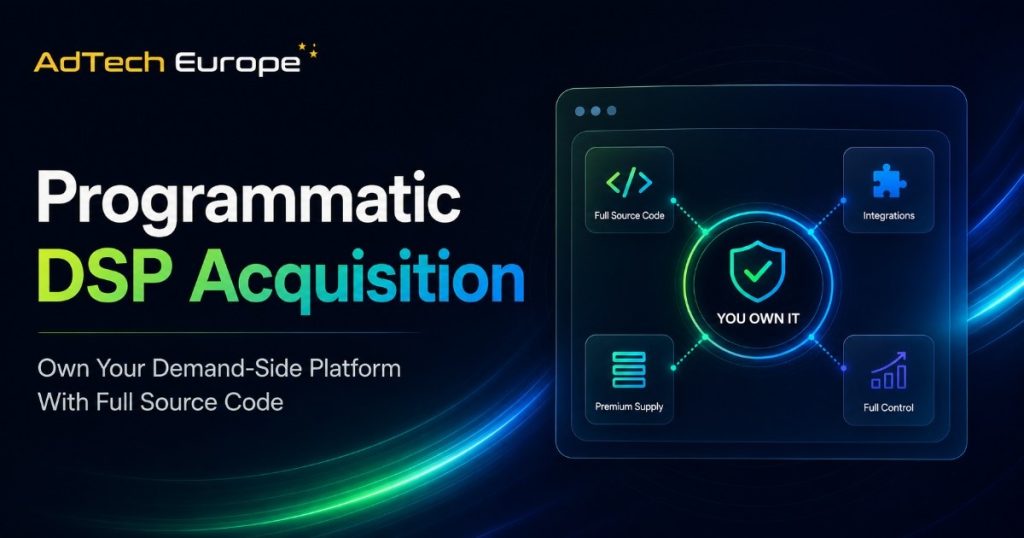
Programmatic DSP acquisition solves this by giving you ownership of the demand-side platform, including full source-code access, infrastructure control, supply integrations, and the freedom to customize the system around your business model.
Key Takeaways
- DSP acquisition means buying or acquiring a working demand-side platform.
- Full source-code access gives more control than standard white-label access.
- DSP ownership helps agencies, ad networks, advertisers, and media buyers reduce platform dependence.
- Revenue can come from media markup, platform fees, managed service fees, licensing, and advertiser accounts.
- ROI depends on traffic volume, retained margin, setup cost, support cost, and supply quality.
- Acquiring a DSP is usually faster and safer than building one from scratch.
What Is Programmatic DSP Acquisition?
Programmatic DSP acquisition is the process of taking ownership of a demand-side platform that can buy digital ad inventory through automated bidding and supply integrations.
Instead of only renting access to another vendor’s platform, you acquire the technology layer behind the buying system.
This may include:
- Full DSP source code
- Admin panel and advertiser dashboard
- Campaign management tools
- Bidder and optimization logic
- Reporting and analytics
- OpenRTB or XML supply connections
- Anti-fraud and traffic quality tools
- Hosting and infrastructure setup
- White-label branding options
For buyers that want deeper control, full code ownership is the main difference between using a DSP and owning one.
How DSP Acquisition Works
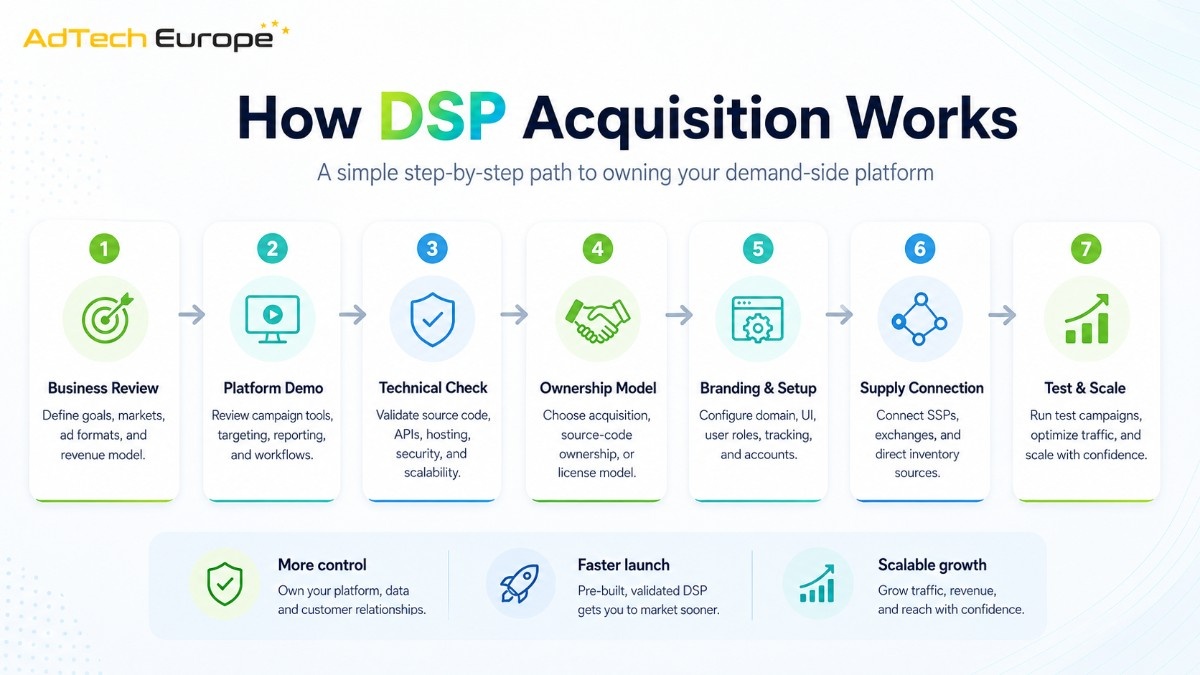
DSP acquisition is the process of taking control of a ready demand-side platform instead of building one from zero or only renting access from a vendor.
The goal is to move from platform user to platform owner, with more control over technology, data, supply, branding, and monetization.
In most cases, DSP acquisition starts with a business and technical review. The buyer checks whether the platform supports the right ad formats, traffic sources, campaign tools, reporting features, user roles, and infrastructure needs.
This helps confirm whether the DSP can support the buyer’s real business model, not just basic media buying.
A proper acquisition process should also define what the buyer receives. This may include source-code access, admin controls, advertiser dashboards, campaign management tools, bidder logic, tracking systems, analytics, supply integrations, and technical support.
| Step | What Happens | Why It Matters |
| 1. Business review | Define the buyer’s goals, target markets, formats, and revenue model | Helps match the DSP to the business plan |
| 2. Platform demo | Review campaign setup, targeting, reporting, user roles, and optimization tools | Shows how the DSP works in real use |
| 3. Technical check | Review source code, hosting, bidder logic, APIs, security, and scalability | Confirms whether the platform is reliable and controllable |
| 4. Ownership model | Choose full acquisition, source-code ownership, license, or white-label access | Sets the level of control and long-term flexibility |
| 5. Branding and setup | Configure domain, logo, UI, advertiser accounts, roles, and tracking | Prepares the DSP for market launch |
| 6. Supply connection | Connect SSPs, exchanges, traffic sources, or direct inventory partners | Gives advertisers real inventory to buy |
| 7. Test campaigns | Run small campaigns by geo, device, format, and source | Helps check traffic quality before scaling |
| 8. Optimization and scaling | Review source-level data, block weak traffic, raise bids on strong sources, and expand budgets | Turns the DSP into a performance-driven buying system |
A strong acquisition should not stop at software transfer. The buyer should also understand how the DSP will be operated after launch. This includes campaign approval, advertiser onboarding, traffic quality review, billing rules, reporting access, technical maintenance, and support.
For example, an agency may acquire a DSP to serve clients under its own brand. An ad network may use it to open a self-serve buying platform for advertisers. A media buyer may acquire a DSP to reduce third-party fees and control bidding logic more directly.
The most important point is simple: DSP acquisition works best when the platform, source code, supply access, and business model are reviewed together. Without supply, the DSP has no traffic to sell. Without source-code control, the buyer may still depend heavily on the vendor. Without reporting and optimization tools, campaigns become hard to scale profitably.
DSP Acquisition vs White-Label DSP vs DSP License
These models can look similar, but they are not the same. The main difference is control.
| Model | Best For | Control Level | Main Limitation |
| DSP acquisition | Agencies, ad networks, DSP owners, serious media buyers | Highest | Higher upfront decision |
| White-label DSP | Fast branded launch | Medium | Vendor still controls core system |
| DSP license | Businesses that need access without full ownership | Medium to low | Limited code and roadmap control |
| Build from scratch | Large technical teams | Full control | Slow, costly, risky |
A white-label DSP can be useful when speed is the main goal. But full acquisition is stronger when ownership, customization, data control, and long-term margins matter.
If the choice is unclear, compare ownership vs access based on how much control your business needs.
Who Should Acquire a DSP?
DSP acquisition is not for every advertiser. It works best for companies that already understand paid media, client campaigns, or traffic buying.
| Buyer Type | Why Acquisition Makes Sense |
| Agencies | Serve clients from a branded platform and keep more media margin |
| Media buyers | Control bidding logic, supply, and optimization rules |
| Ad networks | Build a programmatic buying product for advertisers |
| Affiliate teams | Test traffic sources and manage offers at scale |
| Performance advertisers | Reduce dependence on third-party buying tools |
| Existing DSP operators | Upgrade from limited access to deeper platform control |
| Ad-tech businesses | Add a demand-side product to their stack |
Businesses unsure about fit can use a buyer-fit guide before choosing a model.
How DSP Owners Make Money
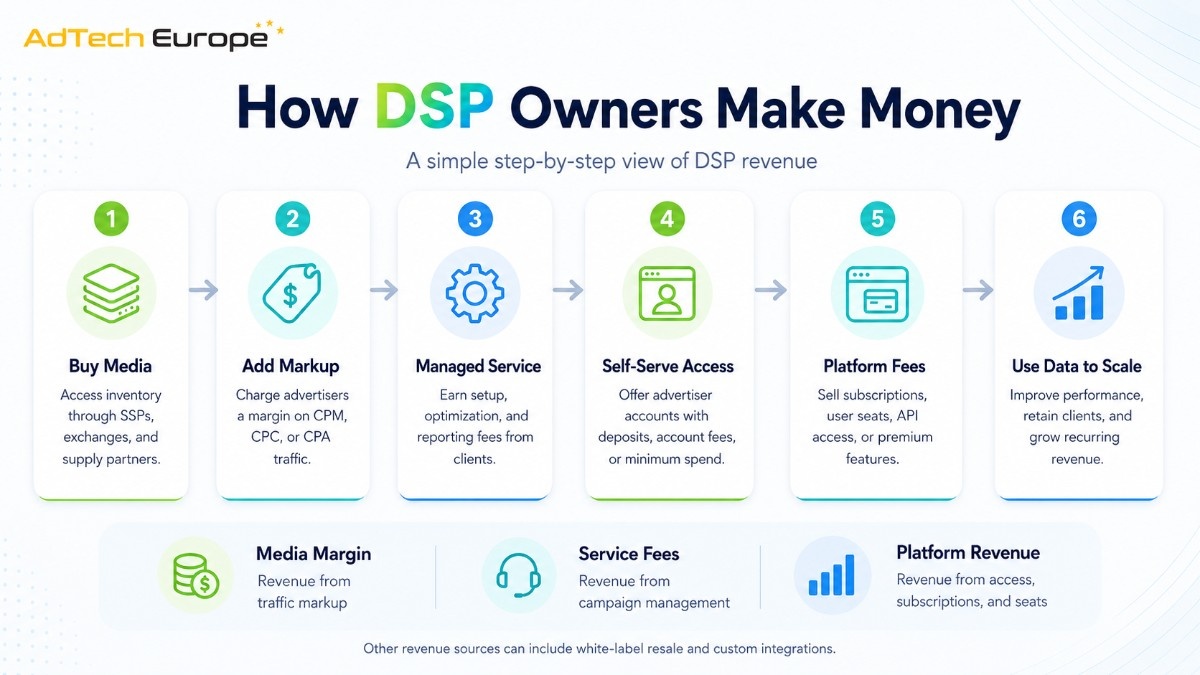
DSP owners make money by controlling the platform layer between advertisers and programmatic media supply. Instead of only buying traffic through another DSP, the owner can manage advertiser accounts, apply pricing margins, offer services, and build recurring platform revenue.
For agencies moving beyond rented tools, full DSP control can turn media buying into a stronger long-term business model.
1. Media Markup
Media markup is the most common revenue model.
The DSP owner buys traffic from supply partners and sells it to advertisers with an added margin. For example, the owner may buy impressions at one CPM and charge advertisers a higher CPM.
This works well for:
- Agencies
- Ad networks
- Managed service teams
- Performance media buyers
2. Managed Service Fees
Many advertisers need help with campaign setup, targeting, testing, optimization, and reporting.
DSP owners can charge for this support through:
- Monthly retainers
- Setup fees
- A percentage of media spend
- Performance-based fees
This lets the owner earn from both media margin and campaign management.
3. Self-Serve Advertiser Accounts
DSP owners can also offer self-serve access. Advertisers log in, create campaigns, add budgets, upload creatives, and review results.
Revenue can come from:
- Minimum monthly spend
- Account access fees
- Deposit-based buying
- Platform margin on traffic
This model can scale because advertisers handle part of the workflow themselves.
4. Platform Subscription or License Fees
Some DSP owners charge businesses for access to the platform.
This may include fees for:
- Extra user seats
- Advanced reporting
- API access
- Premium targeting
- Dedicated support
- Custom dashboard features
This works best when the DSP gives clear value beyond basic traffic buying.
5. White-Label Resale
A DSP owner can resell branded platform access to agencies, ad networks, or regional media companies.
Revenue may come from:
- Setup fees
- Monthly platform fees
- Branding fees
- Support packages
- Revenue share
This helps the owner earn B2B revenue without managing every advertiser directly.
6. Data and Optimization Value
A DSP collects useful campaign data over time. This includes performance by source, geo, device, format, creative, bid price, browser, OS, and conversion event.
That data helps the owner:
- Reduce wasted spend
- Block weak traffic
- Build whitelists and blacklists
- Improve bids
- Find profitable segments
- Keep advertisers longer
In simple terms, DSP revenue grows when the owner controls both the media buying system and the performance data behind it.
DSP Acquisition Cost and ROI
DSP acquisition cost depends on what the buyer receives, how much control is included, and how ready the platform is for commercial use. A low-cost DSP may look attractive at first, but the real value comes from source-code rights, infrastructure quality, supply access, reporting, support, and long-term scalability.
This matters because programmatic buying is still growing fast. According to IAB, U.S. internet ad revenue reached $294.6 billion in 2025, while programmatic advertising grew 20.5% year over year to $162.4 billion. That growth shows why many agencies, media buyers, and ad-tech businesses want more control over their own buying platform.
1. Main Cost Factors in DSP Acquisition
DSP acquisition is not one fixed price. The cost changes based on the platform model and what is included.
Common cost factors include:
- Full source-code access
- White-label branding
- Hosting and infrastructure setup
- OpenRTB or XML supply integrations
- Campaign management tools
- Reporting and analytics
- Anti-fraud and traffic quality controls
- Custom development needs
- Technical support and maintenance
- Advertiser account and billing setup
Before making a decision, buyers should use an acquisition checklist to review both business and technical requirements.
2. How to Estimate DSP ROI
DSP ROI is not only about saving money. It is about how much more value the business can create by owning the platform.
A simple ROI review should include:
- Current media spend
If your agency or buying team already spends large monthly budgets, platform ownership may help retain more margin. - Third-party platform fees
Review how much you currently pay in access fees, tech fees, managed service fees, or hidden media margins. - Revenue from advertisers
Estimate how many advertisers, clients, or partners can use the DSP after launch. - Media margin potential
Check how much margin you can keep from CPM, CPC, CPA, or managed campaigns. - Operational cost
Include hosting, support, AdOps, developers, monitoring, and campaign management. - Time to launch
A ready DSP can reduce the long development cycle needed to build a platform from scratch.
3. ROI Signals to Track After Launch
Once the DSP is live, ROI should be measured through real operating data.
| ROI Signal | What It Shows |
| Monthly media spend | How much buying volume moves through the DSP |
| Gross media margin | How much revenue remains after traffic cost |
| Advertiser retention | Whether clients keep using the platform |
| Platform fees | Recurring revenue from access or accounts |
| CPA or ROAS improvement | Whether better control improves campaign results |
| Source-level performance | Which traffic sources are worth scaling |
| Support and hosting cost | The real operating cost of ownership |
4. Example ROI Logic
If a business already spends heavily through third-party DSPs, acquisition can improve ROI by reducing dependency and keeping more value inside the business.
For example:
- An agency can keep more media margin from client campaigns.
- An ad network can open a self-serve buying platform.
- A media buyer can control bidding rules and traffic sources.
- A DSP operator can resell access through managed or white-label models.
The ROI becomes stronger when the DSP supports quality inventory, transparent reporting, reliable infrastructure, and flexible customization.
5. Cost vs Value: What Buyers Should Remember
The cheapest DSP is not always the best investment. A platform with weak code, poor reporting, limited supply, or no technical support can create higher costs later.
A better question is:
Does this DSP help the business keep more margin, control more data, reduce vendor limits, and create new revenue faster than the current setup?
If the answer is yes, DSP acquisition can be a practical long-term investment rather than only a software purchase.
Why Acquire a DSP Instead of Building From Scratch?
Building a DSP from zero can sound attractive, but it is complex. A modern DSP needs bidder logic, campaign tools, tracking, reporting, fraud controls, traffic integrations, user roles, billing logic, infrastructure, and ongoing maintenance.
Acquisition helps avoid the hardest early-stage risks.
Main advantages include:
- Faster launch
- Lower development risk
- Existing campaign tools
- Ready bidder and reporting logic
- Easier supply connection
- Source-code access for customization
- More control than hosted white-label access
- Shorter path to revenue
The best choice depends on your business stage. For many teams, license or ownership is a better decision than building everything from the first line of code.
What to Check Before Buying a DSP
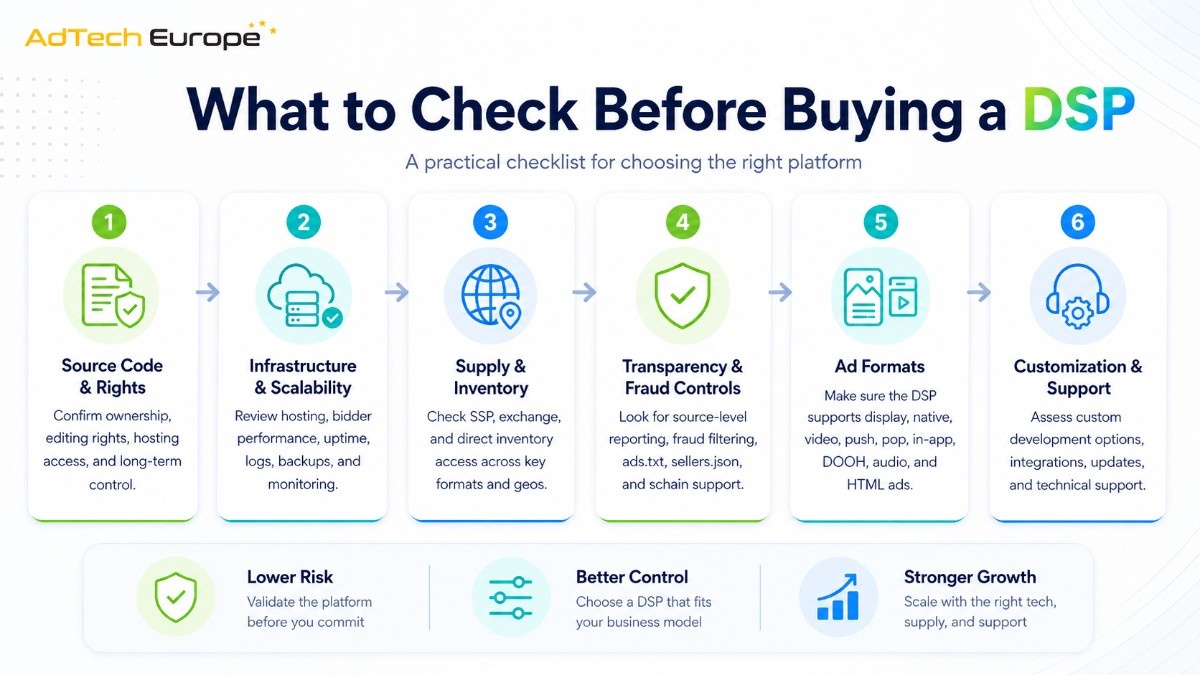
Before acquisition, review the platform like a business asset.
Source Code and Rights
Confirm what you receive. Check whether the source code can be modified, hosted, audited, and extended by your team.
Infrastructure and Scalability
Review hosting, QPS capacity, bidder performance, uptime, logs, backups, and monitoring.
Supply and Inventory
A DSP is only useful if advertisers can buy quality media. Make sure the platform can connect to ready ad supply across formats, geos, and traffic sources.
Transparency and Fraud Controls
Check support for source-level reporting, fraud filtering, ads.txt/app-ads.txt, sellers.json, SupplyChain Object, and placement-level optimization.
Ad Formats
Strong DSPs should support multiple formats such as display, native, push, pop, video, in-app, DOOH, audio, and HTML ads.
Custom Development
Every DSP owner eventually needs custom features. This may include new bidding rules, reporting views, advertiser permissions, payment logic, or unique integrations. A flexible custom build path helps protect long-term growth.
How AdTech Europe Supports DSP Acquisition
AdTech Europe helps advertisers, agencies, media buyers, ad networks, and ad-tech businesses acquire and operate their own programmatic DSP.
The platform supports:
- Full source-code access
- White-label branding
- DSP license and ownership options
- Multi-format campaign management
- OpenRTB and XML supply options
- Geo, device, OS, browser, and source targeting
- Anti-fraud integrations
- Campaign reporting and optimization
- Programmatic inventory access
- Custom development and technical support
For buyers that need traffic access after platform setup, AdTech Europe can also support premium global traffic for scalable programmatic growth.
Ready to Own Your Programmatic DSP?
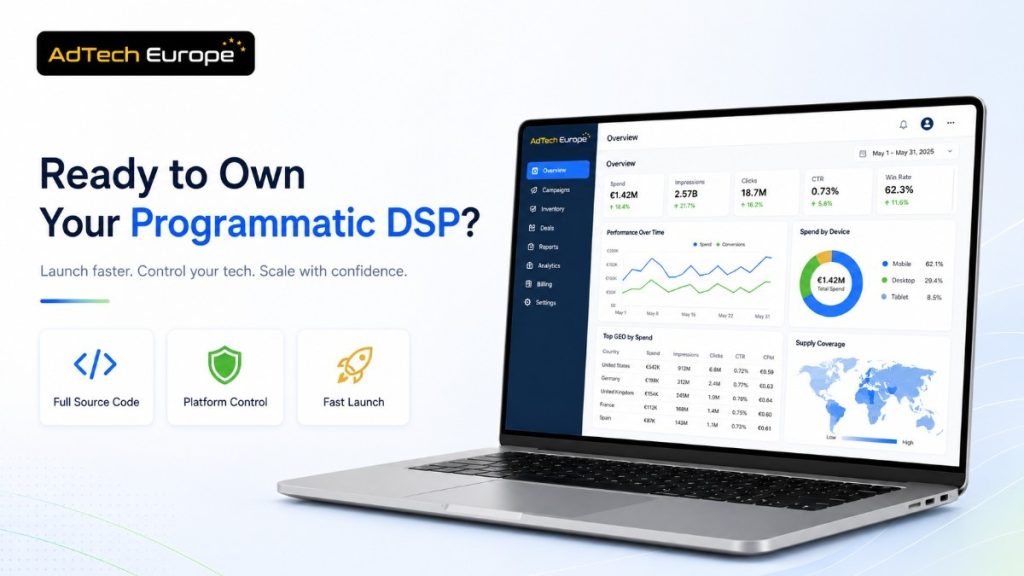
AdTech Europe helps advertisers, agencies, media buyers, ad networks, and DSP owners acquire a fully owned demand-side platform with source-code access, white-label branding, programmatic supply integrations, and scalable infrastructure.
Whether you want to launch your own DSP business, reduce dependence on third-party platforms, control your bidding logic, or build long-term programmatic revenue, connect with AdTech Europe for the technology, integrations, transparency, and ownership you need to operate your own DSP with confidence.
FAQS
Can I acquire a DSP if I do not have an in-house tech team?
Yes. You can acquire a DSP and use external support for setup, hosting, updates, and custom development.
Can I connect my own traffic partners after acquisition?
Yes. A source-code-owned DSP can usually be extended with your own SSPs, exchanges, traffic sources, or direct supply partners.
Is DSP acquisition only for large companies?
No. It is best for businesses with serious media buying needs, advertiser demand, or plans to build a programmatic revenue model.
Can I migrate advertisers from another platform?
Yes. Migration is possible if you prepare advertiser accounts, tracking links, campaign settings, billing rules, and reporting access.
Do I still need AdOps after buying a DSP?
Yes. DSP ownership gives control, but AdOps is still needed for campaign setup, source review, optimization, and quality checks.
What data should a DSP owner control?
A DSP owner should control campaign data, source data, conversion data, advertiser data, billing data, and optimization data.
Can a DSP support both self-serve and managed service clients?
Yes. Many DSP owners use both models. Self-serve clients run their own campaigns, while managed clients pay for expert campaign handling.
What is the biggest risk in DSP acquisition?
The biggest risk is buying software without checking source-code rights, supply access, infrastructure quality, support terms, and traffic transparency.