Programmatic growth looks simple from the outside. You choose a DSP, connect to traffic, launch campaigns, and optimize spend. But once budgets grow, many advertisers, agencies, and media buyers face the same problem: they do not fully control the platform that controls their buying.
That creates pressure. Fees rise. Custom bidding rules are limited. Data stays inside someone else’s system. Supply access depends on vendor rules, platform limits, and roadmap decisions you cannot control.
This is why DSP ownership vs access matters. Access helps you start. Ownership helps you scale with control, transparency, and long-term value.
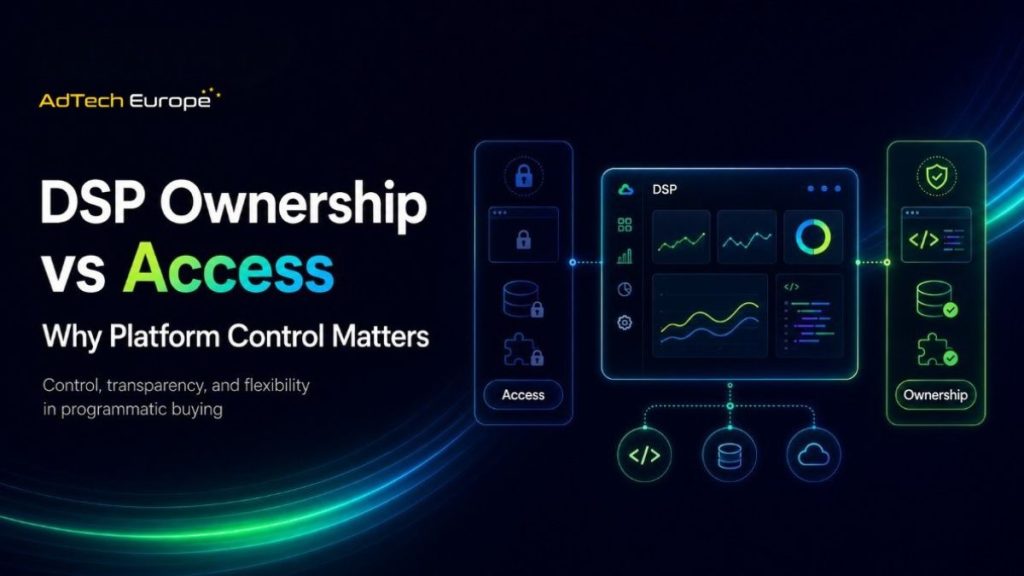
What DSP Ownership vs Access Means
DSP access means you use a platform owned by another provider. This can be a self-serve DSP, managed DSP, licensed DSP, or white-label DSP.
DSP ownership means your business controls the platform technology, source code, data, supply integrations, bidding logic, and infrastructure decisions.
For companies evaluating an owned DSP setup, the real question is not “Can I run campaigns?” It is “Can I control how my media buying business grows?”
| Model | What You Control | What You Usually Do Not Control |
| DSP access | Campaign setup, budgets, creatives, basic targeting | Source code, bidder logic, raw logs, platform roadmap |
| White-label DSP | Branding, client accounts, front-end experience | Core tech, deep customization, vendor rules |
| Full DSP ownership | Code, data, bidding logic, integrations, infrastructure | You must manage growth and operations |
Why Platform Control Matters in Programmatic Buying
A DSP is not only a media buying tool. It is the decision engine behind every bid.
When you own the platform, you can shape how bids are scored, how traffic is filtered, how budgets are paced, and how performance data is used.
This matters because programmatic buying depends on fast decisions. Every impression has a cost, quality signal, user context, placement type, and fraud risk.
With access-only models, your team often works inside fixed limits. With ownership, your team can build around your own business model.
Key control points advertisers should evaluate
- Bid logic and optimization rules
- QPS capacity and traffic volume limits
- Supply-path optimization controls
- Raw bidstream and event-level reporting
- Custom targeting and audience rules
- Fraud filters and brand safety settings
- Data storage, ownership, and export rights
- Infrastructure cost and scaling model
Key Areas to Cover When Comparing DSP Ownership and Access
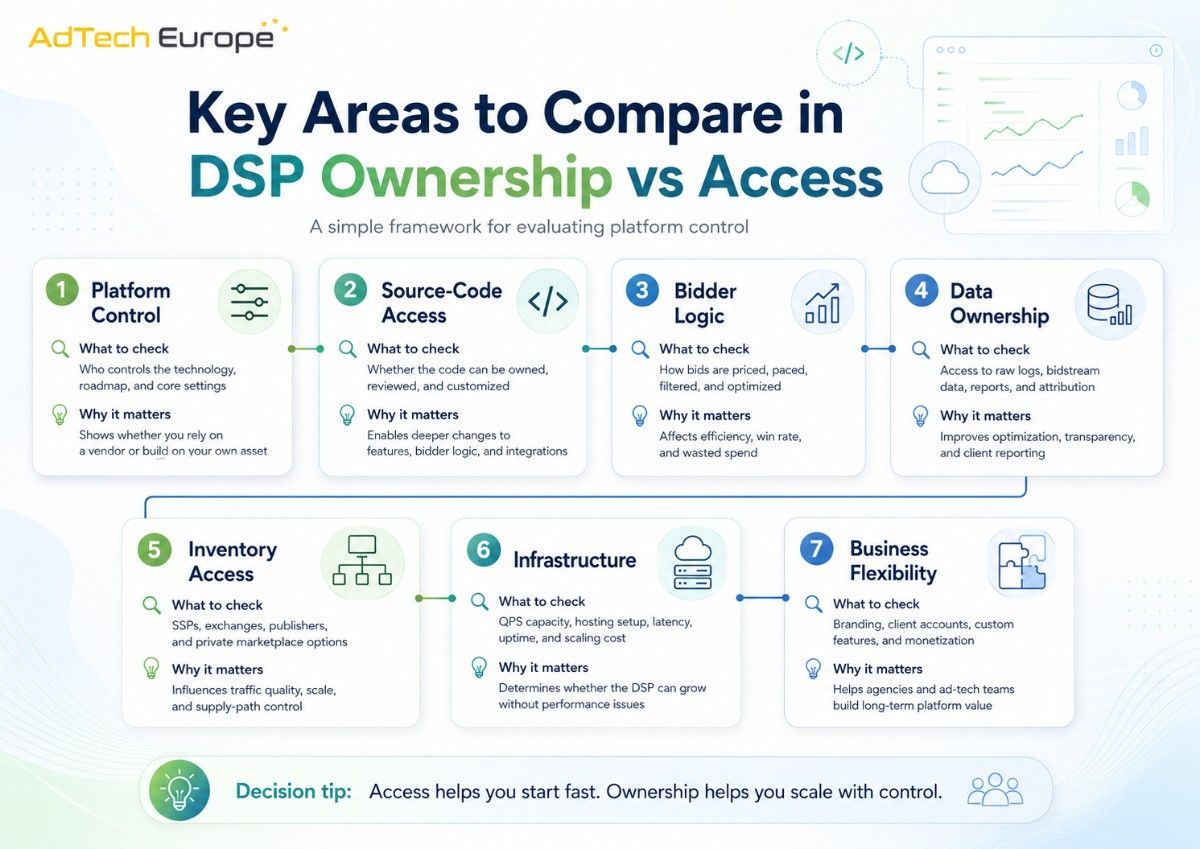
A strong DSP decision is not based on one feature. It depends on how much control your business needs across technology, data, inventory, cost, and scale.
The table below shows the main areas advertisers, agencies, and ad-tech teams should review before choosing a DSP model.
| Area to Review | What to Check | Why It Matters |
| Platform control | Who controls the DSP technology, roadmap, and core settings | Shows whether you are building on your own asset or depending on a vendor |
| Source-code access | Whether the DSP code can be owned, reviewed, and customized | Supports deeper changes to bidder logic, features, and integrations |
| Bidder logic | How bids are priced, paced, filtered, and optimized | Impacts campaign efficiency, win rate, and wasted spend |
| Data ownership | Access to raw logs, bidstream data, reports, and attribution data | Helps improve optimization, transparency, and client reporting |
| Inventory access | SSPs, exchanges, direct publishers, and private marketplace options | Affects traffic quality, scale, and supply-path control |
| Infrastructure | QPS capacity, hosting setup, latency, uptime, and scaling cost | Determines whether the DSP can handle growth without performance issues |
| Business flexibility | Branding, client accounts, custom features, and monetization options | Helps agencies and ad-tech companies build long-term platform value |
When these areas are reviewed together, the choice becomes clearer. DSP access may be enough for simple campaign buying, while DSP ownership is stronger when control, customization, and long-term growth matter.
DSP Access: When It Makes Sense
DSP access is useful when speed matters more than control.
It can work well for:
- New agencies testing programmatic demand
- Small media buyers learning traffic quality
- Brands running limited campaigns
- Teams without technical resources
- Businesses validating client demand
A licensed or white-label platform can help you start fast. A clear DSP acquisition workflow can also help teams understand when access should turn into ownership.
Access is not wrong. It is just not always enough.
DSP Ownership: When Control Becomes the Advantage
DSP ownership becomes important when your business depends on programmatic performance, margin, and scale.
This matters because programmatic buying is now a major part of digital advertising: the IAB/PwC Internet Advertising Revenue Report found that programmatic advertising revenue reached $134.8 billion in 2024, growing 18.0% from the previous year.
As more media spend moves through automated buying, the platform behind each bid becomes more than a tool; it becomes a business asset.
Ownership gives you:
- Full platform independence
- Better control over bidding rules
- Freedom to connect preferred supply partners
- Direct access to campaign and bidstream data
- Room for custom features and client tools
- Long-term asset value
For teams comparing models, a buyer fit guide can help decide whether ownership matches current budgets, traffic volume, and growth goals.
Overlooked Factors in DSP Ownership Decisions
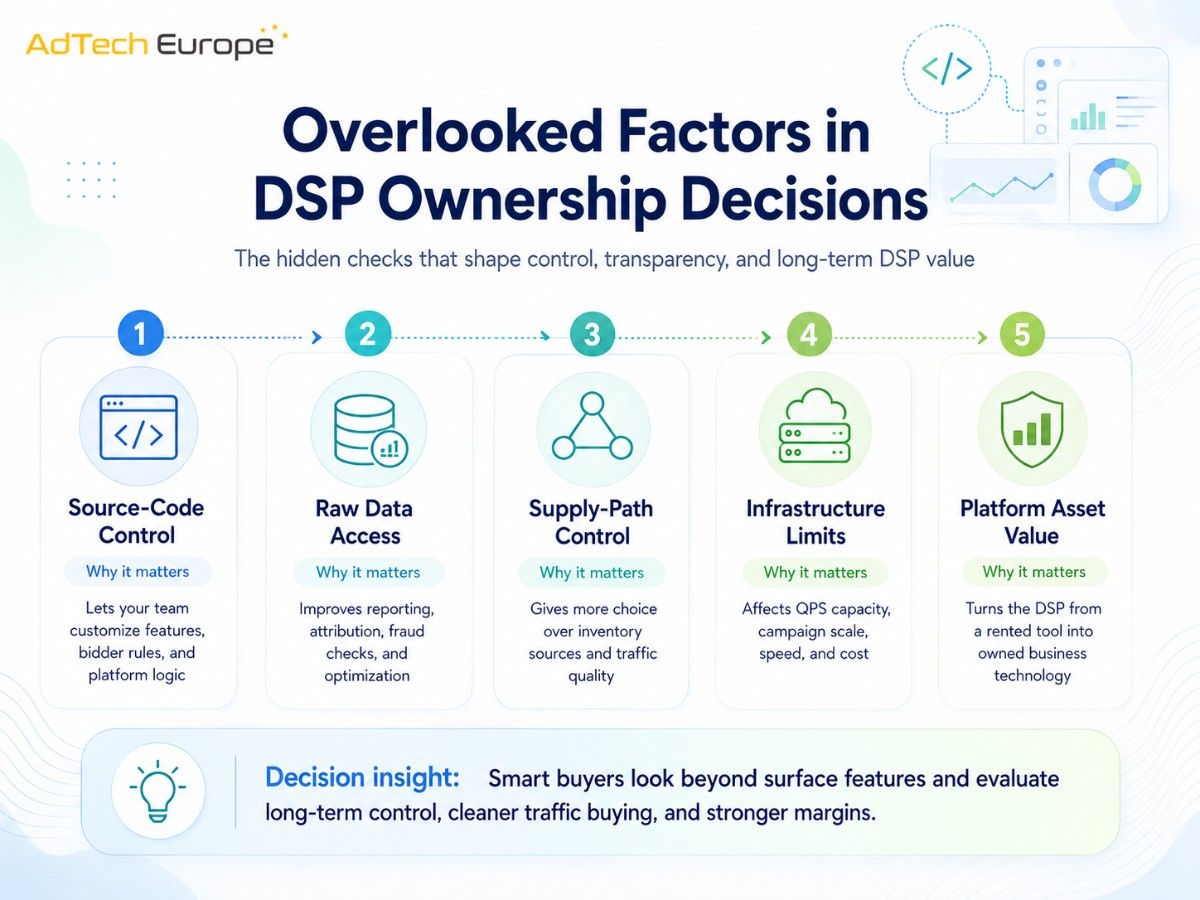
Most DSP comparisons focus on surface-level features like branding, campaign setup, targeting, and access to inventory. These are important, but they do not show the full picture.
For advertisers, agencies, and media buyers, the bigger question is whether the platform can support long-term control, cleaner traffic buying, and stronger margins.
| Overlooked Factor | Why It Matters |
| Source-code control | Lets your team customize features, bidder rules, and platform logic |
| Raw data access | Helps improve reporting, attribution, fraud checks, and optimization |
| Supply-path control | Gives more choice over inventory sources and traffic quality |
| Infrastructure limits | Affects QPS capacity, campaign scale, speed, and cost |
| Platform asset value | Turns the DSP from a rented tool into owned business technology |
A DSP should not only help you launch campaigns. It should help you build a stronger programmatic business.
This is where ownership creates a clear advantage. Instead of relying on a vendor’s fixed roadmap, your business can shape the platform around its own buying strategy, clients, supply partners, and revenue goals.
DSP Ownership vs Access: Practical Decision Table
Use this table to match your business goal with the right DSP model. The best choice depends on how much control, speed, and flexibility your team needs.
| Business Goal | Better Fit | Reason |
| Launch quickly | DSP access | Lower setup work |
| Test client demand | License or white-label | Faster validation |
| Reduce vendor lock-in | DSP ownership | More platform control |
| Customize bidder logic | DSP ownership | Requires deeper code access |
| Build long-term ad-tech value | DSP ownership | Platform becomes an asset |
| Control traffic quality | DSP ownership | Better supply and data control |
| Manage small campaigns | DSP access | Simpler operations |
If source code is a key requirement, DSP source-code access should be part of the buying discussion from day one.
Why Inventory Control Is Part of DSP Ownership
DSP ownership is not only about code. It is also about traffic access.
A DSP needs reliable programmatic inventory from SSPs, exchanges, publishers, and supply partners. Without strong inventory, even the best bidder has limited value.
Owned platforms can be built around preferred inventory supply paths, cleaner traffic sources, and stronger margin control.
This helps buyers reduce wasted spend and avoid overdependence on a single vendor’s supply mix.
What quality inventory should support
- Global traffic access
- Multiple ad formats
- Transparent supply sources
- Fraud and quality checks
- Scalable volume
- Campaign-level performance data
For growth teams, premium traffic access can support faster campaign scaling when paired with the right platform controls.
When Agencies Should Move Beyond White Label
White-label DSPs are useful when branding and speed matter. But as agencies grow, the limits become clearer.
You may need custom reports, direct supply integrations, unique bidding rules, client billing tools, or private marketplace access. At that point, a white-label upgrade path becomes a strategic move.
The shift is simple: stop renting the surface layer and start owning the engine.
How to Choose the Right DSP Model
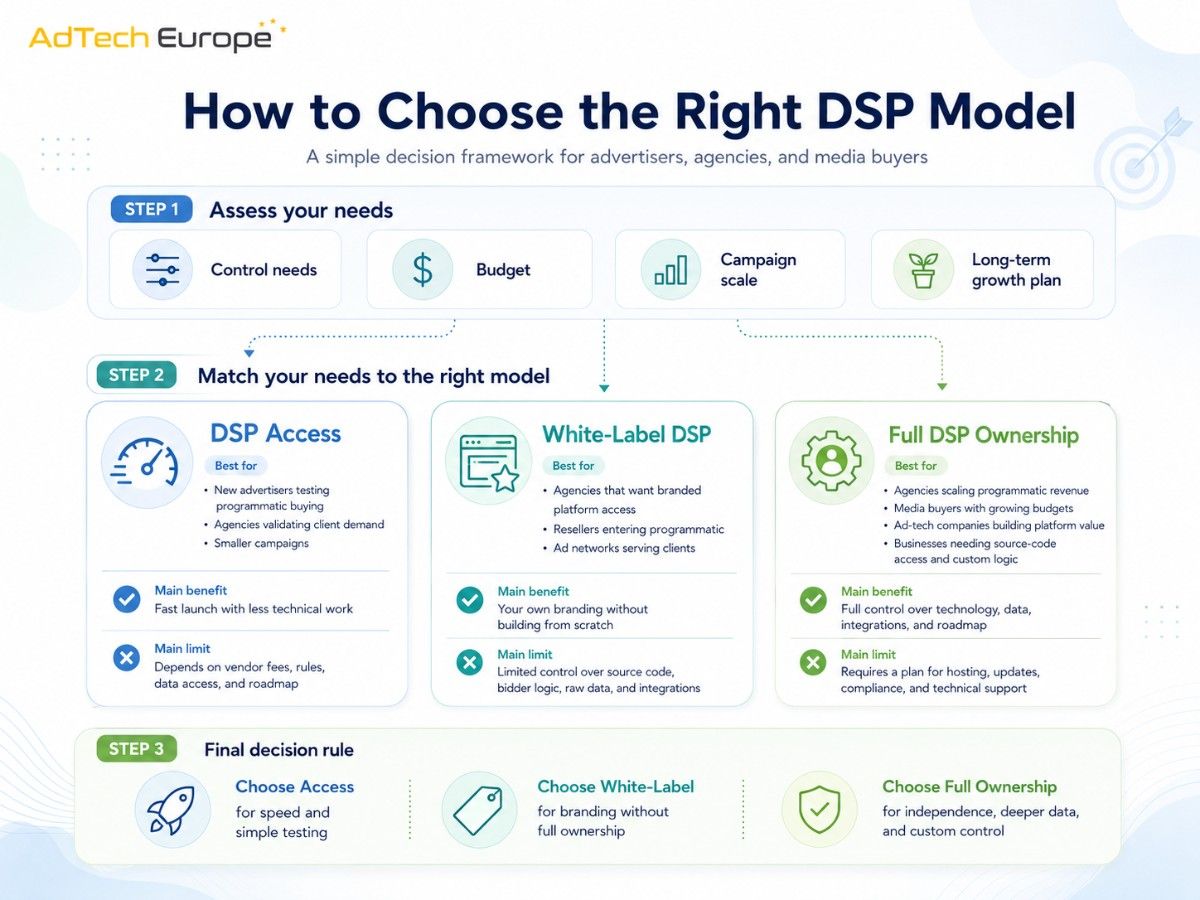
Choosing the right DSP model depends on your control needs, budget, campaign scale, and long-term growth plan. A clear DSP model comparison can help you avoid paying for a setup that does not match your business stage.
1. Choose DSP Access If:
Best for:
- New advertisers testing programmatic buying
- Agencies validating client demand
- Media buyers running smaller campaigns
- Teams that need fast launch with less technical work
Main benefit:
You can start quickly without managing the platform, hosting, or core technology.
Main limit:
You depend on another provider’s fees, rules, data access, and roadmap.
2. Choose White-Label DSP If:
Best for:
- Agencies that want branded platform access
- Resellers entering the programmatic market
- Ad networks offering DSP services to clients
Main benefit:
You get your own branding without building the full DSP from scratch.
Main limit:
You may still lack full control over source code, bidder logic, raw data, and supply integrations.
3. Choose Full DSP Ownership If:
Best for:
- Agencies scaling programmatic revenue
- Media buyers with growing budgets
- Ad-tech companies building long-term platform value
- Businesses that need source-code access and custom logic
Main benefit:
You control the technology, bidding rules, data, integrations, infrastructure, and roadmap.
Main limit:
You need a proper plan for hosting, updates, compliance, and technical support. A practical DSP buying checklist can make this decision easier before investing.
4. Final Decision Rule:
Choose DSP access if: you need speed and simple campaign testing.
Choose white-label DSP if: you need branding but not full technology ownership.
Choose full DSP ownership if: you need independence, deeper data, custom bidding logic, and long-term control.
Ready to Own Your Programmatic DSP?
AdTech Europe helps advertisers, agencies, media buyers, ad networks, and DSP owners move from limited DSP access to full platform control.
With source-code access, white-label branding, supply integrations, custom development, scalable infrastructure, and global inventory options, AdTech Europe gives your business the tools to operate with more independence.
If your goal is to reduce wasted spend, improve traffic buying, control bidding logic, or build long-term programmatic revenue, a fully owned DSP can turn your media buying operation into a real ad-tech asset.
FAQs
Is DSP ownership better than using a popular self-serve DSP?
Not always. A self-serve DSP is better for quick campaign access. DSP ownership is better when you need control, custom logic, data ownership, and long-term scale.
Do I need an engineering team to own a DSP?
You do not always need a large team. But you need technical support for hosting, updates, integrations, and system monitoring.
Can an owned DSP connect to multiple inventory sources?
Yes. An owned DSP can connect to SSPs, ad exchanges, private marketplaces, and direct supply partners, depending on integration support.
What is the biggest risk of DSP access?
The biggest risk is dependency. Your growth depends on another company’s pricing, rules, roadmap, data access, and technical limits.
Does source-code access improve campaign performance?
It can. Source-code access allows deeper changes to bidder logic, filters, reporting, and optimization tools. Performance still depends on strategy, inventory quality, and data.
Is DSP ownership only for large companies?
No. It is best for companies with serious programmatic goals, growing budgets, or plans to build an ad-tech business. Smaller teams may start with access first.
How does DSP ownership reduce wasted ad spend?
It gives more control over traffic filters, bidding rules, data analysis, and supply selection. This helps teams cut low-quality impressions and focus spend on better traffic.