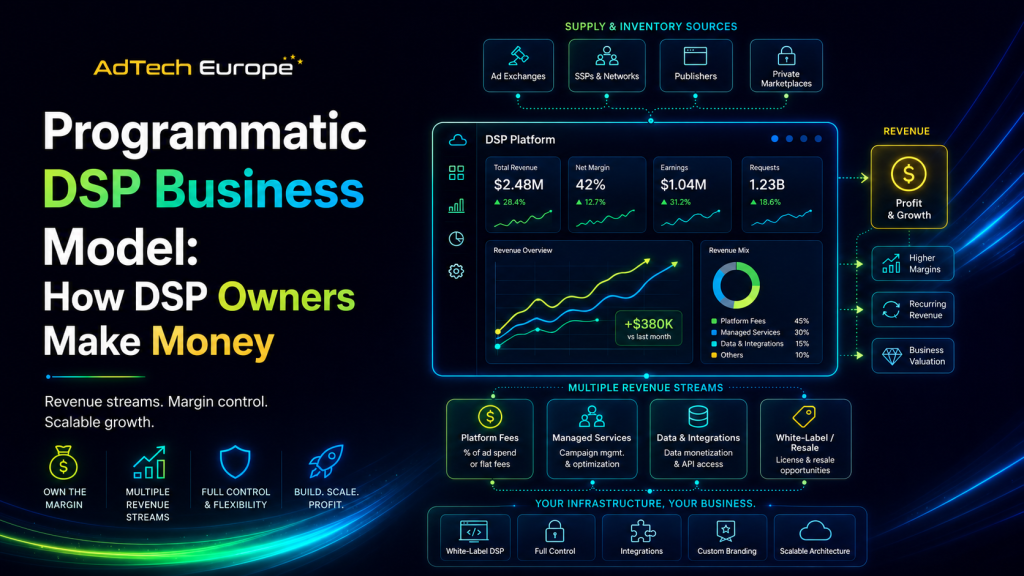
Many advertisers use DSPs to reach audiences across display, native, mobile, video, CTV, and other programmatic channels. But using a DSP and owning a DSP are two very different business models. One gives you access. The other gives you control.
This matters because control affects profit. When you rely only on third-party access, you may have limited visibility into fees, supply paths, bidding logic, and traffic quality. For agencies, media buyers, and ad networks, that can reduce margin and make scaling harder.
In this guide, you will learn how the DSP business model works from the owner’s point of view. We will explain how DSP owners generate revenue, what costs they must manage, and how ownership can help businesses build long-term programmatic value.
What Is the DSP Business Model?
A DSP business model explains how a demand-side platform earns money from programmatic media buying.
A DSP helps advertisers buy digital ad inventory across websites, apps, video, native, display, push, pop, CTV, and other channels. It connects demand to supply sources such as SSPs, ad exchanges, publishers, and traffic partners.
Dentsu’s May 2026 forecast says global ad spend is projected to grow 5.0% in 2026, which shows why advertisers are still investing in scalable media systems.
For a DSP owner, the platform is not only software. It is a revenue engine.
A DSP can earn money from:
- Media spend fees
- Managed service margins
- Platform access fees
- White-label resale
- Inventory markups
- Data and optimization services
- Custom integrations
- Reporting and support packages
For businesses reviewing an owned DSP setup, the key question is simple: do you want to rent access, or do you want to control the buying infrastructure?
How DSP Owners Make Money
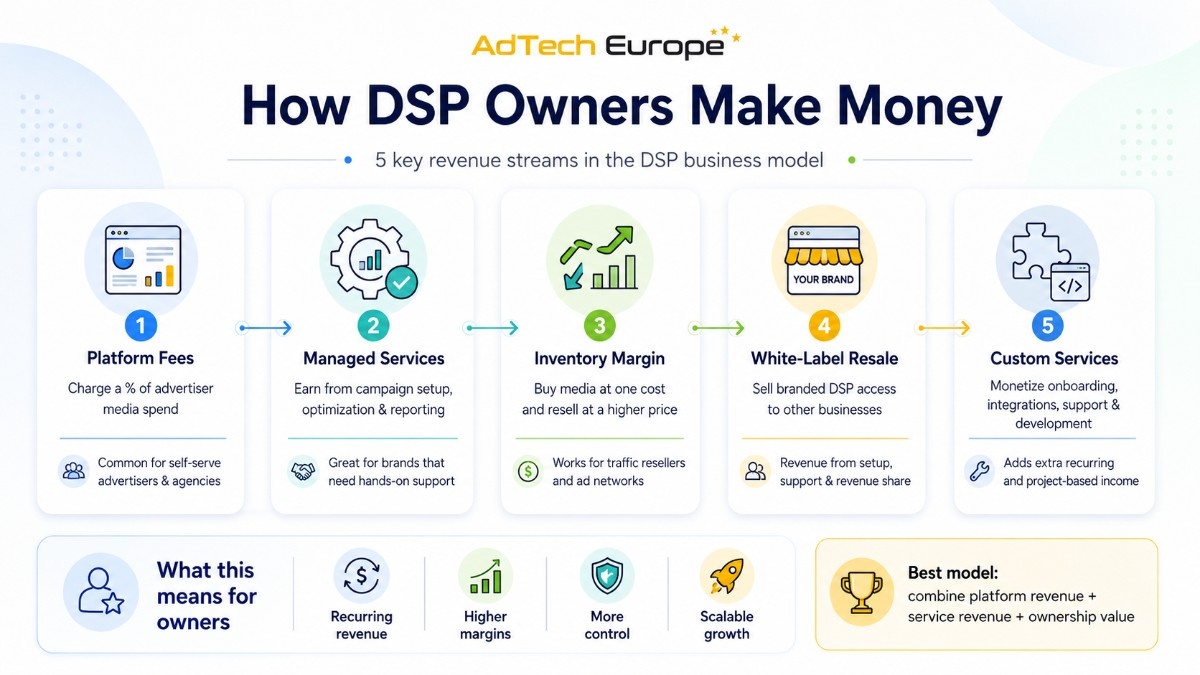
DSP owners usually earn revenue in several ways. The best model depends on the buyer type, campaign volume, supply access, and level of ownership.
Fortune Business Insights estimates the global DSP market will reach $48.19 billion in 2026, so ownership is becoming a serious infrastructure decision, not only a media buying choice.
| Revenue stream | How it works | Best for |
| Platform fee | DSP charges a percentage of media spend | Self-serve advertisers and agencies |
| Managed service margin | DSP team manages campaigns and keeps a service margin | Brands without in-house media buyers |
| Media spread | Owner buys inventory at one cost and sells it at a higher price | Ad networks and traffic resellers |
| White-label resale | Owner sells branded DSP access to other companies | B2B ad-tech businesses |
| Setup and support fees | Client pays for onboarding, training, and support | Enterprise advertisers |
| Custom development | Clients pay for special features or integrations | Advanced DSP owners |
1. Media Spend Fees
The most common DSP revenue model is a percentage fee on advertiser spend.
For example, if an advertiser spends €100,000 per month and the DSP charges 10%, the DSP earns €10,000 in platform revenue.
IAB’s 2026 Outlook Study projects total U.S. ad spend to rise 9.5% in 2026, which makes fee visibility more important as advertiser budgets grow.
This model is simple and easy to scale. As advertiser spend grows, DSP revenue grows with it.
However, advertisers often want clear fee visibility. Hidden fees can reduce trust and make campaigns harder to optimize. This is why businesses moving into DSP control models often care about transparent billing, auction logs, and supply path reporting.
2. Managed Service Margins
Some DSP owners do not only provide the platform. They also manage campaigns for clients.
In this model, the DSP owner may handle:
- Campaign setup
- Targeting
- Creative approval
- Bid optimization
- Traffic quality checks
- Reporting
- Budget pacing
The owner can charge a service fee or keep a margin inside the media budget.
This works well for agencies and media buying teams that already know how to optimize traffic. It also creates a stronger client relationship because the DSP owner is not just selling software. They are selling performance.
3. Inventory Margin and Traffic Resale
Some DSP owners make money by connecting to supply, buying inventory, and reselling access to advertisers.
This model depends on traffic quality, price control, and supply relationships.
If a DSP owner has strong inventory partners, they can build margin by offering advertisers access to quality traffic at scale. This is one reason why programmatic supply access matters when evaluating a DSP business.
Inventory margin must be handled carefully. If the markup is too high, advertisers may lose performance. If the traffic quality is weak, the DSP owner may face refunds, churn, or brand safety issues.
4. White-Label DSP Resale
A DSP owner can also sell branded platform access to other businesses.
This is common for:
- Agencies
- Ad networks
- Affiliate networks
- Regional media companies
- Niche traffic businesses
- Performance marketing teams
The buyer gets a branded dashboard, while the DSP owner earns from setup fees, monthly access, support, and revenue share.
This model is attractive because it creates recurring B2B income. But it works best when the platform has strong permissions, client account control, billing logic, and reporting layers. Businesses comparing a white-label route should review how much control they keep over source code, data, and infrastructure.
5. Source-Code Ownership and Long-Term Profit
The biggest difference in the DSP business model is ownership.
When you only access a DSP, you can run campaigns, but you may not control the source code, bidder logic, data structure, roadmap, or infrastructure decisions.
When you own the DSP, you can control how the platform grows.
Dentsu’s 2026 forecast expects programmatic advertising to account for more than four-fifths of digital investment, which makes owned bidding logic more valuable for high-volume buyers.
| Model | What you control | Main limitation |
| Self-serve DSP | Campaigns, budgets, targeting | Limited platform control |
| White-label DSP | Branding and client access | Vendor still controls core technology |
| Licensed DSP | More operational control | May still depend on vendor rules |
| Owned DSP | Code, data, integrations, bidding logic | Requires stronger operations |
For companies moving past self-serve DSP limits, source-code access can turn the DSP from a media buying tool into a business asset.
With source-code ownership, a DSP owner can add features, build private integrations, adjust bidder logic, improve fraud filters, and create new revenue products.
Key Costs in a DSP Business Model
DSP revenue is only one side of the model. Owners must also understand costs.
Important cost areas include:
- Server and infrastructure costs
- QPS and bid request processing
- Data provider fees
- Anti-fraud tools
- Ad verification tools
- Developer support
- Account management
- Payment processing
- Compliance and privacy operations
A DSP with high campaign spend can still lose money if infrastructure costs, traffic waste, and support costs are not controlled.
This is why ownership should be reviewed with the DSP acquisition process in mind. The business model, technology, inventory, and support structure must work together.
What Makes a DSP Business Profitable?
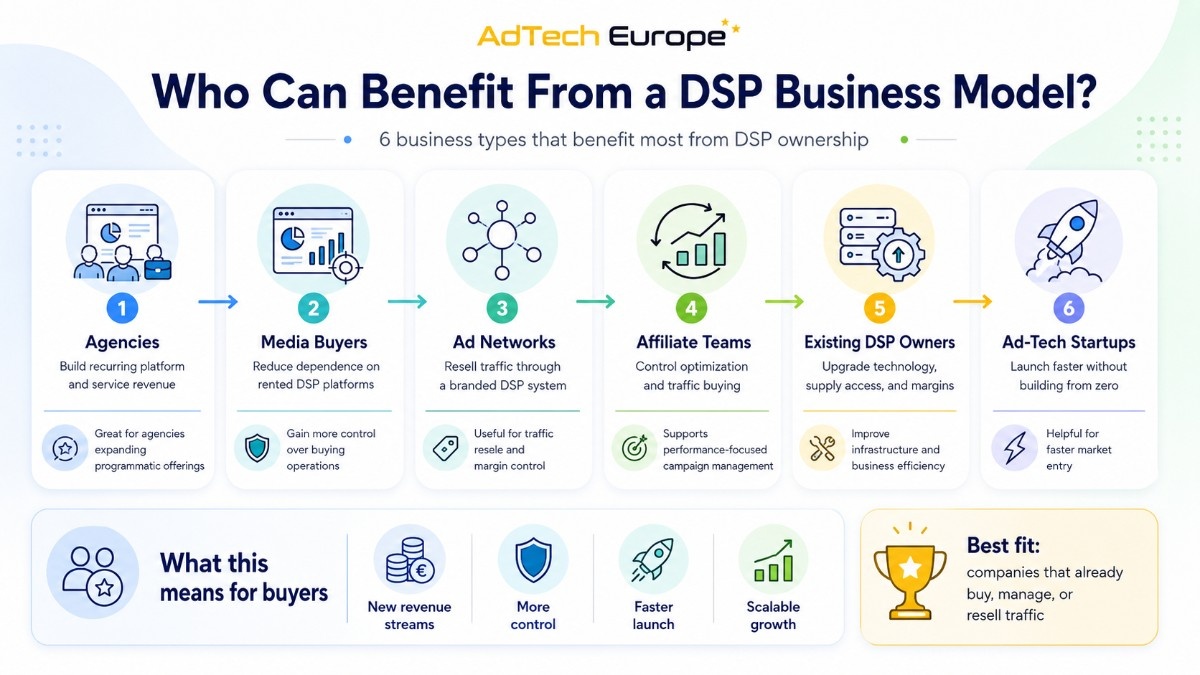
A DSP business becomes profitable when revenue grows faster than the costs needed to run campaigns, process bids, manage clients, and access inventory. High ad spend helps, but profit depends on how well the DSP owner controls fees, traffic quality, infrastructure, and advertiser retention.
Dentsu’s 2026 forecast expects digital advertising to grow 6.7% and represent 68.7% of total ad investment, which shows why DSP owners need systems that can scale with rising digital budgets.
1. Strong Media Spend Volume
Most DSPs earn money from a percentage of advertiser spend. This means revenue grows as more budgets flow through the platform.
| Monthly advertiser spend | DSP fee | DSP revenue |
| €100,000 | 10% | €10,000 |
| €250,000 | 10% | €25,000 |
| €1,000,000 | 10% | €100,000 |
But spend alone is not enough. A DSP owner must also control supply costs, fraud tools, data fees, support costs, and infrastructure expenses.
2. Clear Fee and Margin Control
Profit improves when the DSP owner knows exactly where money is going. This includes platform fees, SSP fees, data costs, verification tools, and managed service costs.
Adalytics found average SSP supply fees around 23%, so DSP owners with better supply-path visibility can protect margin and give advertisers more transparent value.
Even a small margin change matters. On €100,000 in monthly spend, a 10% fee creates €10,000 in revenue, while a 15% fee creates €15,000.
3. Better Inventory Quality
Cheap traffic does not always create profit. If traffic is low quality, advertisers may see weak conversions, wasted spend, and poor campaign results.
A profitable DSP needs clean supply, reliable publishers, low invalid traffic, and clear reporting. Programmatic advertising is expected to account for more than four-fifths of digital investment in 2026, so traffic quality becomes more important as budgets grow.
4. Efficient Platform Costs
DSPs process large numbers of bid requests. If the platform bids on too much low-value traffic, infrastructure costs can rise faster than revenue.
A profitable DSP should monitor bid request cost, win rate, timeout rate, server cost, and campaign performance. The goal is to spend processing power on traffic that has a real chance to win and convert.
5. Repeat Advertiser Budgets
DSP profit becomes stronger when advertisers keep spending every month. Retention lowers sales pressure and increases long-term revenue.
IAB’s 2026 Outlook Study projects U.S. ad spend to rise 9.5% in 2026, so DSP owners that keep advertisers happy are better positioned to capture growing budgets.
Advertisers usually stay when they get clear reporting, stable performance, transparent fees, useful inventory, and fast support.
6. Multiple Revenue Streams
The most profitable DSP businesses do not depend on one income source. They often combine platform fees, managed service fees, inventory margin, white-label access, setup fees, and custom development.
Fortune Business Insights estimates the global DSP market will reach $48.19 billion in 2026, which shows why DSP ownership can become a long-term revenue asset for agencies, ad networks, and media buying companies.
In simple terms, a profitable DSP business needs scale, clean supply, cost control, and repeat advertisers. High spend creates revenue, but smart ownership decides how much profit remains.
Who Can Benefit From a DSP Business Model?
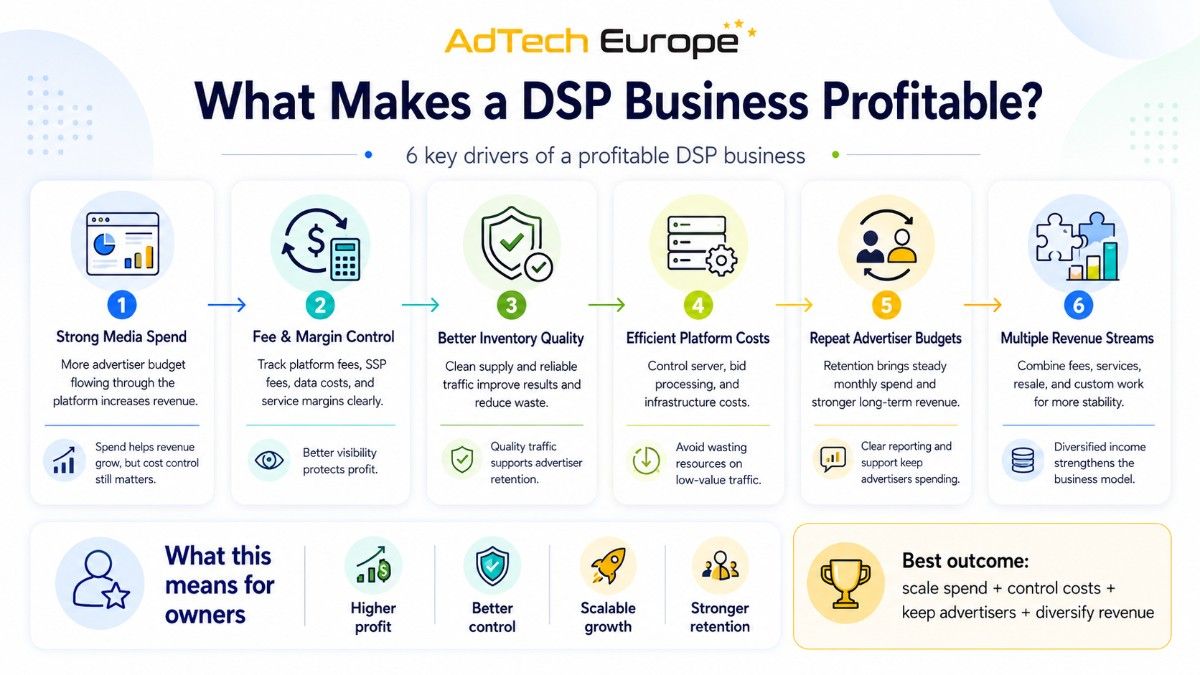
A DSP business model can work well for companies that already buy, manage, or resell traffic.
| Business type | Why DSP ownership helps |
| Agencies | Build recurring platform and service revenue |
| Media buyers | Reduce dependency on rented platforms |
| Ad networks | Resell traffic through their own branded system |
| Affiliate teams | Control optimization and traffic buying |
| Existing DSP owners | Upgrade technology, supply, and margins |
| Ad-tech startups | Launch faster without building from zero |
For companies unsure whether ownership fits their stage, a DSP buyer checklist can help review budget, team skills, supply needs, and growth goals.
Best Revenue Model for DSP Owners
There is no single best model for every DSP owner.
A small agency may start with managed service fees.
A media buying company may focus on margin control. An ad network may earn through resale.
A larger ad-tech company may combine platform fees, supply access, white-label accounts, and custom development.
The strongest DSP business model often combines three layers:
- Platform revenue from usage
- Service revenue from support and optimization
- Ownership value from code, data, integrations, and infrastructure
This creates a more stable business than depending on one fee type only.
Ready to Own Your Programmatic DSP?
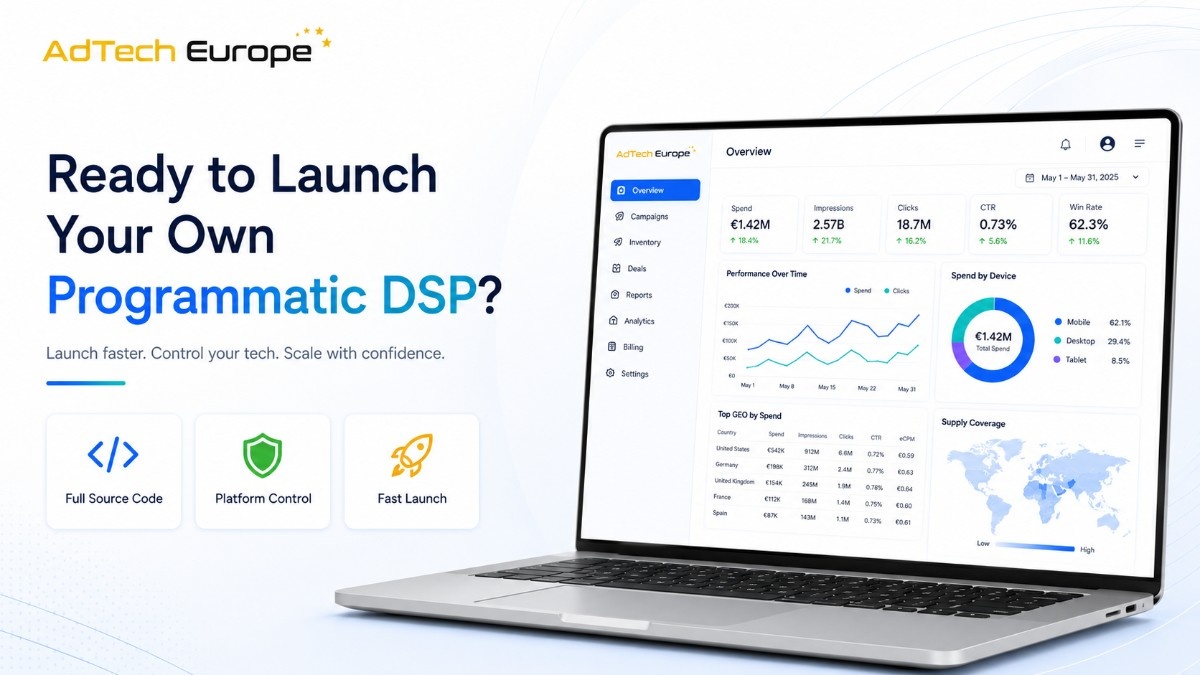
AdTech Europe helps advertisers, agencies, media buyers, ad networks, and DSP owners acquire a fully owned demand-side platform with source-code access, white-label branding, scalable infrastructure, supply integrations, and custom ad-tech development.
Whether you want to launch your own DSP business, reduce dependence on third-party platforms, improve buying transparency, access premium traffic supply, or build long-term programmatic revenue, AdTech Europe gives you the technology, integrations, and ownership structure needed to operate with confidence.
FAQs
Why choose AdTech Europe for DSP ownership?
AdTech Europe is built for businesses that want more control over programmatic buying, platform fees, inventory access, bidding logic, and long-term DSP revenue instead of relying only on third-party DSP access.
Is a DSP business model only for large companies?
No. It can work for agencies, media buyers, ad networks, and startups if they have traffic knowledge, advertiser demand, and a clear growth plan.
How much money can a DSP owner make?
It depends on media spend, fee structure, supply cost, advertiser retention, and infrastructure expenses. Higher spend does not always mean higher profit.
Can a DSP owner sell access to other advertisers?
Yes. Many DSP owners earn by offering self-serve accounts, managed accounts, or white-label platform access to other businesses.
What is the biggest risk in a DSP business?
The biggest risks are poor traffic quality, hidden supply costs, weak fraud control, high infrastructure costs, and low advertiser retention.
Is source-code access important for DSP profit?
Yes. Source-code access gives the owner more control over bidding logic, reporting, integrations, optimization, and long-term platform value.
Can a DSP owner connect private inventory partners?
Yes. A DSP owner can connect SSPs, ad exchanges, publishers, or private traffic partners if the platform supports those integrations.