A media buyer used to log in to a DSP, build a campaign by hand, upload banners and check the report the next morning. More and more, that work is being handed to software agents. An AI agent can now ask a seller what inventory it has, compare the offers, book a buy and pull the delivery numbers, all without a person clicking through screens.
For that to work, buyer agents and seller agents need a shared language. Without one, every agent would need a custom integration with every platform, which is the same problem programmatic advertising solved years ago with OpenRTB. The Ad Context Protocol, or AdCP, is the open standard that is trying to become that shared language for agentic ad buying.
This guide explains what AdCP is, who is behind it, how buyer and seller agents talk to each other, which tasks the protocol covers, and what it means if you run a DSP, an SSP or an ad exchange. All facts are as of November 2026 and link to their sources.
What Is AdCP?
AdCP is an open standard for agentic advertising. It defines how AI agents that buy media and AI agents that sell media can discover each other’s capabilities, exchange offers, place orders and report on delivery. The official documentation lives at docs.adcontextprotocol.org and the specification is developed in the open on GitHub.
The name started as Ad Context Protocol. Since version 3.0 the project calls itself Advertising Context Protocol, but the acronym is still AdCP, and both names refer to the same standard. As of November 2026 the current version is AdCP 3.2, which is generally available. The project is run under AgenticAdvertising.org, an industry organization.
AdCP does not replace real-time bidding. OpenRTB is about one impression and one bid in a few milliseconds. AdCP works one level higher: it is about planning and booking a media buy, the kind of work that a trader or account manager does over hours or days. In many setups, the buy that an agent books through AdCP is still delivered through the normal ad serving and bidding stack underneath.
Who launched AdCP?
AdCP launched in October 2025. Scope3, Yahoo and PubMatic were among the companies leading the effort, and Triton Digital and Optable were also named at launch. Since then the specification has moved quickly through several versions, and more ad tech companies have started to build on it.
How Buyer Agents and Seller Agents Work
AdCP is built around two roles. A buyer agent works for an advertiser or an agency. It receives a goal in plain language, such as a budget, an audience, a date range and a channel, and it goes looking for inventory that fits. A seller agent works for a publisher, an SSP, an ad network or any platform that has inventory to sell. It answers questions about that inventory and accepts or rejects orders.
The two agents do not talk through a web page. They talk through structured tasks that both sides understand. AdCP runs over two transports that already exist in the AI world: MCP (Model Context Protocol), which lets AI assistants call tools, and A2A (Agent2Agent), which lets agents work with other agents. A seller that exposes AdCP over these transports can be reached by any compliant buyer agent, without a custom integration for each one.
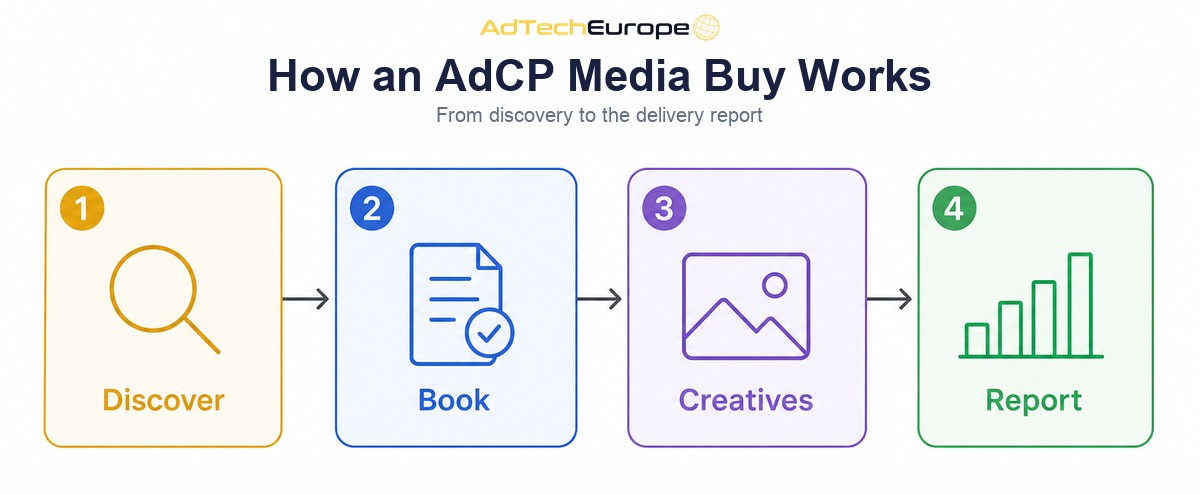
A typical media buy through AdCP looks like this:
- Discover. The buyer agent asks the seller agent what it can do and what products it offers (get_adcp_capabilities and get_products). Products describe inventory, formats, targeting and pricing options.
- Book. The buyer agent picks a product and places an order with create_media_buy. The seller agent can accept it, reject it or hold it for review.
- Creatives. The buyer agent sends or updates the ads with sync_creatives, so the seller can check and attach them.
- Adjust. During the flight the buyer can change the buy with update_media_buy, for example to pause it, resume it or change the budget.
- Report. The buyer agent pulls delivery numbers with get_media_buy_delivery and uses them to decide what to do next.
Two safety details are worth knowing. First, buyer requests can be signed with RFC 9421 HTTP Message Signatures, so the seller can check that a request really comes from the agent it claims to be and was not changed on the way. Second, requests carry an idempotency_key. If a response is lost and the agent sends the same request again, the seller recognises the retry and returns the original buy instead of booking it twice. When money is involved, that matters.
The Main AdCP Tasks
The protocol is organised into task groups. The table below lists the ones most platforms care about first. The full list, with request and response formats, is in the AdCP documentation.
| Task | What it does | Who calls it |
| get_adcp_capabilities | Tells the buyer which AdCP features and versions the seller supports | Buyer agent |
| get_products | Returns the inventory products the seller offers for a brief | Buyer agent |
| create_media_buy | Places an order for one or more products | Buyer agent |
| update_media_buy | Changes a running buy: pause, resume, budget, dates | Buyer agent |
| get_media_buy_delivery | Returns delivery data such as impressions and spend | Buyer agent |
| sync_creatives | Uploads or updates the creatives for a buy | Buyer agent |
| get_signals / activate_signal | Finds audience or data signals and switches them on | Buyer agent |
AdCP also covers account, audience and catalog sync, so a buyer can keep its accounts, first-party audiences and product catalogs in line with the seller. Not every seller has to support every task. That is what the capabilities call is for: the buyer asks first, then uses only what the seller says it supports.
Who Is Already Building on AdCP?
AdCP is young, but real companies are building on it. A few examples from public sources:
- Prebid. Prebid.org stewards an open-source Sales Agent under the Apache 2.0 license. It implements the AdCP seller role and lets publishers expose their inventory to buyer agents. The project describes itself as alpha software.
- Magnite. Trade press reported in January 2026 that Magnite built a seller agent into SpringServe, after a test in December 2025 with Scope3 as the buyer agent.
- PubMatic. PubMatic launched AgenticOS in January 2026, and it has reportedly been used to run autonomous campaigns since then.
These are early steps, not a finished market. Most agentic buying today is still pilots, tests and first campaigns. But the direction is clear: the large platforms are making sure their inventory can be reached by agents, and the tools to do it are becoming open and free.
What AdCP Means for DSP, SSP and Ad Exchange Owners
If you run an ad platform, AdCP changes who your next customer might be. Today your users are people: traders, account managers and agency teams who log in to your interface. Tomorrow, part of the demand may arrive as an AI agent that never sees your interface at all. It will only see what your platform exposes through the protocol.
That has a few practical effects:
- Your inventory has to be machine-readable. If a buyer agent cannot discover your products, it will book somewhere else. Clear product definitions, formats and targeting options become a sales channel.
- Your controls have to be in the platform, not in people’s heads. An agent will not read an email about a policy. Review rules, budget limits and balance checks must be enforced by the system itself.
- Reporting has to be reliable and fast. Agents decide based on delivery data. If your numbers are late or unclear, the agent will move budget away.
- SSPs and exchanges become seller agents too. On the sell side, an SSP or an ad exchange can package supply as products that buyer agents can find, alongside normal bid requests. If you need a refresher on the two sides, see our guide to DSP vs SSP.
Why Owning Your Platform Matters Here
Agentic buying is a new layer on top of the ad stack. Whoever controls that layer controls a lot: which inventory an agent can see, which rules apply to a booking, and where the data ends up. If you rent access to someone else’s platform, you depend on that platform’s roadmap for when, and whether, you get AdCP support, and on its rules for what an agent may do with your clients’ money.
If you own the platform, you decide. You choose which inventory to expose, which checks a booking has to pass, and how delivery data is reported back. You can also add the protocol when it makes sense for your business, not when a vendor gets to it. We have written more about this shift in AI is replacing media buyers unless you own the platform and in our guide to owning your DSP.
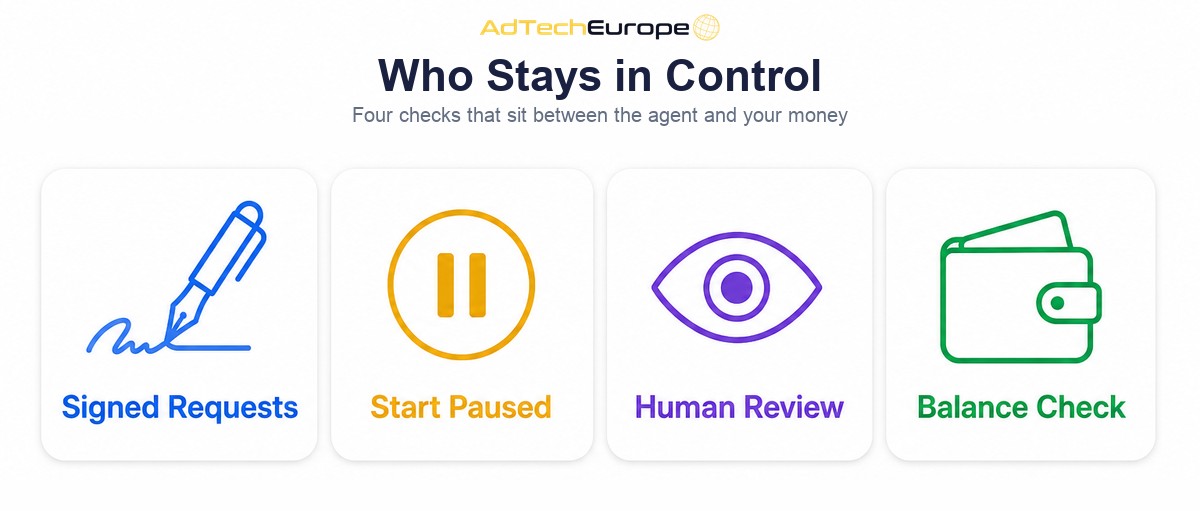
Whatever platform you run, a few rules make agentic buying safer:
- Accept only signed requests from agents you can identify.
- Start new bookings in a paused state until they are approved.
- Keep human review for new advertisers, new creatives and unusual budgets.
- Check the account balance and budget limits before any buy goes live.
- Log every task an agent calls, so you can explain later what happened.
AdTech Europe’s AdCP Agent: Beta and Early Access
AdTech Europe now has an AdCP Agent in beta, available as early access. It is a seller agent that connects a platform built on our technology to the Ad Context Protocol, for DSP, SSP and ADX setups.
With it, AI buying agents can discover your inventory, book a media buy, pause and resume it, and pull delivery reports, using the AdCP media-buy tasks over MCP and A2A. New bookings start paused until they are approved. Your platform’s own review, budget and balance checks stay in charge, so an agent cannot spend past the rules you already have.
Because it is early access, we are adding platforms one at a time. If you want to join, book a call with our team and we will walk you through how it works on your setup.
Ready to Make Your Platform Agent-Ready?
AdTech Europe helps agencies, ad networks and adtech entrepreneurs own their advertising technology instead of renting it. We build and run DSP, SSP, ad exchange and DMP platforms that you can rent under your own brand, license or own with full source code. See the options on our pricing page, or start with our white label DSP.
Want to talk about agentic buying and what AdCP could mean for your business? Schedule a programmatic strategy meeting with our team.
FAQs
What is AdCP?
AdCP is an open standard for agentic advertising. It defines how AI buyer agents and seller agents discover inventory, book media buys, send creatives and report on delivery. It runs over MCP and A2A.
What does AdCP stand for?
It first stood for Ad Context Protocol. Since version 3.0 the project uses the name Advertising Context Protocol. The acronym AdCP is the same.
Who created the Ad Context Protocol?
AdCP launched in October 2025, led by Scope3, Yahoo and PubMatic, with Triton Digital and Optable also named at launch. It is now run under AgenticAdvertising.org.
Does AdCP replace OpenRTB?
No. OpenRTB handles single impressions and bids in real time. AdCP works at the level of planning and booking media buys. The two can work together.
What is a seller agent in AdCP?
A seller agent is software that represents a platform with inventory, such as a publisher, SSP or ad network. It answers buyer agents’ questions about products and accepts, rejects or holds their orders.
Is AdCP safe for real budgets?
The protocol supports signed requests and idempotency keys, which stop fake requests and double bookings. Platforms should still keep their own review, budget and balance checks in front of every buy.