
Artificial intelligence is rapidly transforming the programmatic advertising landscape. Tasks that once required experienced media buyers, such as bid optimization, audience targeting, and campaign management, are now increasingly handled by algorithms operating in real time. As a result, the role of the media buyer is evolving, and in some cases, being replaced.
However, this shift does not affect all participants in the ecosystem equally. While some media buyers are becoming less essential, others are becoming more powerful than ever. The difference lies in one key factor: ownership.
This article explores how AI is reshaping programmatic advertising and why owning the platform is becoming the defining advantage in the industry.
The Impact of AI on Programmatic Advertising
The integration of AI into programmatic platforms has significantly increased efficiency across the board. Campaigns can now be launched faster, optimized continuously, and scaled with minimal manual intervention. Machine learning models analyze vast datasets to improve targeting accuracy, predict user behavior, and adjust bids dynamically.
This level of automation reduces the need for manual campaign management. As a result, traditional media buying roles focused purely on execution are becoming less relevant. Platforms are increasingly designed to simplify the process, allowing even less experienced users to achieve acceptable results.
While this democratization of tools lowers the barrier to entry, it also increases competition. When everyone has access to similar optimization capabilities, the advantage shifts away from execution and toward something more fundamental.
The Shift from Execution to Infrastructure
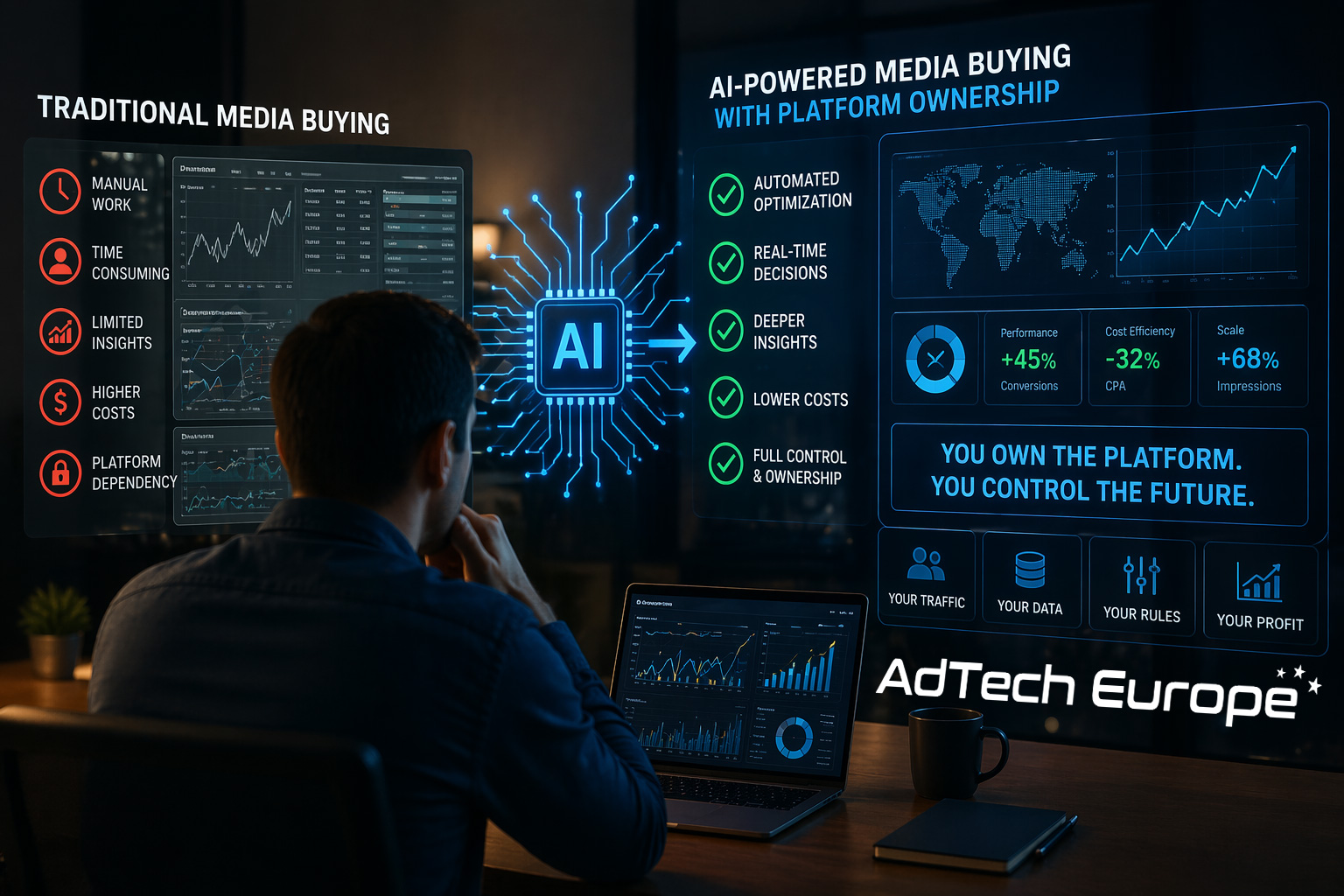
As AI takes over operational tasks, the value within the ecosystem moves from execution to infrastructure. In other words, the focus is no longer on how well you run campaigns, but on where and how those campaigns are executed.
Owning the platform allows you to control key elements of the programmatic process. This includes access to traffic sources, bidding logic, data flow, reporting systems, and cost structures. Instead of relying on predefined systems, you define how the system works.
This shift is subtle but critical. Media buyers who continue to operate solely within third-party platforms remain dependent on external rules, fees, and limitations. Those who move toward platform ownership gain flexibility, control, and long-term strategic advantage.
The Limitations of Platform Dependency
Operating within third-party DSPs introduces several structural limitations. These platforms often impose restrictions on traffic volume, campaign configurations, and integration capabilities. In addition, they may include hidden fees, revenue-sharing models, or pricing structures that reduce overall margins.
Another challenge is the lack of transparency. Many platforms operate as black boxes, limiting visibility into traffic sources, bidding processes, and performance data. This makes it difficult to fully understand what drives results and where inefficiencies occur.
As AI continues to optimize campaigns automatically, these limitations become more significant. Media buyers may achieve short-term performance gains, but they have little control over the underlying mechanics of their campaigns.
Why Ownership Changes the Dynamic
Owning a programmatic platform fundamentally changes the way campaigns are executed and scaled. Instead of working within predefined constraints, platform owners can customize their infrastructure according to their needs.
This includes full control over integrations, access to multiple supply partners, detailed traffic filtering, and advanced reporting capabilities. It also allows for the implementation of custom optimization strategies that go beyond standard platform features.
More importantly, ownership enables better cost control. Without platform-imposed fees or scaling penalties, businesses can maintain healthier margins as they grow. This becomes increasingly important as campaign budgets increase and competition intensifies.
Solutions like AdTech Europe make it possible to achieve this level of ownership without the complexity of building a DSP from scratch. By providing a ready-to-deploy infrastructure, they allow agencies and media buyers to transition from platform users to platform operators.
The Evolution of the Media Buyer Role
The role of the media buyer is not disappearing, but it is evolving. Instead of focusing solely on campaign execution, modern media buyers are becoming strategic operators who understand both performance and infrastructure.
This evolution requires a broader perspective. It involves thinking beyond individual campaigns and considering the overall system in which those campaigns operate. Media buyers who adapt to this shift can leverage AI as a tool rather than compete against it.
By combining human strategy with machine-driven optimization, and placing both within a controlled infrastructure, they create a more powerful and scalable model.
Market Direction and Future Outlook
The programmatic advertising industry is moving toward greater consolidation and sophistication. As AI continues to improve, basic campaign management will become fully automated. This will reduce the value of purely operational roles and increase the importance of strategic positioning.
The market is likely to divide into two main groups: those who own infrastructure and those who use it. Infrastructure owners will have the ability to innovate, scale, and optimize at a deeper level. Platform users will remain dependent on external systems and compete primarily on execution.
This shift is already underway and is expected to accelerate as more businesses recognize the long-term benefits of ownership.
Conclusion
AI is not simply replacing media buyers; it is redefining their role within the programmatic ecosystem. While automation reduces the need for manual execution, it increases the importance of control, transparency, and infrastructure.
Media buyers who continue to rely solely on third-party platforms may find themselves limited by factors beyond their control. Those who move toward platform ownership gain a structural advantage that extends beyond individual campaigns.
In an environment where execution is increasingly automated, ownership becomes the key differentiator. Understanding this shift and acting on it will determine who leads and who follows in the next phase of programmatic advertising.