Every programmatic campaign has a small group of users who see the ad far more often than anyone intended. They are not the target audience. They are simply the people your platform can identify most reliably, on the sites they visit most often, at the hours they browse most. Without a limit, the auction keeps buying them because they keep being available.
That is what frequency capping is for. It is one of the simplest settings in a demand-side platform and one of the easiest to configure badly. Set it too loose and a fraction of your audience absorbs a large share of your budget. Set it too tight and the campaign stops reaching enough people to matter. Set it in the wrong place and it may not be enforced at all.
This guide explains what a frequency cap actually counts, where in the supply chain it is applied, how to choose sensible limits for different campaign goals, why identity loss makes caps leak, and what changes when you own the platform enforcing them instead of renting one.
What Is Frequency Capping in Programmatic Advertising?
Frequency capping is a rule that limits how many times the same user can be shown the same advertising within a defined time window. A typical cap reads as a small sentence: three impressions per user per day, or ten impressions per user per week.
Mechanically, it is a filter applied before bidding. When a bid request arrives, the platform looks up the identifier in that request, checks how many impressions it has already served to that identifier for the campaign, and decides whether to bid at all. If the count has reached the cap, the platform does not lower its bid — it skips the auction entirely. That distinction matters, because a skipped auction costs nothing and frees the bidder to evaluate the next request.
Frequency is therefore a targeting decision, not a pacing decision. Pacing controls how quickly a budget is spent across the day. Frequency controls how that budget is distributed across people. Two campaigns can spend exactly the same amount at exactly the same rate and reach wildly different numbers of individuals, purely because one of them has a cap and the other does not.
Why Uncapped Delivery Quietly Wastes Budget
Programmatic supply is not evenly distributed. A small share of users generates a large share of the available impressions, because they browse more pages, spend longer in apps, and carry stable identifiers that make them easy to recognise. An uncapped campaign will find those users again and again, since every one of their page views produces another eligible bid request.
The result is a campaign that looks healthy in aggregate and is concentrated in practice. Impressions climb, spend paces correctly, and the delivery report shows no errors. What the report does not show, unless you ask it to, is that the average impressions-per-user figure has drifted upward while unique reach has flattened.
There is a second cost that is easier to overlook. Repetition changes how the ad performs. The first few exposures do the persuading; later ones mostly annoy. Click-through rate on the heaviest-exposed users tends to decay, and because those users are cheap to buy and constantly available, they can drag the campaign’s blended performance down while consuming the budget that would otherwise open new audiences. Capping is one of the few settings that improves efficiency and reach at the same time.
| Behaviour | Uncapped campaign | Capped campaign |
| Budget distribution | Concentrated on high-availability users | Spread across more individuals |
| Unique reach | Flattens as spend continues | Continues to grow with spend |
| Creative wear-out | Fast on the heaviest segment | Slower and more even |
| Auction participation | Bids on every eligible request | Skips requests over the cap |
| Bidder capacity | Spent re-evaluating the same users | Freed for new requests |
Where a Frequency Cap Is Actually Enforced
Buyers often assume a cap is a single switch. In a real supply chain there are three separate places a limit can live, and they do not know about each other.
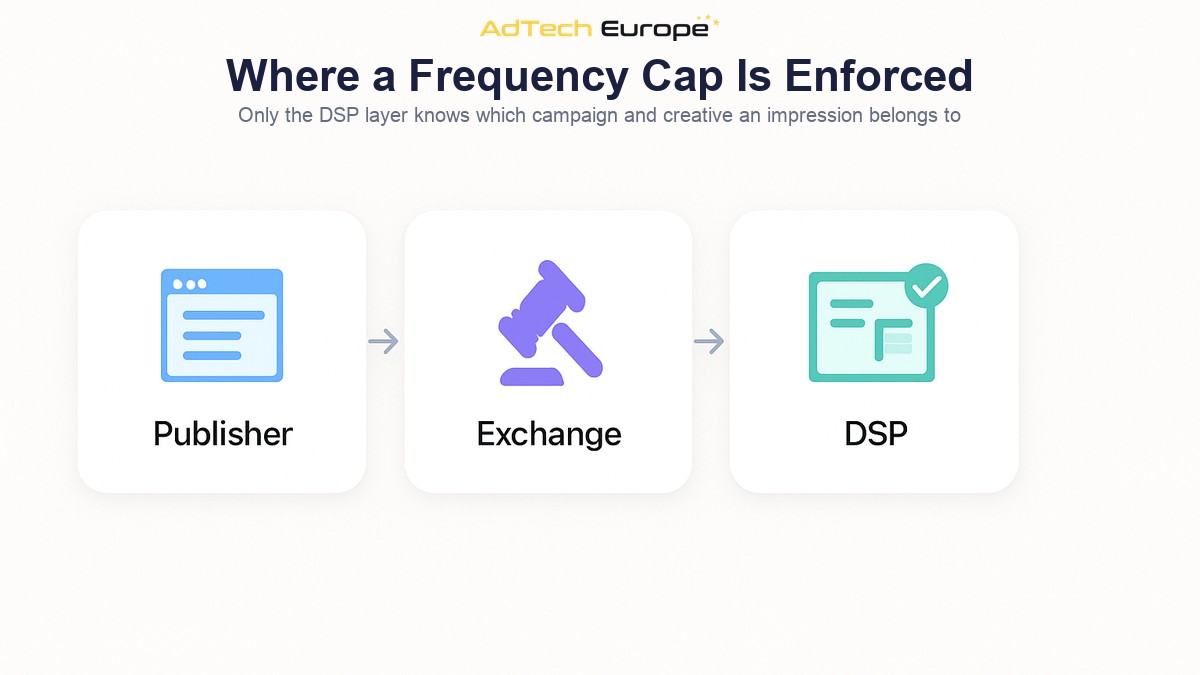
The first layer is the publisher or the ad server, which may limit how many ads of any kind a single page or session shows. The second is the exchange or supply-side platform, which sometimes applies its own per-user limits across all buyers. The third is your DSP, which is the only layer that knows the campaign, the creative and the budget behind the impression.
Only the third layer can enforce a cap that means anything to an advertiser, because only it can count exposures for your campaign specifically. A publisher-side limit constrains the total ad load on a page; it says nothing about how many times your creative in particular was served. This is also why caps set in one DSP do not carry over to another. If the same advertiser runs the same creative through two buying platforms, each one counts from zero, and the user sees the sum of both.
The practical rule is straightforward. Consolidate a campaign into one buying platform when frequency control matters, and set the cap on the layer that understands the campaign. If a brand insists on running the same message through several buyers at once, treat the cap as a per-platform limit and divide the intended total between them deliberately rather than setting the same number in each.
The Cap Levels a DSP Should Offer
A single campaign-level number is rarely enough. A capable platform lets you place limits at several levels at once, and the levels interact.
- Per creative: how often one specific banner or video is shown to a user. Useful when several executions rotate within a campaign and you want each to stay fresh.
- Per campaign: the total exposures across all creatives in that campaign. This is the number most buyers think of as “the” cap.
- Per advertiser: a ceiling across every campaign for one brand, so a retargeting line and a prospecting line do not double up on the same person.
- Per session or per hour: a short-window limit that prevents several impressions landing within minutes of each other, which is the pattern users notice most.
- Per placement or domain: a limit on repetition within a single property, useful when one site supplies a disproportionate share of impressions.
Two windows working together usually beat one. A daily cap alone can still deliver every impression inside a ten-minute burst. Pairing a per-hour or per-session limit with a daily or weekly one spreads exposure across the day without reducing the total. If your platform only offers a single flat number, that is a genuine functional gap worth raising, and it is one of the DSP features worth checking before buying.
How to Set a Frequency Cap for Your Campaign Goal
There is no universal correct number, and any source that gives you one is guessing. The right cap depends on what the campaign is trying to do, how long the decision cycle is, and how many creatives are in rotation. What follows is a starting framework, not a benchmark.
| Campaign type | What the cap protects | Sensible starting shape |
| Awareness and reach | Breadth of audience | Low daily cap, longer weekly window |
| Consideration and traffic | Message repetition without fatigue | Moderate daily cap, several creatives rotating |
| Retargeting | Brand perception and cost per user | Tight daily cap plus a decay after several days |
| Short promotion or event | Urgency inside a fixed window | Higher cap, very short flight |
| Always-on performance | Efficiency over months | Weekly or monthly cap, reviewed regularly |
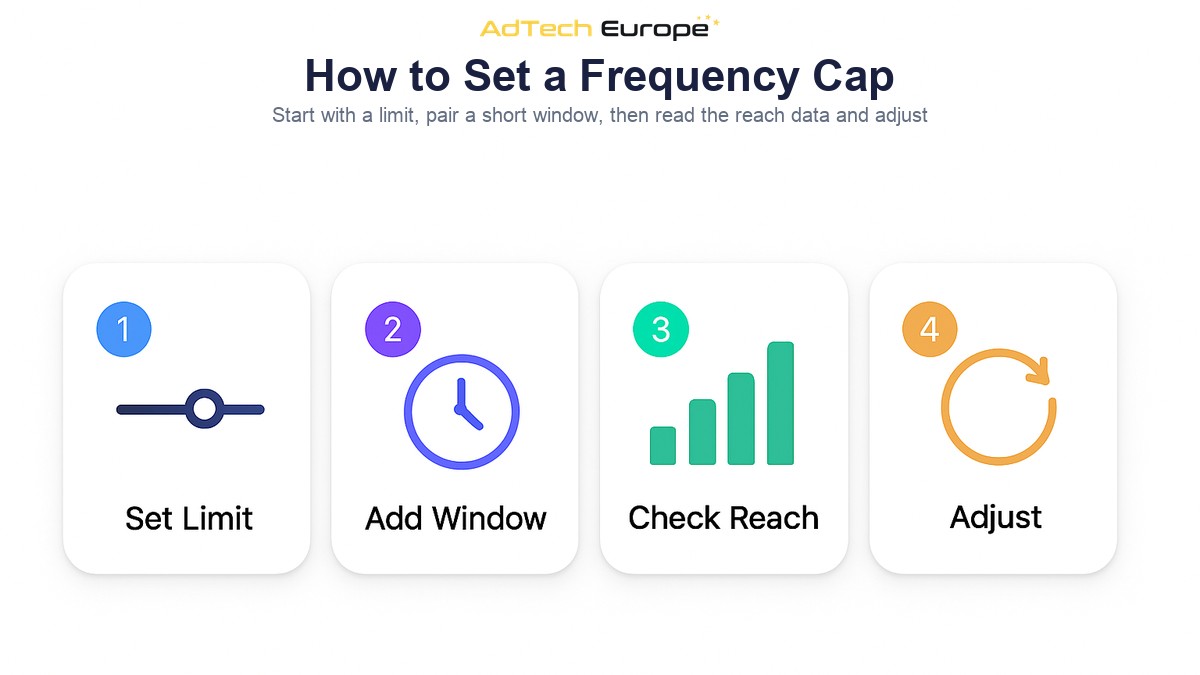
The method matters more than the starting values. Set a cap, run long enough to gather meaningful delivery data, then read the distribution rather than the average. Look at what share of impressions went to users at or near the cap, and what happened to unique reach and cost per outcome when you moved the number. If tightening the cap increases unique reach without hurting conversions, tighten it again. If it starts costing conversions, you have found the floor for that campaign. The delivery and outcome fields you need for this loop are covered in our guide to DSP reporting metrics.
What a Frequency Cap Counts When There Is No Cookie
A cap is only as good as the identifier it counts against. On the open web that identifier has traditionally been a cookie, and cookies are now unreliable across browsers, blocked by many users, and absent entirely from several environments a DSP buys in.
Inside mobile apps there is no cookie at all. The counter has to use the device advertising identifier passed in the bid request, and only when the user has permitted it. Where that identifier is missing, the platform is counting against something weaker, or not counting at all. The mechanics of these app-side signals are described in our guide to in-app programmatic advertising.
Connected TV adds another wrinkle: the identifier usually represents a household device rather than a person, so a cap of three per day may mean three exposures for everyone watching, not three for one viewer. On the open web, where no durable identifier is available, some platforms fall back to a probabilistic signal built from IP address and user agent. That is better than nothing for smoothing bursts, but it is not a reliable person-level count and should not be treated as one.
The honest conclusion is that no cap is exact. Treat the number as an upper bound on what your platform can see rather than a guarantee of what a person experienced, and expect real exposure to be somewhat higher than the setting. Where identity is weak, lean on structural controls instead: cap per placement, limit how much volume any single domain or app can supply, and keep an eye on where impressions concentrate. That is the same discipline behind supply path optimization.
Common Frequency Capping Mistakes
- Setting a daily cap and nothing else, so the whole allowance can be delivered in a few minutes.
- Copying the same cap into two buying platforms running the same creative, which doubles real exposure.
- Capping per creative but not per campaign, so a user hits the limit on five different banners for the same brand.
- Leaving retargeting uncapped because it converts well, which is exactly the line that irritates people fastest.
- Capping so aggressively that the campaign cannot spend, then raising the bid to compensate and paying more for the same reach.
- Setting a cap once at launch and never revisiting it as creatives, supply mix and flight length change.
- Assuming the counter works in environments where no usable identifier exists.
The last one is worth restating. If a platform reports that a cap is active but cannot tell you what share of impressions it was able to attribute to a known identifier, you do not know whether the cap is working. Ask for that number.
Why Platform Ownership Changes What You Can Cap
Frequency control is a good example of a feature where the difference between renting access to a platform and owning one shows up in practice. On a shared self-serve seat you take the cap levels the vendor exposes: usually a campaign-level number, sometimes a creative-level one, rarely a session window, and almost never a custom rule of your own design.
On a platform you control, frequency becomes a configurable part of the bidding logic. You can add the cap levels your accounts actually need, set defaults that apply to every new campaign so nobody launches uncapped by accident, and expose the exposure distribution in reporting instead of only the average. For an agency running many advertisers, being able to enforce a house standard across every campaign is worth more than any single setting. The broader trade-off between renting and owning is covered in our comparison of a self-serve seat and an owned DSP.
There is a throughput angle too. Capping is a pre-bid filter, so a well-implemented cap reduces the number of auctions your bidder has to evaluate seriously. That only helps if the platform is not already throttled on request volume, which is why unmetered query capacity and frequency control belong in the same conversation — see our explanation of QPS in programmatic advertising.
Ready to Control Frequency on Your Own Platform?
AdTech Europe supplies the platform layer for agencies, ad networks and media-buying teams that want to own their buying technology rather than rent a seat on someone else’s. Every plan includes unlimited QPS scaling, more than 1,000 SSP integrations, white-label branding and lifetime free upgrades, so the controls you configure are yours to change.
As of September 2026, the White Label DSP is $500 per month with no setup fee on a month-to-month contract, a DSP License is $25,000 one-time, and a full DSP Acquisition with source code ownership is $50,000 one-time; instalment options are available on the license and acquisition plans. Current figures and the full feature comparison are on the DSP pricing page.
If you want to walk through how frequency, pacing and bidding rules would be configured for your accounts before committing to anything, schedule a programmatic strategy meeting with our team.
FAQs
What does frequency capping mean in programmatic advertising?
Frequency capping is a rule that limits how many times the same user can be shown a campaign’s ads within a set time window, such as three impressions per day. The DSP checks the identifier in each bid request against a counter and skips the auction once the limit is reached.
What is a good frequency cap for a display campaign?
There is no universal number, and it depends on the goal, the flight length and how many creatives are rotating. Awareness campaigns generally use a low daily cap to maximise unique reach, while retargeting uses a tight cap with a decay over several days. Set a starting value, then adjust it based on your own reach and cost-per-outcome data.
Does frequency capping reduce reach?
No — it usually increases unique reach for the same budget, because impressions that would have gone to already-exposed users are spent on new ones instead. What it reduces is total impressions per person. A cap only limits reach if it is set so low that the campaign cannot spend its budget.
Where is a frequency cap enforced: the DSP, the SSP or the publisher?
All three can apply limits, but only the DSP knows which campaign and creative an impression belongs to, so campaign-level capping has to happen there. Publisher and exchange limits control overall ad load, not how often your specific creative appears.
How does frequency capping work without third-party cookies?
In apps and on connected TV, the counter uses the device advertising identifier passed in the bid request when the user has permitted it. On the open web without a cookie, platforms fall back to weaker probabilistic signals such as IP address and user agent, which smooth bursts but are not reliable person-level counts.
Can a frequency cap be shared across two DSPs?
Not in practice. Each platform keeps its own counter, so the same cap set in two DSPs running the same creative allows roughly double the real exposure. Either consolidate the campaign into one platform or split the intended total between them deliberately.
Does frequency capping save money?
It redirects money rather than reducing it. The budget that would have bought a fifteenth impression for one user buys a first impression for someone new, which normally lowers cost per unique user reached and slows creative wear-out. Capping also skips auctions entirely rather than bidding low, so bidder capacity goes to fresh requests.