
Ad networks and SSPs often have strong traffic, but that does not always mean strong demand. You may have publisher supply, daily impressions, ad formats, and GEO coverage, yet still struggle to connect that inventory to serious programmatic buyers.
The real problem is trust. DSP owners, advertisers, agencies, and media buyers do not only want more traffic. They want clean bid requests, clear seller paths, working tracking, stable volume, and proof that the inventory can perform.
AdTech Europe helps supply partners connect ad network inventory to programmatic demand through structured integrations, quality checks, and performance visibility. This article explains how the process works, what inventory partners need to prepare, and how to make supply easier for buyers to test, trust, and scale.
What It Means to Connect Ad Network Inventory
To connect ad network inventory means making your available ad impressions accessible to buyers through a programmatic path.
This path may include:
- Ad networks
- SSPs
- Ad exchanges
- DSPs
- Direct advertisers
- Media buying teams
- Analytics and reporting systems
For buyers, inventory is not just traffic. It is a stream of bid requests with useful data attached. Each request should help the buyer understand the placement, format, device, GEO, floor price, seller identity, and traffic source.
AdTech Europe supports supply connections for teams that want a clearer route between traffic and demand. For DSP owners looking to buy from trusted sources, ready ad supply can reduce delays during campaign launch.
Why Ad Networks and SSPs Connect to AdTech Europe
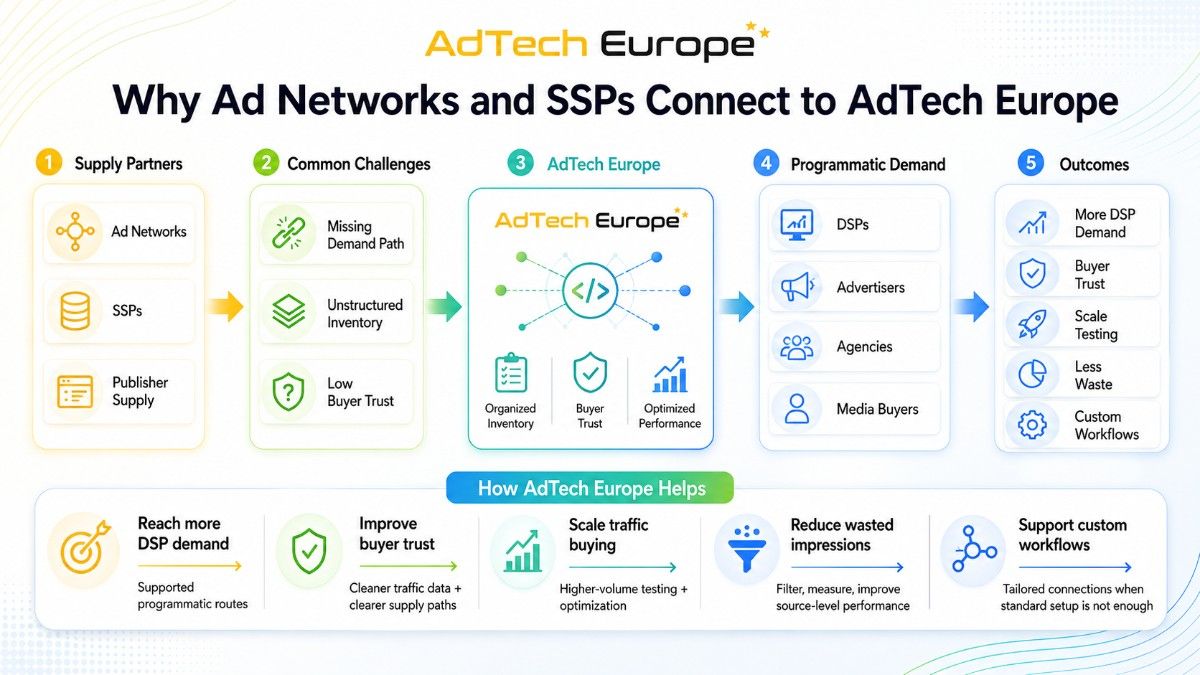
Many supply partners already have inventory but lack the right demand path. Others have demand but cannot scale because their inventory is not structured well enough for programmatic buyers.
AdTech Europe helps close this gap by giving supply-side businesses a more organized way to connect with demand.
| Supply Partner Goal | How AdTech Europe Helps |
| Reach more DSP demand | Connect inventory through supported programmatic routes |
| Improve buyer trust | Use cleaner traffic data and clearer supply paths |
| Scale traffic buying | Support higher-volume testing and optimization |
| Reduce wasted impressions | Filter, measure, and improve source-level performance |
| Support custom workflows | Build tailored connections when standard setup is not enough |
For advertisers and DSP owners, strong programmatic media inventory gives campaigns more room to test, optimize, and scale.
Who This Connection Is For
This type of integration is useful for supply-side businesses that control, aggregate, or manage ad traffic.
Best-fit partners include:
- Ad networks with direct or managed publisher traffic
- SSPs with display, native, video, mobile, or in-app supply
- Ad exchanges looking to increase demand access
- Publisher networks with grouped traffic sources
- DSP owners that also manage supply relationships
- Agencies building private media buying routes
- Ad-tech businesses launching custom platforms
If your business wants deeper control over buying and supply access, DSP platform ownership may be a better long-term path than renting limited third-party tools.
What AdTech Europe Needs Before Integration
A smooth setup starts with clear inventory data. Buyers need to understand what they are bidding on before they spend more budget.
| Requirement | What to Prepare |
| Traffic source | Publisher, app, site, network, or exchange source |
| Ad format | Display, native, video, push, pop, mobile, or in-app |
| GEO mix | Countries, regions, and traffic share |
| Device data | Desktop, mobile, tablet, OS, browser, app, or web |
| Volume | Daily impressions and expected QPS |
| Floor price | CPM floor by format, source, or GEO |
| Protocol | OpenRTB, XML, or custom endpoint |
| Transparency | ads.txt, app-ads.txt, sellers.json, and schain |
| Tracking | Win notices, impressions, clicks, conversions, and postbacks |
This data helps buyers judge whether the inventory fits their campaigns. It also helps AdTech Europe organize the supply before traffic goes live.
For DSP owners, better programmatic inventory access means more control over what traffic enters the buying stack.
Choosing the Right Connection Method
Different supply partners need different connection types. The right method depends on your technology, traffic model, and buyer needs.
OpenRTB connection
OpenRTB is the common standard for real-time bidding. It is usually best for SSPs, ad exchanges, and larger ad networks that need auction-based buying.
OpenRTB can support:
- Bid requests and bid responses
- Floor prices
- Ad formats
- Device and GEO data
- Impression tracking
- Win notices
- User and contextual signals
- Supply transparency fields
For many supply partners, XML and OpenRTB connectivity gives enough flexibility to support different buyer needs.
XML connection
XML can work well for simpler ad network workflows. It is often used when the supply path does not need a full real-time auction setup.
XML may be useful for:
- Feed-based ad delivery
- Simpler traffic buying
- Some performance traffic models
- Direct network-to-network connections
Custom connection
Some partners need custom logic for routing, reporting, filtering, or traffic control. In those cases, custom adtech development can help build a setup around the partner’s business model.
Inventory Quality Signals Buyers Care About
DSP buyers do not scale every supply source right away. They test first.
The better your quality signals, the easier it is for buyers to trust the traffic.
Important quality signals include:
- Clear source names
- Real placement data
- Valid seller information
- Working ads.txt or app-ads.txt paths
- sellers.json alignment
- SupplyChain object support
- Stable request volume
- Low invalid traffic risk
- Clean device and GEO data
- Clear floor pricing
- Accurate reporting
- Fast endpoint response times
Strong supply transparency also helps buyers understand the wider programmatic ecosystem roles between DSPs, SSPs, exchanges, and networks.
How the Connection Process Works
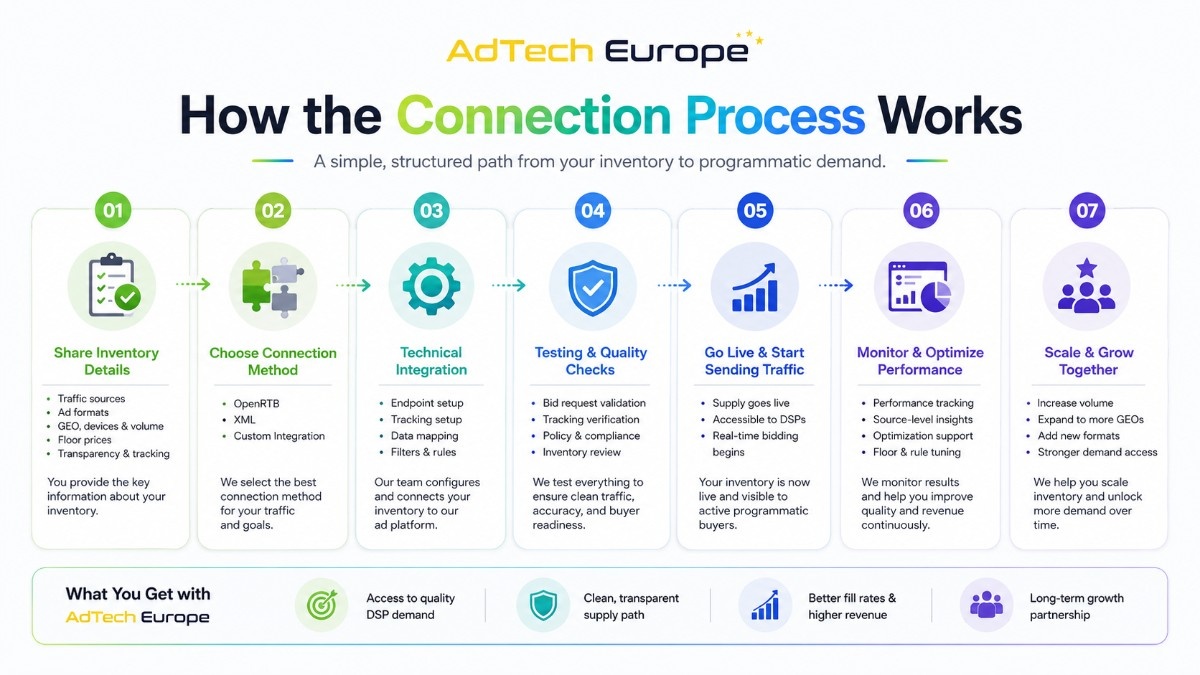
The connection process should be simple, but it must be structured. Each step helps reduce errors and improve buyer trust.
Step 1: Share inventory details
The supply partner shares traffic type, volume, GEOs, formats, QPS, floors, endpoints, and tracking methods.
Step 2: Review the supply path
AdTech Europe reviews how the inventory is sourced, routed, and passed to buyers. This helps identify any missing fields or transparency gaps.
Step 3: Select the protocol
The team decides whether OpenRTB, XML, or a custom setup is the best fit.
Step 4: Test the endpoint
Technical testing checks whether bid requests, responses, tracking events, timeouts, and reports work correctly.
Step 5: Start with controlled traffic
Traffic starts at a limited volume. This protects both buyers and sellers while performance data is collected.
Step 6: Optimize and scale
Once the traffic performs well, stronger sources can receive more demand. Weak sources can be blocked, adjusted, or priced differently.
An organized ad exchange integration can help supply partners improve how inventory moves into programmatic demand channels.
How to Package Inventory for Better Demand
Raw traffic is harder to sell. Organized inventory is easier for buyers to test.
Instead of sending all traffic as one mixed source, supply partners should package inventory by value, format, and buyer intent.
| Inventory Package | Best Use Case |
| Premium GEO bundle | Campaigns targeting high-value countries |
| Mobile traffic package | App install, mobile web, and performance campaigns |
| Native inventory group | Content-style placements and engagement campaigns |
| Video inventory package | Brand, awareness, and high-impact media buying |
| Performance source list | CPA, CPL, and conversion-focused campaigns |
| Private source bundle | Selected buyers that need controlled traffic access |
AdTech Europe’s available inventory options can support different buying needs across advertisers, agencies, DSP owners, and media teams.
How Advertisers and DSP Owners Benefit
When ad network inventory is connected properly, buyers gain more than traffic. They gain better control.
Advertisers and DSP owners can use connected inventory to:
- Test more traffic sources
- Reduce overdependence on one platform
- Improve bid strategy
- Control campaign spend
- Compare source-level results
- Scale winning placements
- Block weak sources faster
- Build private supply paths
For larger buyers, premium global traffic can help support broader campaign testing across markets and formats.
Why Analytics Matter After Launch
The first connection is only the start. The real value comes from reading the data and improving traffic decisions.
Buyers and supply partners should track:
- Bid requests
- Bid rate
- Win rate
- Fill rate
- eCPM
- Spend
- Clicks
- Conversions
- Timeout rate
- Source-level quality
- GEO performance
- Device performance
With real-time inventory analytics, teams can see what is working faster and reduce wasted spend before it grows.
Common Mistakes That Reduce Buyer Trust
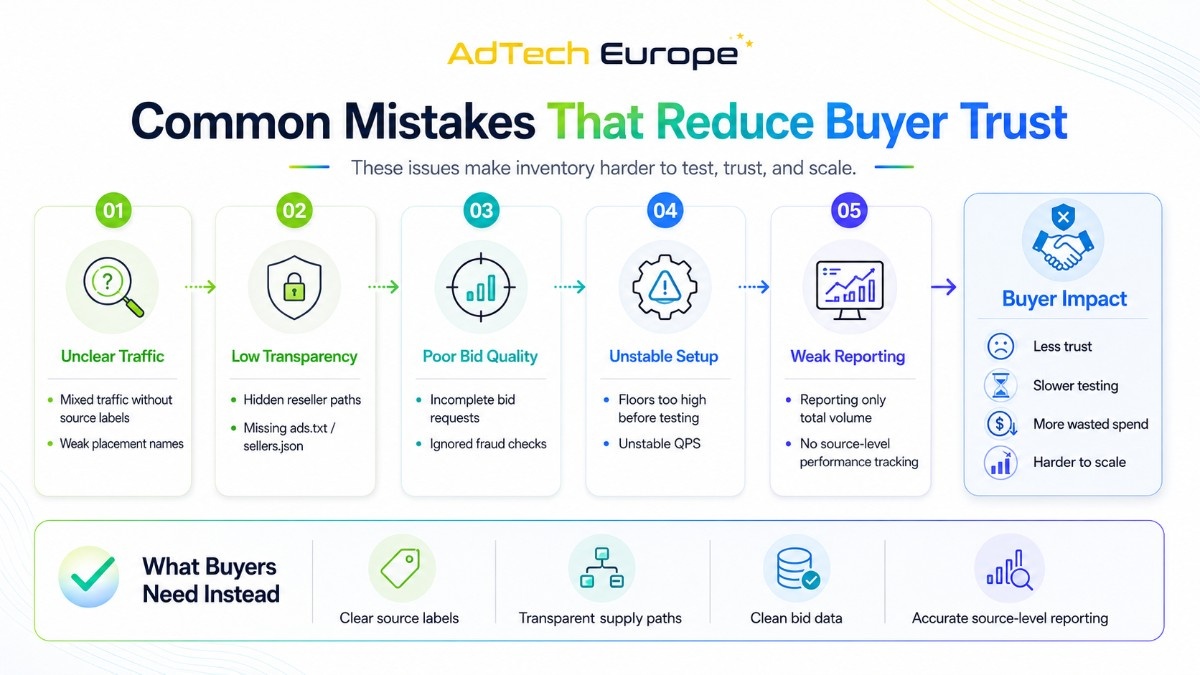
Many ad networks and SSPs lose demand because their inventory is not clean, clear, or easy to measure.
Avoid these mistakes:
- Sending mixed traffic without source labels
- Hiding reseller paths
- Using weak placement names
- Passing incomplete bid requests
- Setting floors too high before testing
- Sending unstable QPS
- Ignoring fraud checks
- Missing ads.txt or sellers.json data
- Reporting only total volume
- Not tracking source-level performance
Buyers need proof before they scale. Clear setup, clean data, and honest reporting make inventory easier to buy.
Where DSP Ownership Fits Into the Strategy
Some businesses only want to connect supply. Others want to own the full buying layer as well.
Owning a DSP can help ad networks, agencies, and media buyers control:
- Bidding logic
- Supply integrations
- Campaign rules
- Margin structure
- Reporting
- Traffic testing
- Platform branding
- Long-term technology direction
The DSP acquisition process can help businesses understand how platform ownership works before making that decision.
For teams that want to go beyond rented buying tools, global advertising inventory can support broader programmatic growth.
Ready to Connect Your Inventory to AdTech Europe?
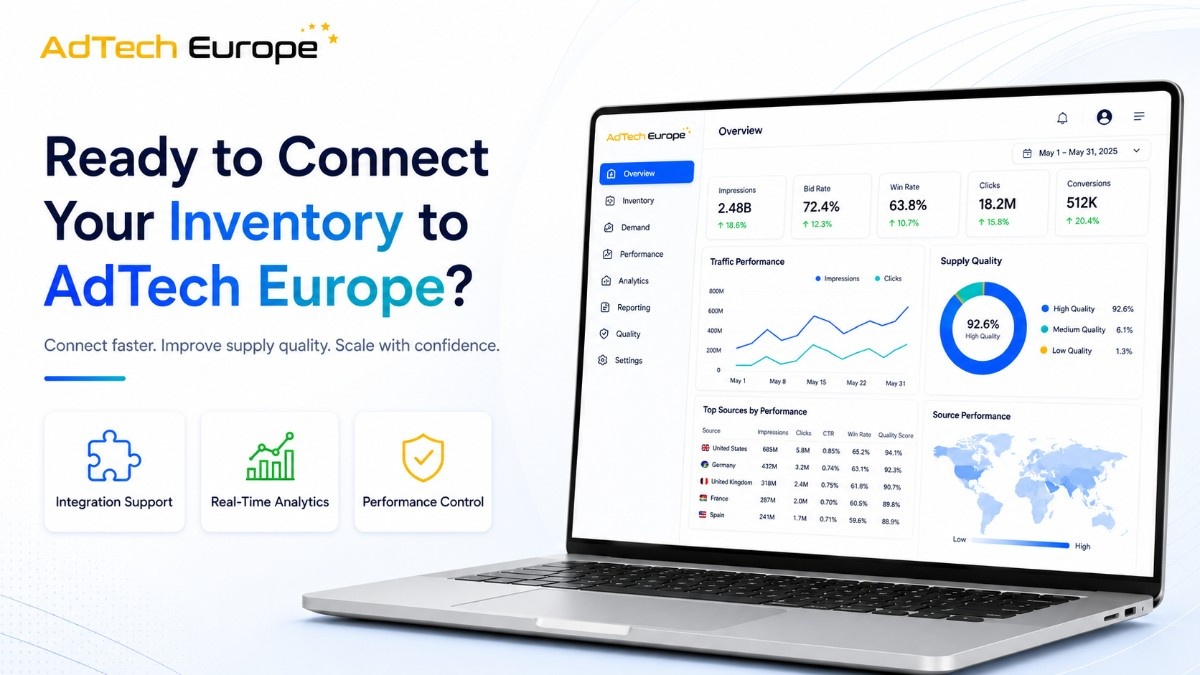
AdTech Europe helps ad networks, SSPs, exchanges, DSP owners, agencies, advertisers, and media buyers connect inventory to real programmatic demand with better structure, transparency, and performance control.
Whether you want to connect ad network inventory, improve supply quality, monetize traffic, scale campaigns, or build a stronger ad-tech business, AdTech Europe gives you the integration support, analytics, and infrastructure needed to turn inventory into measurable demand.
FAQs
1. Do I need a large traffic volume to connect inventory?
No. Large volume helps, but clean traffic, clear sources, and stable delivery are more important during the first test.
2. Can AdTech Europe work with both direct and resold inventory?
Yes. Direct inventory and resold inventory can both be reviewed, but the seller path must be clear and transparent.
3. Is OpenRTB required for every supply partner?
No. OpenRTB is often preferred, but XML or custom connections may work better for some ad network models.
4. Can I connect only selected inventory sources?
Yes. You can start with selected sources, formats, or GEOs before opening more inventory.
5. What happens if some traffic performs poorly?
Poor sources can be paused, blocked, repriced, or optimized based on performance data.
6. Do buyers see all my publisher details?
That depends on the setup and transparency model. Buyers usually need enough data to trust the source and validate the supply path.
7. Can AdTech Europe support custom integration logic?
Yes. Custom workflows can be built for special routing, reporting, endpoint, or platform requirements.
8. Why is inventory transparency important?
Transparency helps buyers avoid risky supply paths, reduce wasted spend, and make better bidding decisions.