White-label DSP solutions have become one of the fastest ways for agencies, media buyers, and ad networks to enter the programmatic advertising industry. They provide branded infrastructure, fast deployment, and the ability to launch programmatic operations without building technology from scratch.
For many businesses, this is the perfect starting point.
However, as operations grow, advertising volume increases, and infrastructure requirements become more advanced, many companies begin reaching an important strategic decision:
Should they continue operating under a white-label structure, or upgrade to full DSP ownership?
Increasingly, the answer is ownership.
As programmatic advertising continues evolving, more businesses are recognizing that controlling infrastructure creates stronger long-term margins, greater scalability, and significantly more operational freedom.
This is why many successful white-label DSP operators eventually transition toward full ownership models.
Understanding the White Label DSP Model
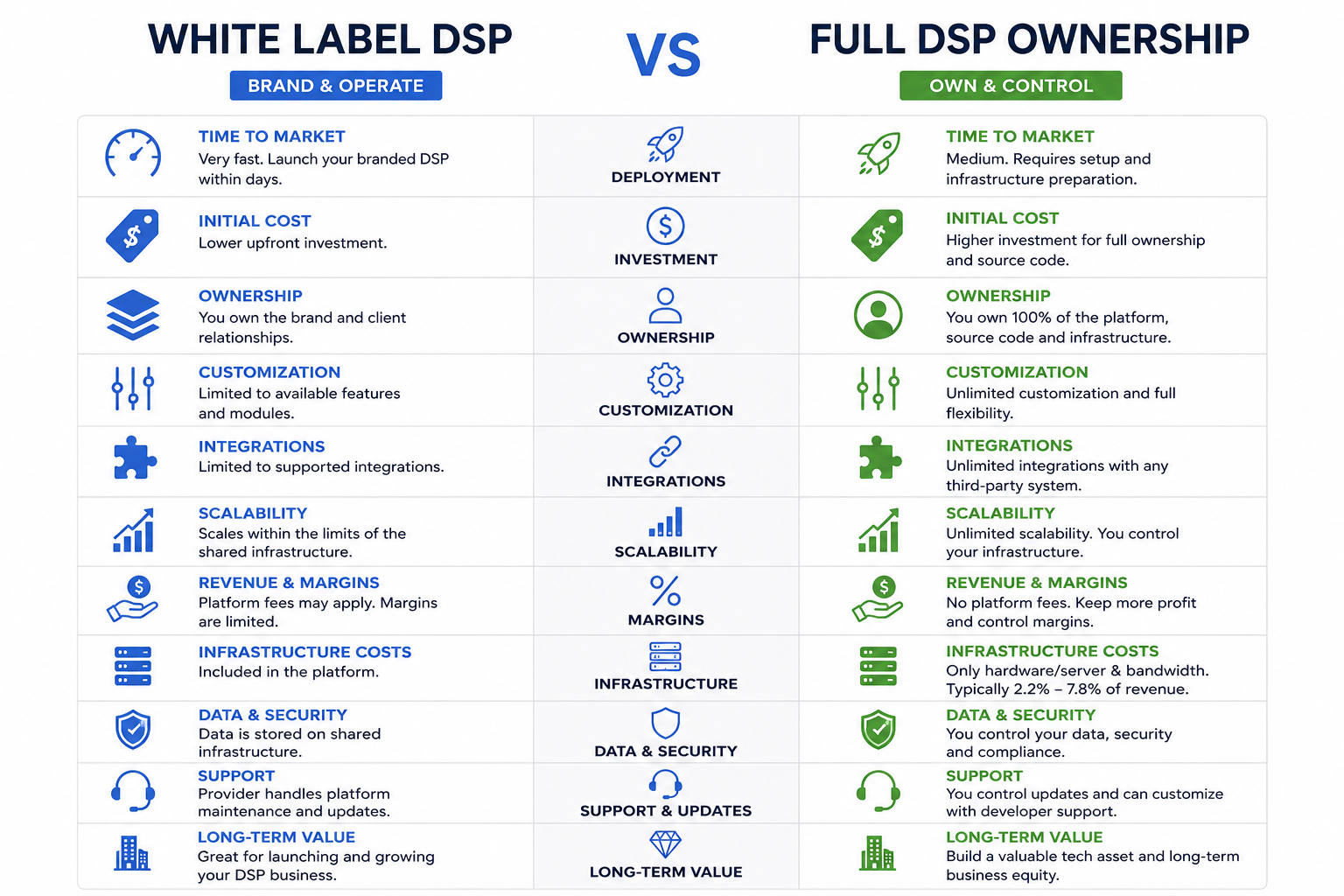
A white-label DSP allows businesses to launch their own branded programmatic advertising platform using existing infrastructure.
This approach provides several important advantages.
Businesses can:
- Launch quickly
- Reduce upfront development costs
- Start onboarding advertisers immediately
- Operate under their own branding
- Access programmatic infrastructure without technical complexity
For agencies entering the programmatic space, this creates a highly efficient market-entry solution.
Instead of spending years building infrastructure, businesses can focus on advertiser acquisition, traffic optimization, and operational growth.
This is one of the main reasons white-label DSP solutions have become increasingly popular in recent years.
Why White Label Is Often the First Step
For many companies, white-label infrastructure represents the beginning of a larger long-term strategy.
It allows businesses to:
- Validate the market
- Build advertiser relationships
- Scale operational experience
- Understand programmatic economics
- Generate recurring revenue
This creates a low-friction entry point into the ad tech ecosystem.
Many successful DSP owners originally started with white-label models before transitioning toward greater infrastructure control later.
The Limitations of White Label Infrastructure
Although white-label solutions provide speed and accessibility, they also introduce certain structural limitations over time.
As businesses scale, they often require:
- Greater customization
- More infrastructure control
- Independent integrations
- Flexible monetization structures
- Advanced optimization capabilities
At this stage, businesses begin realizing that long-term scalability may require more ownership over the underlying infrastructure.
White-label environments are excellent for launching and operating efficiently, but they may not always provide the level of flexibility needed for larger-scale expansion.
This is where full DSP ownership becomes increasingly attractive.
What Full DSP Ownership Changes
Upgrading to full DSP ownership fundamentally changes how a programmatic business operates.
Instead of accessing infrastructure, businesses fully control it.
This includes ownership of:
- The DSP platform
- Infrastructure architecture
- Source code
- Data systems
- Traffic management
- Integration environments
This creates significantly more operational flexibility and strategic independence.
Businesses are no longer constrained by external platform limitations or shared infrastructure structures.
Instead, they can expand and optimize according to their own business objectives.
Infrastructure Ownership Creates Better Long-Term Economics
One of the biggest reasons agencies upgrade from white-label environments to full ownership is economics.
Traditional platform structures often include:
- Platform fees
- Revenue sharing
- Scaling limitations
- Operational restrictions
- Third-party dependency
As advertising volume increases, these limitations become more financially significant.
With full ownership, businesses gain much more control over operational costs and monetization structures.
Instead of continuously paying for external platform access, companies invest directly into their own infrastructure.
This creates stronger long-term margins and better scalability.
Hardware Costs Scale More Efficiently Than Platform Fees
One of the most important financial advantages of full ownership is how infrastructure costs behave at scale.
In most programmatic environments, the primary scaling costs become:
- Server infrastructure
- Bandwidth usage
- Storage capacity
- Traffic processing resources
Unlike traditional platform fees, these costs generally increase only when traffic volume actually requires additional infrastructure.
In many cases, total hardware and bandwidth costs represent only approximately:
2.2% to 7.8% of total revenue
This creates extremely efficient economics for businesses operating at scale.
Instead of losing substantial percentages to third-party platforms, infrastructure owners retain far more control over profitability.
More Control Over Profit Margins
Ownership also provides complete flexibility when defining commercial strategies.
Businesses can:
- Adjust margins per advertiser
- Customize pricing structures
- Scale traffic without platform penalties
- Expand monetization models
- Launch independent partner ecosystems
This level of flexibility becomes increasingly important as advertising operations grow larger and more sophisticated.
Instead of operating inside rigid systems controlled externally, businesses define their own economics and operational strategy.
Full Ownership Enables Unlimited Scalability
As advertising businesses scale, infrastructure flexibility becomes increasingly important.
Full DSP ownership allows businesses to:
- Process higher traffic volumes
- Expand globally
- Integrate directly with exchanges and SSPs
- Customize optimization systems
- Launch white-label environments for partners
- Build proprietary advertising ecosystems
This creates opportunities far beyond standard campaign management.
The DSP itself becomes a scalable technology asset.
Ownership Creates Long-Term Business Value
One of the most overlooked advantages of full DSP ownership is asset creation.
A fully owned DSP is not simply software.
It becomes:
- A long-term business infrastructure
- A monetization engine
- A technology asset
- A valuation multiplier
This is a major strategic difference between renting infrastructure and owning it.
As the programmatic advertising market continues growing globally, infrastructure ownership itself becomes increasingly valuable.
Why More Agencies Are Making the Upgrade
As agencies gain more experience in programmatic advertising, many realize they are already managing the operational side successfully.
At that point, ownership becomes the logical next step.
Instead of continuously scaling inside external systems, businesses begin building their own infrastructure and long-term ecosystem.
Solutions like AdTech Europe help simplify this transition by providing both white-label DSP solutions and full ownership models, allowing businesses to upgrade gradually as they scale.
This creates a clear path from operational growth to infrastructure ownership.
Choosing the Right Time to Upgrade
The decision to move from white-label infrastructure to full ownership depends on several factors.
Businesses often begin considering ownership when they:
- Manage larger monthly advertising volumes
- Require deeper customization
- Want greater operational independence
- Need additional integrations
- Aim to build long-term technology assets
For smaller operations, white-label infrastructure may remain highly effective.
But as scale increases, ownership often becomes economically and strategically more attractive.
Conclusion
White-label DSP infrastructure has opened the door for many agencies and media buyers to enter the programmatic advertising industry quickly and efficiently.
However, as businesses grow, many eventually recognize that infrastructure ownership provides stronger economics, greater flexibility, and better long-term scalability.
Upgrading from a white-label DSP to full ownership is not simply a technical decision.
It is a strategic business transition.
It changes how companies scale, monetize, optimize, and build long-term value within the programmatic advertising ecosystem.
As the industry continues expanding globally, businesses that control their own infrastructure may ultimately gain the strongest long-term advantage.