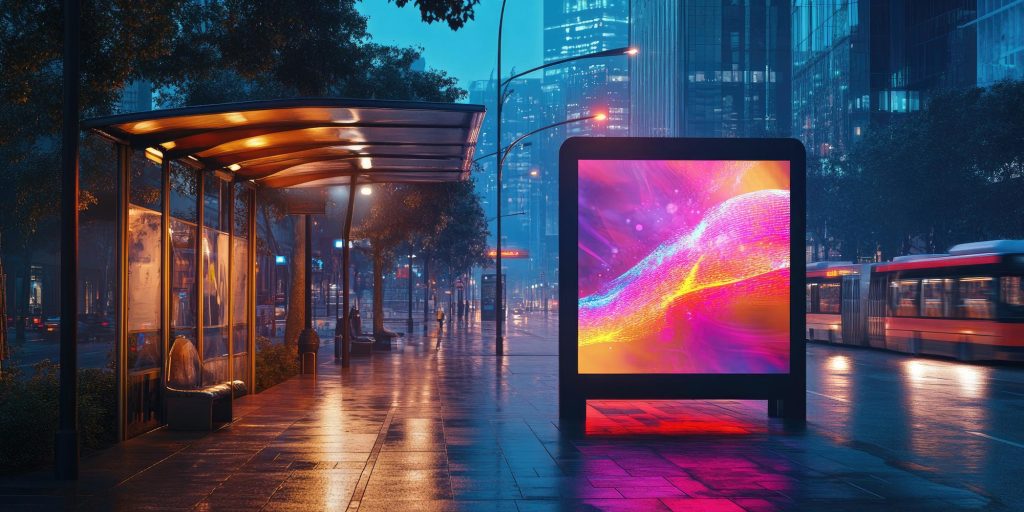
Digital out-of-home (DOOH) advertising means ads shown on digital screens in public places: roadside billboards, metro and rail stations, airports, shopping centres, gyms, office lobbies, lifts, taxis and petrol stations. Programmatic DOOH is the practice of buying those screens through the same kind of automated, auction-based systems used for web, app and connected TV inventory.
On paper it sounds simple: plug outdoor screens into a DSP and buy them like display banners. In practice, DOOH works differently from online advertising in a few important ways. A screen is seen by many people at once, nobody clicks it, ads play in a loop rather than loading on demand, and proof of delivery comes from play logs rather than browser pixels. This guide explains how programmatic DOOH actually works, how it is measured, what to check before you buy, and where buyers most often go wrong.
How Programmatic DOOH Works
The supply chain looks familiar, but each link has an outdoor twist.
The players
- Media owners own or lease the screens. Some run large roadside and transit networks; others run a handful of screens in gyms, pharmacies or cafes.
- Content management systems (CMS) and ad servers decide what plays on each screen and when. They manage the loop, the schedule and the play logs.
- DOOH SSPs sit on the media owner side. They expose screen inventory to buyers, package screens into deals, and translate a slot in the loop into a bid request.
- DSPs let buyers plan, target, bid and report. Some are DOOH specialists; many general DSPs now also connect to DOOH supply.
- Audience data providers estimate how many people are likely to see a given screen at a given time, using sources such as traffic counts, mobile location panels and venue footfall data.
The bid request is about a screen, not a person
In web advertising a bid request usually represents one user on one page. In DOOH it represents a screen about to play an ad slot. The IAB Tech Lab’s OpenRTB standard includes DOOH-specific objects and fields so that the request can describe the venue type, the screen’s location, its size and orientation, and how many people are expected to be in front of it. Buyers should check which version of OpenRTB and which DOOH extensions their DSP and SSP actually support, because support varies between vendors.
Impression multipliers
Because one play can be seen by many people, DOOH uses an impression multiplier. The SSP attaches an estimate to each ad play: for example, a play on a busy station screen at rush hour might be counted as several impressions, while the same play late at night might be counted as less than one. You pay CPM on the multiplied figure, not on the number of plays.
This is the single most important concept in DOOH buying. Two screens with the same CPM can deliver very different value depending on how the multiplier is calculated, so you should always ask which audience data source is used, how often it is updated and whether it changes by hour of day.
Play logs and proof of play
Online, an impression is usually counted when an ad renders in a browser or app. In DOOH there is often a gap between winning the auction and the ad actually playing, because the creative has to be downloaded and slotted into the loop. Delivery is confirmed by proof-of-play logs from the media owner’s player or CMS, which record that a specific creative played on a specific screen at a specific time. Good partners make these logs available at screen level, so you can reconcile what you paid for with what actually ran.
Venue Types and What They Are Good For
Venue type shapes dwell time, audience mix and the kind of creative that works. The table below is a practical starting point rather than a rulebook.
| Venue type | Typical viewing situation | Often used for |
|---|---|---|
| Roadside billboards | Drivers and passengers passing at speed; a few seconds of attention | Broad reach, brand awareness, simple messages |
| Transit (stations, platforms, airports) | Commuters and travellers, often waiting; strong time-of-day patterns | Commuter brands, travel, finance, rush-hour messages |
| Retail and shopping centres | Shoppers close to the point of purchase | Retail promotions, product launches, in-store traffic |
| Gyms, cafes, offices, waiting rooms | Longer dwell time, smaller audiences per screen | Niche audiences, health, B2B, local services |
| Lifts and residential buildings | Short, repeated exposure to the same people | Frequency-driven local campaigns |
| Taxis and rideshare screens | Seated passengers, mobile location | City-level targeting, entertainment, apps |
The original version of this article listed shopping mall displays, airport terminals, street-level billboards, taxi and rideshare screens, digital kiosks, gyms, cafes, office buildings, lifts and waiting rooms as places programmatic campaigns can run. That list still holds; what changes from one to the next is the audience model behind each screen.
What Programmatic Adds Over a Traditional OOH Booking
Traditional out-of-home is usually booked as fixed packages for fixed periods. Programmatic buying changes several things:
- Flexible scheduling. You can run only during certain hours or days, rather than buying a full week of a loop.
- Trigger-based delivery. Campaigns can be switched on by conditions such as weather, time of day or live data feeds, if the DSP supports it.
- Screen-level selection. You can pick individual screens or filter by venue type, location radius or audience estimate.
- Faster changes. Creative can be swapped or campaigns paused without renegotiating a contract.
- One workflow. DOOH can be planned alongside display, video and mobile in the same platform, which makes budget shifting and reporting easier.
DOOH also has qualities that come from the medium itself. Ads appear in public, often on large screens, and the environment is chosen by the media owner, which tends to make brand safety simpler than on the open web. Targeting is based on place and time rather than on cookies or personal identifiers, which makes it less dependent on user tracking.
Planning a Programmatic DOOH Campaign: A Checklist
- Define the job. Is the goal reach, local footfall, a launch moment, or support for another channel? This decides venue types and schedule.
- Choose locations deliberately. Start from where your audience actually is: near stores, along commuter routes, at event venues.
- Ask about the audience model. Which data source drives the impression multiplier, how often it is refreshed and whether it varies by hour.
- Check creative specs per network. Resolutions, orientation (landscape or portrait), file formats, maximum length, and whether audio is allowed. Many screens play silently.
- Plan for creative approval. Many media owners review creatives before they play. Build approval time into your launch date.
- Set day-parting and frequency. Avoid paying for empty platforms at 3 a.m. and avoid hammering the same lift screen all day.
- Use deals where it matters. Private marketplace or programmatic guaranteed deals help secure premium screens that may not appear in open auctions.
- Agree on reporting. Insist on screen-level proof-of-play logs and a clear explanation of how impressions were counted.
- Decide how you will measure impact. Options include brand lift studies, footfall or store-visit studies, search uplift in exposed areas, or matched-market tests comparing regions with and without DOOH.
Creative That Works on Screens
Outdoor viewers are moving, distracted or both. Creative that performs well online often fails on a screen across the road.
- Keep the message to a few words and one clear visual. Viewers may see it for a couple of seconds.
- Make the brand visible from the first frame; you cannot rely on viewers watching to the end of the spot.
- Use high contrast and large type. Test at a distance, not on your laptop.
- Design for silence unless the network confirms audio.
- If you use dynamic content (local store address, weather, countdowns), test every variation before launch.
- QR codes can work in venues with dwell time, such as stations and waiting rooms, but are close to useless on roadside screens.
Common Mistakes
- Comparing DOOH CPMs to display CPMs. A DOOH impression is a modelled estimate of people near a screen, not one ad rendered to one user. The numbers are not directly comparable.
- Ignoring the multiplier source. If you do not know how impressions were estimated, you do not really know what you bought.
- Treating DOOH like a click channel. Nobody clicks a billboard. Judge it on reach, frequency, lift and downstream effects, not CTR.
- Reusing online creative. Busy banners with small text are unreadable at distance.
- Skipping the approval buffer. Campaigns launch late because creatives were not cleared by media owners in time.
- Buying too thin. Spreading a small budget across many cities often means no single place gets enough frequency to matter.
- Not reconciling play logs. Billing and proof of play should match. Check them, especially on the first campaigns with a new partner.
Who Should Consider Programmatic DOOH
DOOH suits advertisers who care about physical places and broad visibility: retailers driving store traffic, events and venues promoting dates, national brands supporting a launch across cities, and local businesses that want to be seen in specific neighbourhoods. It is less suited to campaigns judged purely on direct online conversions with no way to measure offline impact.
FAQ
What is the difference between DOOH and programmatic DOOH?
DOOH is the medium: digital screens in public places. Programmatic DOOH is a way of buying it, through automated platforms and auctions or deals, instead of booking fixed packages directly with each media owner.
How are DOOH impressions counted?
Each ad play is assigned an estimated audience, called an impression multiplier, based on data about how many people are near the screen at that time. Buyers pay CPM on that estimated audience, and delivery is confirmed by proof-of-play logs.
Does programmatic DOOH use personal data?
Targeting is typically based on screen location, venue type, time and aggregated audience estimates rather than on identifying individual viewers. Some audience models are built from aggregated mobile location data, so it is still worth asking providers how their data is sourced.
Can I measure sales from DOOH?
Not through clicks. Common approaches are footfall studies, brand lift surveys, and matched-market tests that compare exposed and unexposed areas. Plan the measurement before launch, not after.
Final Thoughts
Programmatic DOOH gives outdoor advertising some of the flexibility of online buying, but it keeps its own rules: audience is estimated per play, delivery is proven by logs, and creative has to work at a glance. Buyers who understand multipliers, venue types and proof of play will get far more from the channel than those who treat it as another banner placement. If you are building or running a DSP or exchange and want DOOH alongside display, video and mobile, AdTech Europe’s platforms include DOOH integrations as part of the inventory mix.